

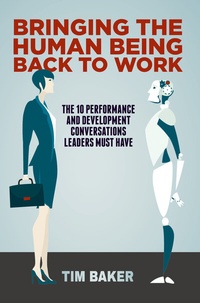
Bringing the Human Being Back to Work
Description

For the past 100 years, we've progressively dehumanized our places of work. We've learned to systemize, homogenize, and mechanize - all in the quest for greater efficiency and cost-saving. We've forgotten that the human being is the centre of work.
This book highlights the ten essential performance and development conversations leaders must have to restore human spirit at work. First, it explains the importance of cultivating an authentic workplace by resisting the dumbing down of work and respecting employee dignity. Second, it presents five developmental conversations, from coaching to relationship-building. Third, it outlines five performance conversations, from climate review to innovation.
An organization - any organization - is a group of people working together towards a common goal, but we tend to lose sight of this simple idea. Too often, human resources are lumped in with technological resources, administrative resources and financial resources. Managers become obsessed with processes, procedures and systems. Tim Baker provides leaders with a roadmap to bring the human being back to work.
More details
Other editions
Additional editions
Person
Tim Baker is a thought leader, international consultant and author. He is Managing Director of WINNERS-AT-WORK Pty Ltd, which specializes in assisting managers to develop productive workplace cultures. He was voted one of the 50 Most Talented Global Training & Development Leaders by the World HRD Congress, awarded by a distinguished international panel to professionals "who are doing extraordinary work" in the field of Human Resource Development.
Tim has published seven books with Palgrave Macmillan, including The New Influencing Toolkit: Capabilities for Communicating with Influence (2015), The End of the Job Description: Shifting From a Job-Focus To a Performance-Focus (2015) and Performance Management for Agile Organizations: Overthrowing The Eight Management Myths That Hold Businesses Back (Palgrave Macmillan, 2017).
Tim has conducted over 2,430 seminars, workshops and keynote addresses to over 45,000 people in 11 countries across 21 industry groups. He regularly writes for HR industry press.
Content
1 The dumbing down of work.- 2 Human spirit and work.- 3 The concept of workplace of dignity.- 4 A lack of authentic conversations.- 5 Two task-focused pillars of authentic conversations.- 6 Three people-focused pillars of authentic conversations.- 7 Conversation #1 - The coaching conversation.- 8 Using G.R.O.W. for a better coaching conversation.- 9 Conversation #2 - The delegation conversation.- 10 Ten keys to a better delegation conversation.- 11 Conversation #3 - The visioning conversation.- 12 Visioning questions to ask.- 13 Conversation #4 - The encouraging conversation.- 14 Twelve powerful ways to engage or disengage people at work.- 15 Conversation #5 - The relationship building conversation.- 16 Five steps to relationship building conversations.- 17 Overview of the five conversations framework.- 18 Rationale and benefits of the five conversations framework.- 19 Conversation # 6 - The climate review conversation.- 20 Conversation # 7 - The strengths and talents conversation.- 21 Conversation # 8 - The opportunities for growth conversation.- 22 Conversation # 9 - The learning and development conversation.- 23 Conversation # 10 - The innovation and continuous improvement conversation.
