

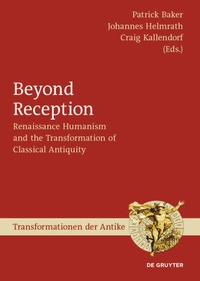
Beyond Reception
Description

Beyond Reception applies a new concept for analyzing cultural change, known as 'transformation', the study of Renaissance humanism. Traditional scholarship takes the Renaissance humanists at their word, that they were simply viewing the ancient world as it actually was and recreating its key features within their own culture. Initially modern studies in the classical tradition accepted this claim and saw this process as largely passive. 'Transformation theory' emphasizes the active role played by the receiving culture both in constructing a vision of the past and in transforming that vision into something that was a meaningful part of the later culture. A chapter than explains the terminology and workings of 'transformation theory' is followed by essays by nine established experts that suggest how the key disciplines of grammar, rhetoric, history, poetry, and philosophy in the Renaissance represent transformations of what went on in these fields in ancient Greece and Rome. The picture that emerges suggests that Renaissance humanism as it was actually practiced both received and transformed the classical past, at the same time as it constructed a vision of that past that still resonates today.
Reviews / Votes
"
Beyond Reception
is an interesting volume that contains some outstanding contributions. [...] Despite the range of the topics covered, several of the chapters are in dialogue with each other and the theoretical views outlined by the editors in the introduction are articulated in various ways throughout the volume, offering both a review of the development of scholarship within Renaissance studies, as well as a prospectus of the shape of things to come."
Carl O'Brien in: BMCR 2019.10.31
More details
Other editions
Additional editions
Persons
P. Baker and J. Helmrath , Humobldt University, Berlin, Germany; C. Kallendorf , Texas A&M University, College Station, USA.
Content
- Intro
- Contents
- Introduction
- Transformation: A Concept for the Study of Cultural Change
- The Transformation of Attitudes towards Ancient Latin Authors and the Legacy of Lorenzo Valla
- The Greek Renaissance: Transfer, Allelopoiesis, or Both?
- How Did Renaissance Rhetoric Transform the Classical Tradition?
- Political-Assembly Speeches, German Diets, and Aeneas Sylvius Piccolomini
- The Virtue Politics of the Italian Humanists
- "Haec Domus Omnium Triumphorum": Petrarch and the Humanist Transformation of the Ancient Triumph
- Tradition, Reception, Transformation: Allelopoiesis and the Creation of the Humanist Virgil
- Renaissance Humanism and the Transformations of Ancient Philosophy
- The Effects of Authorial Strategies for Transforming Antiquity on the Place of the Renaissance in the Current Philosophical Canon
- Contributors
- Index
