


Agentic AI For Dummies
Description

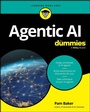
An easy-to-follow guide to demystifying Agentic AI, the next step in the evolution of artificial intelligence
Agentic AI is the next big leap in artificial intelligence. Agentic systems don't just respond to commands. They set goals, make decisions, and take initiative without direct human interaction. Sound like a lot to wrap your head around? Fortunately Agentic AI For Dummies is here to help you gain understanding of this advancing technology.
Written by the author of ChatGPT For Dummies and Generative AI For Dummies, this easy-to-understand tech guide helps you take your first steps into Agentic AI. Get insight into the technologies driving Agentic AI, a road map for shifting from legacy systems to Agentic systems, and a tour of real-world use cases for Agentic AI. This books arms you with an understanding to make better decisions about how and when to use Agentic AI technologies.
Inside the book:
- Discussions of the technological foundations of agentic AI
- Explorations of the wide variety of applications of the AI agents, including in scientific research, innovation, business operations, healthcare, and more
- Insightful examinations of the ethical considerations and hurdles you'll need to navigate when it's time to deploy agentic AI in your company
Perfect for business owners, entrepreneurs, managers, executives, professionals and team leaders in the private sector, Agentic AI For Dummies is a hands-on toolkit and strategy guide for using autonomous AI solutions to solve hard problems in your organization.
More details
Other editions
Additional editions
Person
Pam Baker has nearly two decades of experience as a tech journalist, consultant, and trainer. She's the author of ChatGPT For Dummies and Generative AI For Dummies. Based in metro Atlanta, she helps readers navigate emerging technologies with clarity and practical insights.
Content
- Intro
- Title Page
- Copyright Page
- Table of Contents
- Introduction
- About This Book
- Foolish Assumptions
- Icons Used in This Book
- Beyond the Book
- Where to Go from Here
- Part 1 Understanding Agentic AI
- Chapter 1 Introducing Agentic AI
- Defining Agentic AI
- Moving toward AGI with Agentic AI
- Noting that agentic systems already exist
- Reasoning as AI's Way Forward
- Exploring philosophy, reason, and fear
- Putting AI reasoning into perspective
- Recognizing the operational challenges of Agentic AI
- Differentiating between AI Agents and Agentic AI
- Meeting examples of agents and agentic systems
- Seeing what agents and Agentic AI systems have in common
- Recognizing the distinctions between agents and Agentic AI systems
- Mapping the Path from Prompt Engineering to AI Autonomy
- Engineering your prompts for successful AI interaction
- Controlling AI system actions with effective prompting
- Viewing prompting as foundational
- The Budding Agentic AI Web
- Expanding the duty of agents online
- Scaling up to a citywide, nationwide, and global reach
- Following the Shift to A-Commerce
- Recognizing the fallibility of AI answers
- Reducing specific website interaction
- Relying on personal AI shoppers
- Optimizing commerce sites for AI
- Navigating the transition to A-commerce
- Chapter 2 Peeking Inside the AI Agent Mind
- Linking the Fundamental Building Blocks
- Identifying Agentic AI building blocks
- Enter the overseers
- Exploring Reasoning, Memory, and Goal Setting
- Assessing Agentic AI reasoning
- Considering AI's limited intelligence
- Recognizing its intentional design
- Evaluating Agentic AI memory
- Adding memory to a system's design
- Blending memory and reasoning in the design
- Getting (too) personal with memory
- Grasping Agentic AI goal setting
- Understanding Adaptive Behavior and Self-Directed Learning
- Dissecting adaptive behavior
- Delving into self-directed learning
- Learning more than new information
- Examining other aspects of meta-learning
- Directing Agentic AI
- Talking it over with Agentic AI
- Continuing direction over the AI's work
- Completing the mission and next steps
- Interacting with GenAI and Agentic AI
- Combining Generative Abilities and Real-Time Decision-Making
- Expanding on content generation
- Applying agentic capabilities to complex interconnections
- Operating autonomously across time
- Staying the course in a changing environment
- Chapter 3 Meeting Agentic AI Core Technologies
- Driving Multi-Agent Coordination and Planning
- Computational complexity and task decomposition
- Specialized expertise and division of labor
- Scalability and fault tolerance
- Distributed information and resources
- When resources can't be moved
- Apply the multi-agent approach
- Emerging coordination mechanisms
- Communication and shared understanding
- Connecting Contextual Awareness and Situational Reasoning
- World modeling
- Perception and sensor fusion
- Memory architectures
- Theory of mind modeling
- Communication protocols and intent signaling
- Planning and goal-conditioned learning
- Distributed coordination and federated learning
- Self-Correcting Continuous Improvement
- Improving by failing and adjusting
- Correcting more than just mistakes
- Shifting to Multimodal Input and Cross-Domain Functionality
- Contrasting reactive and proactive operation
- Exploiting multiple streams of input
- Enabling the growth of multimodal systems
- Streamlining Integrations Using New Protocols
- Model Context Protocol (MCP)
- Seeing how MCP works
- Recognizing MCP's limitations
- Agent Network Protocol
- Agent2Agent protocol (A2A)
- Fostering agent communication
- Barriers to agent collaboration
- Agent Communication Protocol
- Incorporating internet methods
- Focusing on precision
- Building AI Agents
- Choosing technical architecture approaches
- Building from scratch
- Using agentic frameworks
- Using AI agent-building platforms
- Supporting system development, regardless of method
- Building without coding
- Recognizing both benefits and drawbacks
- Looking over types of platforms
- Building with coding
- From-scratch options (or not)
- Framework options
- Chapter 4 Interacting with Agentic AI
- Mistaking AI as a Colleague Creates Errors
- Establishing the AI-as-tool mindset
- Discovering how to direct Agentic AI
- Comparing Context Engineering to Prompt Engineering
- Seeing why you need both practices
- Understanding the fundamental differences in engineering methods
- Examining the basics of context engineering
- Providing comprehensive awareness
- Interconnecting system components
- Augmenting context engineering with prompt engineering
- Incorporating prompt engineering in Agentic AI
- Prompting and tool integration
- Maintaining agent behavior
- Evolving Voice, Intent, and Semantic Interface Design
- Voicing your intent with AI
- Interpreting meaning with semantic interfaces
- Rising Hyper-Real AI Avatars
- Personalizing Workflows
- Taking informed actions
- Adapting to (and for) user's roles
- Tailoring output based on user feedback or co-agent needs
- Shifting from Apps to Agents
- Reducing the complexity of our world
- Dying app stores
- Reimagining the internet through agents
- Grappling with AI-related challenges
- Forbidding AI Agents from Running Certain Machines
- Recognizing the system design differences
- Addressing the timing issue
- Noting the current lack of Agentic AI transparency
- Exposing the interface issues
- Examining data integrity
- Part 2 Getting Started on the Agentic AI Path
- Chapter 5 Planning for the Shift to Agentic AI Systems
- Comparing Generative AI to Agentic AI with Goals in Mind
- Considering AI strengths and oversight required
- Seeing the power of combined AI
- Thinking Through an Agentic AI Plan
- Recognizing the five pillars of Agentic AI planning
- Setting up SMART goals and detailed follow-up
- Double-checking your plan
- Following the Steps for Planning and Implementing Agentic AI
- Step 1: Establishing strategic intent
- Making a strategic-intent commitment
- Examining the components of strategic intent
- Step 2: Evaluating readiness
- Step 3: Identifying high-impact use cases
- Linking Agentic AI deployments to business priorities
- Looking for value and success
- Choosing a pilot project
- Step 4: Designing the pilot framework
- Step 5: Building or integrating Agentic AI systems
- Implementing technical strategies
- Integration architecture and data flow
- Monitoring and observability systems
- Deployment and operational considerations
- Step 6: Running, measuring, and refining
- Taking the right measurements
- Refining operational system models
- Step 7: Expand and scale
- Facing challenges of Agentic AI expansion
- Starting small and scaling up
- Meeting organizational complexity
- Step 8: Establishing governance and trust
- Step 9: Upskilling your workforce
- Step 10: Reimagining business models and value creation
- Chapter 6 Sampling Sector Use Cases for AI Agents
- Developing Healthcare, Diagnostics, and Pharmaceuticals
- Personalizing with AI treatment agents
- Dispatching AI medical imaging agents
- Accelerating clinical trial patient matching
- Upskilling surgeons for robotic surgery
- Building Business Operations and Decision Support
- Simulating economies with AI financial modeling agents
- Optimizing procurement and negotiations with AI agents
- Auditing with ever-present internal AI agents
- Adding AI Agents for Marketing, Customer Experience, and Inventory
- Deploying AI marketing agents
- Engaging AI customer experience agents
- Building AI inventory optimization agents
- Creating Content: Writing, Design, and Media
- Collaborating with AI writing agents
- Designing with AI agents
- Editing with post-production agents
- Reinventing Education
- Personalizing AI learning agents
- Contextually aware tutoring agents
- Upgrading administration automation
- Chapter 7 Considering Risks, Ethics, and Hard Questions
- Losing Human Skill and Baseline Knowledge
- Seeing the scope of AI-involved skill loss
- Delegating work to AI agents responsibly
- Designing agentic systems to mitigate loss of competency
- Autonomy versus Control: Establishing Who's in Charge
- Transportation: Lessons in control
- Healthcare: Human oversight in life-and-death decisions
- Finance: Algorithms, autonomy, and accountability
- Education: Autonomy and human agency
- Discovering Alignment Problems and Value Misfires
- Value learning drift
- Everyday misfires
- High-stakes alignment challenges
- Why achieving alignment is so hard
- Detecting misfires
- Value alignment as a collective effort
- Missing Transparency and Explainability
- Looking for transparency in Agentic AI reasoning
- Addressing explainability
- Revisiting Bias, Justice, and Inclusivity
- From hidden bias to active misfires
- Justice as more than accuracy
- Inclusivity as a design imperative
- Cultural and contextual sensitivity in autonomous operations
- Hallucinating AI Agents at the Wheel?
- Addressing AI hallucinations
- Aiding AI with clear direction and human oversight
- Part 3 Agentic AI in the Real World
- Chapter 8 Reshaping Work with Agentic AI
- Shaping Human Minds and Mindsets
- Heeding a warning from MIT
- Taking an active approach to using AI
- Augmenting Human Judgment and Creativity
- Redefining Job Roles and Workflows
- Seeing the big picture of adapting jobs
- Changing the human role in customer service
- Freeing financial analysts from data collection
- Collaborating for efficiency in creative or marketing fields
- Fine-tuning healthcare teams' interactions
- Collaborating with Shared Intelligence
- Pooling abilities to achieve combined intelligence
- Accessing the same operational context
- Maintaining human oversight
- Trusting in collaborative intelligence
- Drawing on past memory
- Feeding it all back
- Surviving the Transition to the Agentic AI Workplace
- Using tools for sophisticated job hunting
- Finding AI tools for financial relief
- Reducing expenses by using AI agents
- Making money (maybe) by using AI agents
- Chapter 9 Predicting Agentic AI's Economic Impact
- Predicting Productivity Gains and Automation Impacts
- Current progress and productivity gains
- Expected productivity gains
- Deciding Who or What Gets the Job
- Understanding Agentic AI's core capabilities
- Discovering human advantage in complex contexts
- Identifying where Agentic AI excels
- Strategies for Delegating Tasks to Humans or AI Agents
- Teaming, rather than competing
- Making a framework for task assignments
- Avoiding common pitfalls
- Determining Impact on the Future of Work
- Rising new industries, roles and disciplines, and business models
- The industries
- The roles
- The business models
- Reinventing digital marketplaces and economies
- For the buyers
- For the sellers
- And beyond
- Chapter 10 Building Agentic Systems Responsibly
- Developing Design Principles for Safe Autonomy
- Looking at known risks for design decisions
- Containing AI behavior
- Recognizing outside threats to AI
- Building a design doctrine
- Navigating regulatory frameworks and global standards
- Tying Together Design Principles
- Placing limits on agentic systems' reach
- Instilling human-in-the-loop safeguards
- Promoting trustworthy outcomes
- Incorporating ready-made tools
- Testing, evaluation, and red teaming
- Training AI Agents
- Pre-training models for Agentic AI systems
- Adding the proactive piece
- Refining in simulated or real environments
- Building in protections and ethical practices
- An Agentic AI training example
- Evolving beyond Data Training: World Models
- Operating in 3D
- Learning within the real world
- World models already in operation
- The pros and cons of world models
- Part 4 Exploring Myths and Realities
- Chapter 11 Dispelling Common Agentic AI Misconceptions
- Agentic AI = Fully Autonomous, Uncontrollable Systems
- Acknowledging the boundaries of Agentic AI
- Avoiding unrealistic mandates
- Recognizing the frameworks that surround Agentic AI
- Emergent, unpredictable behaviors aren't chaotic autonomy
- It's Just a Fancier Chatbot
- Witnessing the development of capabilities
- Acknowledging the importance of a conversational interface
- Breaking down the real differences
- Agents Replace People
- Taking the businesses' perspective
- Figuring where the costs lie
- Following the media's spin
- Seeing how AI can take over work
- Only Giant Companies Can Use Agentic AI
- Noting the costs involved
- Watching a trend toward less-costly AI
- It's the Same as Traditional Automation
- When traditional automation works
- When to opt for Agentic AI
- Combining automation and Agentic AI approaches
- Agentic AI Requires Universe-Sized Datasets
- Chapter 12 Upskilling for the Agentic Age
- Knowing What to Learn and Unlearn
- Becoming an AI agent manager
- Ramping up your data literacy
- Applying systems thinking
- Weaving in ethics and governance
- Enhancing creative problem-solving skills
- Reframing old skills and habits
- Roles for Technologists, Creative Professionals, and Leaders
- Technologists: From builders to orchestrators
- Creative professionals: Dictated creations and director roles
- Leaders: From managers to ecosystem orchestrators
- Lifelong Learning and Agile Adaptation
- Developing a strategic learning framework
- Building actionable learning strategies
- Future-proofing your career
- Ethical Fluency and Human Judgment
- Understanding ethical fluency
- Appreciating the value of human judgment
- Creating your personal development plan
- Emotional Intelligence versus Intuitive Intelligence
- Chapter 13 Scoping the Future of Agency
- Consciousness, Intent, and Artificial Goals
- Recognizing the appearance of consciousness
- Identifying the nature of artificial intent
- Directing the power of Agentic AI goals
- Raging at the machine is humans fighting with themselves
- Asking Philosophical and Existential Questions about Agentic AI
- Free will and determinism in AI agents
- Exploring the free-will piece
- Examining the idea of determinism
- Making AI agents more predictable
- Ensuring clear operations
- Focusing on oversight
- Proving and securing
- Synthetic Agency and Collective Intelligence
- Collective intelligence in multi-agent ecosystems
- Swarm intelligence and decentralized agency
- Possible Futures: Utopia, Dystopia, or Both?
- Looking toward utopia
- Hearing the dystopian alarms
- Taking the middle road
- Part 5 The Part of Tens
- Chapter 14 Ten Surprising Ways Agentic AI Can Change Daily Life
- You Stop Googling So Much
- Errands Run Themselves
- Your Calendar Coordinates For You
- Your E-Mail Inbox Shrinks
- You Make Better Decisions
- You Have a Personal Finance Manager
- You Get Fully Personalized Learning
- You Don't Have to Shop
- You Get a Travel Planner, Tour Guide, and Concierge
- Your Digital Presence Manages Itself
- Chapter 15 Ten Things Agentic AI Is Terrible at Doing
- Understanding Human Emotion in Context
- Making Moral or Ethical Judgments
- Handling Novel, Unstructured Problems
- Using Creative Intuition and Artistic Vision
- Understanding the Bigger Picture
- Reacting to Sudden, High-Stakes Emergencies
- Balancing Competing Human Preferences
- Building Human Trust and Rapport
- Respecting Privacy and Boundaries
- Saying "I Don't Know"
- Chapter 16 Ten Bold Predictions about the Future of Agentic AI
- Personal AI Agents Will Become as Common as Smartphones
- Agentic AI Ecosystems Will Replace Traditional Apps
- A-Commerce Will Surpass E-Commerce
- SEO Will Evolve into AI Agent Optimization
- Agentic AI Will Reshape Knowledge Work
- New Legal and Ethical Frameworks Will Emerge for AI Agents
- Agentic Education Will Become Mainstream
- Digital Labor Markets for Agents Will Form
- Healthcare Will See a Surge in AI-Driven Preventive Care
- Humans Using Special AI Agents Will Lead Major Social Movements
- Appendix
- Agentic AI Readiness Checklist
- Phases for Creating and Using Agentic AI Systems
- Phase 1: Strategic foundation and use case selection
- Phase 2: Technical architecture and integration planning
- Phase 3: Governance and monitoring framework
- Phase 4: Risk management and compliance
- Index
- EULA
