

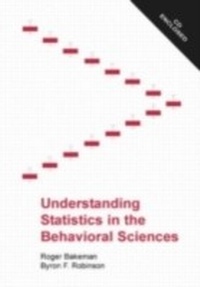
Understanding Statistics in the Behavioral Sciences
1st Edition
Published on 23. March 2005
336 pages
978-1-4106-1262-5 (ISBN)
Description

Understanding Statistics in the Behavioral Sciences is designed to help readers understand research reports, analyze data, and familiarize themselves with the conceptual underpinnings of statistical analyses used in behavioral science literature. The authors review statistics in a way that is intended to reduce anxiety for students who feel intimidated by statistics. Conceptual underpinnings and practical applications are stressed, whereas algebraic derivations and complex formulas are reduced. New ideas are presented in the context of a few recurring examples, which allows readers to focus more on the new statistical concepts than on the details of different studies.
The authors' selection and organization of topics is slightly different from the ordinary introductory textbook. It is motivated by the needs of a behavioral science student, or someone in clinical practice, rather than by formal, mathematical properties. The book begins with hypothesis testing and then considers how hypothesis testing is used in conjunction with statistical designs and tests to answer research questions. In addition, this book treats analysis of variance as another application of multiple regression. With this integrated, unified approach, students simultaneously learn about multiple regression and how to analyze data associated with basic analysis of variance and covariance designs. Students confront fewer topics but those they do encounter possess considerable more power, generality, and practical importance. This integrated approach helps to simplify topics that often cause confusion.
Understanding Statistics in the Behavioral Sciences features:*Computer-based exercises, many of which rely on spreadsheets, help the reader perform statistical analyses and compare and verify the results using either SPSS or SAS. These exercises also provide an opportunity to explore definitional formulas by altering raw data or terms within a formula and immediately see the consequences thus providing a deeper understanding of the basic concepts.
*Key terms and symbols are boxed when first introduced and repeated in a glossary to make them easier to find at review time.
*Numerous tables and graphs, including spreadsheet printouts and figures, help students visualize the most critical concepts.
This book is intended as a text for introductory behavioral science statistics. It will appeal to instructors who want a relatively brief text. The book's active approach to learning, works well both in the classroom and for individual self-study.
The authors' selection and organization of topics is slightly different from the ordinary introductory textbook. It is motivated by the needs of a behavioral science student, or someone in clinical practice, rather than by formal, mathematical properties. The book begins with hypothesis testing and then considers how hypothesis testing is used in conjunction with statistical designs and tests to answer research questions. In addition, this book treats analysis of variance as another application of multiple regression. With this integrated, unified approach, students simultaneously learn about multiple regression and how to analyze data associated with basic analysis of variance and covariance designs. Students confront fewer topics but those they do encounter possess considerable more power, generality, and practical importance. This integrated approach helps to simplify topics that often cause confusion.
Understanding Statistics in the Behavioral Sciences features:*Computer-based exercises, many of which rely on spreadsheets, help the reader perform statistical analyses and compare and verify the results using either SPSS or SAS. These exercises also provide an opportunity to explore definitional formulas by altering raw data or terms within a formula and immediately see the consequences thus providing a deeper understanding of the basic concepts.
*Key terms and symbols are boxed when first introduced and repeated in a glossary to make them easier to find at review time.
*Numerous tables and graphs, including spreadsheet printouts and figures, help students visualize the most critical concepts.
This book is intended as a text for introductory behavioral science statistics. It will appeal to instructors who want a relatively brief text. The book's active approach to learning, works well both in the classroom and for individual self-study.
More details
Other editions
Additional editions
Paul & Montagu
Understanding Statistics in the Behavioral Sciences
Book
08/2014
Psychology Press Ltd
€57.14
The article will not be published
Roger Bakeman | Byron F. Robinson
Understanding Statistics in the Behavioral Sciences
Book
01/2005
1st Edition
Psychology Press
€215.41
Shipment within 10-20 days
Content
Contents: Preface. Preliminaries: How to Use This Book. Getting Started: The Logic of Hypothesis Testing. Inferring From a Sample: The Binomial Distribution. Measuring Variables: Some Basic Vocabulary. Describing a Sample: Basic Descriptive Statistics. Describing a Sample: Graphical Techniques. Inferring From a Sample: The Normal and t Distributions. Accounting for Variance: A Single Predictor. Bivariate Relations: The Regression and Correlation Coefficients. Inferring From a Sample: The F Distribution. Accounting for Variance: Multiple Predictors. Single-Factor Between-Subjects Studies. Planned Comparisons, Post Hoc Tests, and Adjusted Means. Studies With Multiple Between-Subjects Factor. Single-Factor Within-Subjects Studies. Two-Factor Studies With Repeated Measures. Power, Pitfalls, and Practical Matters.
