

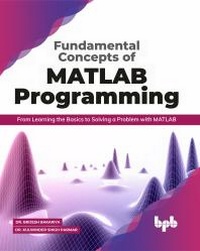
Fundamental Concepts of MATLAB Programming
From Learning the Basics to Solving a Problem with MATLAB
1st Edition
Published on 2. September 2020
316 pages
978-93-89845-83-9 (ISBN)
Description

No detailed description available for "Fundamental Concepts of MATLAB Programming".
More details
Other editions
Additional editions
Kulwinder Singh Parmar | Brijesh Bakariya
Fundamental Concepts of MATLAB Programming
From Learning the Basics to Solving a Problem with MATLAB (English Edition)
Book
08/2020
BPB Publications
€49.70
Available (delivery time upon request)
Content
- Cover Page
- Title Page
- Copyright Page
- Dedication Page
- About the Authors
- About the Reviewer
- Acknowledgements
- Preface
- Errata
- Table of Contents
- 1. Basics of MATLAB
- Objective
- Introduction
- Importance of MATLAB
- The MATLAB interface
- The Features of MATLAB
- The MATLAB paradigm
- Applications of MATLAB
- The MATLAB setup
- Some helpful screenshots
- Command window
- Current directory section
- Workspace section
- Command History section
- Conclusion
- Questions
- 2. Expressions and Basic Commands of MATLAB
- Objective
- Introduction
- Expression checking
- Valid expression
- Invalid expression
- Notations
- The colon (:) notation
- Comments
- Basic commands
- System commands
- I/O commands
- Conclusion
- Questions
- 3. Data Types, Variables and Operators
- Introduction
- Type conversion
- Variable
- Some important commands
- The clc command
- The who command
- The whos command
- The clear command
- Operators in MATLAB
- Types of operators
- The arithmetic operators
- The relational operators
- The logical operators
- The bitwise operations
- Set operations
- Conclusion
- Questions
- 4. Decision Control Statements
- Objective
- Introduction
- Types of decision making
- The if statements
- Conclusion
- Questions
- 5. Loops Control Statements
- Objective
- Introduction
- Types of loops
- The while loop
- The for loop
- The nested loop
- The jumping statements
- The break statement
- The continue statement
- Conclusion
- Questions
- 6. Vectors
- Objective
- Introduction
- Types of vectors
- Row vectors
- Column vectors
- Accessing value from vector
- Deletion of data from vector
- Basic operations of vector
- Addition of vectors
- Row wise addition
- Column wise addition
- Addition of two vectors
- Subtraction of vectors
- Row wise subtraction
- Column wise subtraction
- Subtraction of two vectors
- Multiplication of vectors
- Row wise multiplication
- Column wise multiplication
- Multiplications of two vectors
- Division of vectors
- Row wise division
- Column wise division
- Appending of vectors
- Types of append
- Row wise appending
- Column wise appending
- Magnitude of vector
- The dot product of a vector
- Scalar operations of vectors
- Transpose of vector
- Conclusion
- Questions
- 7. Matrix
- Objective
- Introduction
- Accessing value from the matrix
- Deletion of data from the matrix
- Deleting a column in a matrix
- Addition of matrices
- Row wise addition
- Column wise addition
- Addition of two matrices
- Subtraction of matrices
- Row wise subtraction
- Column wise subtraction
- Subtraction of two matrices
- Multiplication of matrices
- Row wise multiplication
- Column wise multiplication
- Multiplications of two matrices
- Division of matrices
- Row wise division
- Column wise division
- Concatenation of matrices
- Types of concatenation
- Horizontal concatenation
- Vertical concatenation
- Identity and inverse of matrices
- Identity
- Inverse
- Scalar operations of matrix
- Determinant of matrix
- Transpose of matrix
- Conclusion
- Questions
- 8. Arrays
- Objective
- Introduction
- Why array?
- Types of array
- Declarations and initialization of an array
- One dimensional array
- Two dimensional array
- Multi dimensional arrays
- Predefined functions in an array
- The zeros() function
- The ones() function
- The rand() function
- The magic() function
- The eye() function
- Some other functions
- Multi-dimensional arrays
- Sorting of arrays
- Simple sorting
- Row wise sorting
- Column wise sorting
- Accessing data in cell arrays
- Conclusion
- Questions
- 9. Strings
- Objective
- Introduction
- An array of character in rectangular form
- Functions of strings
- Arrays, functions for identifying parts of strings, find and replace substrings
- Functions for string comparison
- Some other functions
- Conclusion
- Questions
- 10. Functions
- Objective
- Introduction
- Definition
- Types of functions
- Predefined function
- Cell array functions
- Structure functions
- Histogram functions
- Logical functions
- Exponential and logarithmic functions
- Hyperbolic functions
- Complex functions
- Statistical functions
- Random number functions
- Numeric functions
- String functions
- Numerical methods
- Polynomial and regression functions
- Interpolation functions
- Root finding and minimization
- Numerical integration functions
- Numerical differentiation functions
- Predefined input functions
- User-defined function
- Syntax of user-defined function
- Conclusion
- Questions
- 11. Data Import and Export
- Objective
- Introduction
- Why Data Import?
- Array format
- Data format
- Clipboard format
- Low-level file I/O
- Import text data files with low-level I/O
- Outputting formatted data to a text file
- Data export
- Diary function
- dlmwrite function
- fprintf function
- Conclusion
- Questions
- 12. Plotting a Graph
- Objective
- Introduction
- Definition
- Types of plot
- 2D plot
- 3D plot
- Types of 3D plots
- Various commands and functions
- The hold command
- The line command
- The view() function
- Conclusion
- Questions
- 13. Graphics
- Objective
- Introduction
- Types of graphics objects
- Composite graphics objects
- Plot objects
- Annotation objects
- Group objects
- Transforming objects
- Object properties
- Using the handle
- Conclusion
- Questions
- 14. Basic Algebra in MATLAB
- Objective
- Introduction
- The solve( ) function
- The root( ) function
- The disp( ) function
- Solving linear equations
- Solving quadratic equations
- Solving higher order equations
- Expanding and collecting equations in MATLAB
- Factorization and simplification of algebraic expressions in MATLAB
- The calculus in MATLAB
- Solving limits
- Left and right sided limits
- Differential formations
- Basic rules of differential
- Derivatives of logarithmic, exponential and trigonometric functions
- Solution of higher order derivatives
- Maxima and minima of a curve
- The solution of differential equations
- Integration
- Indefinite integral using MATLAB
- Definite integral using MATLAB
- Calculations of polynomials
- Roots of the polynomials
- Polynomial curve fitting
- Conclusion
- Questions
