

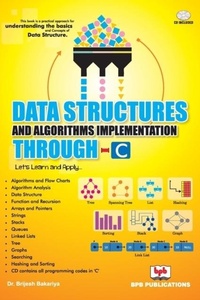
Data Structures and Algorithms Implementation Through C
Let's Learn and Apply
1st Edition
Published on 15. January 2018
324 pages
978-93-89423-84-6 (ISBN)
Description

No detailed description available for "Data Structures and Algorithms Implementation Through C".
More details
Other editions
Additional editions
Brijesh Bakariya
Data Structures and Algorithms Implementation Through C
Book
01/2018
BPB Publications
€31.80
Article exhausted; check different version
Content
- Cover Page
- Title Page
- Copyright Page
- Dedication
- Acknowledgement
- Preface
- Table of Contents
- Chapter 1: Algorithms and Flowcharts
- 1.1 Introduction of Algorithm
- 1.2 What is an algorithm?
- 1.3 Flowcharts
- 1.3.1 Reason to Use Flowcharts
- 1.4 Advantages
- 1.5 Symbols Used for Making Flowcharts
- 1.6 Pseudocode
- 1.7 Difference between Algorithm and Pseudocode
- Chapter 2: Algorithm Analysis
- 2.1 Introduction
- 2.2 Why to Study an Algorithm?
- 2.3 Definition of an Algorithm
- 2.4 Steps to Construct an Algorithm
- 2.5 Analysis of an Algorithm
- 2.5.1 Apriori Analysis
- 2.5.2 Aposteriori Analysis
- 2.6 Complexity of an Algorithm
- 2.6.1 Time Complexity
- 2.6.2 Space Complexity
- 2.7 Asymptotic Notation
- 2.7.1 Properties of Asymptotic Notation
- Chapter 3: Introduction to Data Structure
- 3.1 Introduction
- 3.2 Definition
- 3.3 Classification of Data Structure
- 3.3.1 Primitive Data Structure
- 3.3.2 Non Primitive Data Structure
- 3.4 Array
- 3.4.1 Declaration and Initialization of an Array
- 3.5 Stacks
- 3.6 Queue
- 3.7 Linked List
- 3.8 Tree
- 3.9 Graph
- 3.10 Memory Allocation in C
- 3.10.1 Static Allocation
- 3.10.2 Dynamic Allocation
- 3.10.2.1 The malloc() function
- 3.10.2.2 The calloc () Function
- 3.10.2.3 The free() Function
- 3.10.2.4 The realloc() Function
- 3.11 Functions of Data Structure
- Chapter 4: Function and Recursion
- 4.1 Introduction
- 4.2 Definition
- 4.3 Types of Functions
- 4.3.1 Predefined Function
- 4.3.2 User Defined Function
- 4.4 Function Prototype
- 4.5 Introduction of Recursion
- 4.5.1 Definition
- 4.5.2 Types of Recursion
- 4.5.2.1 Direct Recursion
- 4.5.2.2 Indirect Recursion
- 4.6 Fundamental Need of Recursion
- 4.7 Iteration and Recursion
- 4.8 Program for Function and Recursion
- Chapter 5: Arrays and Pointers
- 5.1 Introduction to Arrays
- 5.2 Definition
- 5.3 One Dimensional Array
- 5.3.1 Initialization of One Dimensional Array
- 5.3.2 Accessing an Element from One Directional Array
- 5.3.3 Array Implementation in Memory
- 5.4 Process of Deleting an Element from an Array
- 5.5 Merging of Two Arrays
- 5.6 Multi Dimensional Arrays
- 5.6.1 Initialization of two-dimensional array
- 5.6.2 Accessing of Element in Two Dimensional Array
- 5.7 Pointer
- 5.8 Pointer to Structure
- Chapter 6: Strings
- 6.1 Introduction to Strings
- 6.2 Definition
- 6.3 Library Functions of Strings
- Chapter 7: Stack
- 7.1 Introduction to Stack
- 7.2 Definition
- 7.3 Stack Implementation
- 7.4 Operations of Stack
- 7.5 Applications of Stack
- 7.6 Programs for Stacks
- 7.7 Multiple Stacks
- Chapter 8: Queues
- 8.1 Introduction to Queue
- 8.2 Definition
- 8.3 Queue Implementation
- 8.4 Circular Queue
- 8.4.1 Some Important Points about Circular Queue
- 8.4.2 Insertion in Circular Queue
- 8.4.3 Deletion in Circular Queue
- 8.5 De-queue
- 8.6 Priority Queue
- Chapter 9: Linked Lists
- 9.1 Introduction
- 9.2 Terminology
- 9.3 Representation of Linked List
- 9.4 Operations of Linked List
- 9.5 Types of Linked List
- 9.6 Singly Linked List
- 9.7 Program for Implementing Linked List
- 9.8 Circular Linked List
- 9.9 Doubly Linked List
- 9.10 Program for Implementing Doubly Linked List
- 9.11 Circular Doubly Linked List
- 9.12 Addition of Two Polynomials
- 9.13 Program for Implementing Circular Doubly Linked List
- Chapter 10: Trees
- 10.1 Introduction to Tree
- 10.2 Tree Terminology
- 10.3 Binary Tree
- 10.3.1 Binary Tree Representation using Array
- 10.3.2 Binary Tree Representation using Linked List
- 10.4 Dynamic Implementation of Binary Search Tree
- 10.5 Strictly Binary Tree
- 10.6 Complete Binary Tree
- 10.7 Tree Traversal
- 10.7.1 In-order Traversal
- 10.7.2 Pre-order Traversal
- 10.7.3 Post-order Traversal
- 10.8 Recursive Code for Preorder, Inorder and Postorder Traversal
- 10.9 Tree Construction
- 10.10 Binary Search Tree
- 10.11 Expression Tree
- 10.12 Threaded Binary Tree
- 10.12.1 Types of Threaded Binary Trees
- 10.13 AVL Tree
- 10.14 Balance Factor
- 10.15 Insertion in AVL tree
- 10.16 M-way Tree
- 10.17 B- Tree
- 10.18 B+ Tree
- Chapter 11: Graph
- 11.1 Introduction to Graphs
- 11.2 Basic Terminology of a Graph
- 11.3 Representation of Graph
- 11.4 Graph Traversals
- 11.4.1 DFS (Depth First Search)
- 11.4.2 BFS (Breadth First Search)
- 11.5 Spanning Tree
- 11.5.1 General Properties of Spanning Tree
- 11.5.2 Application of Spanning Tree
- 11.6 Minimum Spanning Tree (MST)
- 11.6.1 Minimum Spanning-Tree Algorithm
- 11.6.1.1 Kruskal's Algorithm
- 11.6.1.2 Prim's Algorithm
- 11.7 Shortest Path
- 11.7.1 Dijkstra's Algorithm
- 11.7.2 Bellman Ford's Algorithm
- Chapter 12: Searching
- 12.1 Introduction to Searching
- 12.2 Types of Searching
- Chapter 13: Sorting
- 13.1 Introduction
- 13.2 Types of sorting
- 13.3 Sorting Techniques
- 13.3.1 Bubble Sort
- 13.3.2 Selection Sort
- 13.3.3 Insertion Sort
- 13.3.4 Quick Sort
- 13.3.5 Merge Sort
- 13.3.6 Heap Sort
- Chapter 14: Hashing
- 14.1 Introduction to Hashing
- 14.2 Direct Address Table
- 14.3 Hash Function
- 14.4 Collision
- 14.4.1 Types of Hash Functions
- 14.5 Collision Resolution Technique (CRT)
- 14.6 Perfect Hashing
