

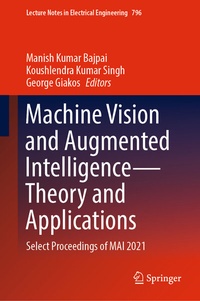
Machine Vision and Augmented Intelligence-Theory and Applications
Description

More details
Other editions
Additional editions
Persons
Manish Kumar Bajpai is an assistant professor in the Department of Computer Science and Engineering at the Indian Institute of Information Technology Design and Manufacturing, Jabalpur, India. He completed his Ph.D. from IIT Kanpur in the area of image reconstruction and parallel algorithm design. Dr. Bajpai has published over 50 publications in international journals and conferences. He has several sponsored research and consultancy projects funded by agencies such as SPARC, MHRD, DST, USIEF, ATAL, BRNS, and NVIDIA. 11 students have completed/pursuing their Ph.D. under his supervision. His areas of research are augmented intelligence, machine vision, brain-computer interface, medical imaging, and parallel algorithms design. Dr. Bajpai is a senior member of IEEE and a life member of the Indian Science Congress and Indian Nuclear Society.
Koushlendra Kumar Singh is currently working as an assistant professor in the Department of Computer Science and Engineering at the National Institute of Technology, Jamshedpur, India. He completed his doctoral degree and master's program from the Indian Institute of Information Technology, Design, and Manufacturing, Jabalpur, India, in 2016 and 2011, respectively. Dr. Singh graduated in computer science and engineering from Bhagalpur College of Engineering, Bhagalpur, in 2008. He has published several papers in international refereed journals and conferences. His current research interest areas are image processing, biometrics, and different applications of fractional derivatives, computational modeling, epidemic forecasting, etc.
George Giakos is a professor and chair in the Department of Electrical and Computer Engineering at Manhattan College, NY, USA. His research is articulated in technology innovation through the integration of physics, engineering, and artificial intelligence. He is a founding director of the Laboratory for Quantum Cognitive Imaging and Neuromorphic Engineering (CINE), Augmented Intelligence, and Bioinspired Vision Systems at Manhattan College. He has more than 20 US and foreign patents, 350 peer-reviewed published papers. He got extensive training in the design of innovative bioinspired electro-optical imaging sensor systems, by serving as a contractor at NASA, US Air Force Laboratories (AFRL), and Office of Naval Research. He is the recipient of the Fulbright Award to India, granted by the US Department of State, 2019-2020. Dr. Giakos has been recognized for his leadership efforts in advancing the professional goals of IEEE by receiving the 2014 IEEE-USA Professional Achievement Award in recognition of his efforts in strengthening links between industry, government, and academia.
