

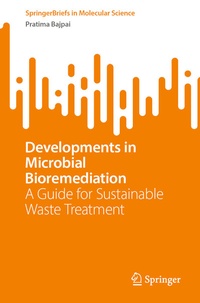
Developments in Microbial Bioremediation
Description

This book sheds new light on the transformative role of microorganisms in waste management, offering a comprehensive overview of microbial waste management strategies and their applications. Through this book, readers will learn about the latest advancements in bioremediation and microbial consortia technology, providing a fresh perspective on sustainable waste treatment solutions.
The chapters cover topics such as the types and origins of waste, the importance of microorganisms in various waste management processes, and the benefits of bioremediation compared to traditional methods. Readers will discover diverse strategies for managing microbial waste, including bioleaching, bioaugmentation, and utilizing microorganisms to aid phytoremediation. The book also discusses the combined use of bacteria and microalgae for wastewater treatment and emerging innovations in microbial consortia technology. Critical attention is given to the role of microbes in multiple industrial applications such as pharmaceuticals, food processing, textiles, explosives, distilleries, and petrochemicals. Additionally, it explores bioinformatics approaches like genomics and proteomics that drive bioremediation efforts.
This volume is an essential resource for researchers in environmental science, biotechnology professionals focusing on sustainable practices, scholars studying advanced wastewater treatment methods using nanotechnology or plant species integration with microorganisms. It invites readers to think through critical questions about sustainable waste treatment practices while offering valuable insights into future perspectives on microbial waste management.
More details
Other editions
Additional editions
Person
Pratima Bajpai is currently working as a Consultant in the field of Paper and Pulp. Her research career spans about forty years, having worked at the National Sugar Institute, University of Saskatchewan, University of Western Ontario, and Thapar Research and Industrial Development Centre in India. She also worked as a visiting professor at the University of Waterloo, Canada and as a visiting researcher at Kyushu University, Fukuoka, Japan. She has been named among the World's Top 2% Scientists by Stanford University in the list published in October 2023. This is the fifth consecutive year that she has made it into the prestigious list. Dr. Bajpai's main areas of expertise are industrial biotechnology, pulp and paper, and environmental biotechnology. She has contributed immensely to the field of industrial biotechnology and is a recognized expert in the field. Dr. Bajpai has written several advanced level technical books on environmental and biotechnological aspects of pulp and paper which have been published by leading publishers in the USA and Europe. She has also contributed chapters to several books and encyclopedia, obtained 11 patents, written several technical reports, and has implemented several processes in Indian Paper mills. Dr. Bajpai is an active member of the American Society of Microbiologists and is a reviewer of many international research journals.
Content
Chapter 1.Introduction and General Background of Microorganisms in Waste Management.- Chapter 2.Strategies and Technologies for Waste Management.- Chapter 3.Wastewater Treatment Using Microorganisms.- Chapter 4.Industrial Applications and Bioinformatics.- Chapter 5.Challenges and Future Perspectives.
