

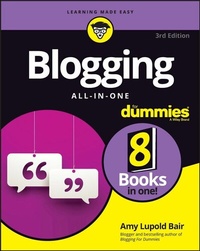
Blogging All-in-One For Dummies
Description

If you're looking for a complete guide to creating and solidifying your place in the blogosphere, you've come to the right place! With 8 books in one, Blogging All-in-One For Dummies is the only resource you'll need to get started or to improve your existing blog. Learn about the most popular blogging platforms, creating content worth reading, and methods for driving traffic to your blog. Cut through the confusion and find the facts about monetizing your blog, using the best blogging tools for you, and increasing reader engagement to become an active, successful member of the blogging community. You're ready to start blogging, so let Dummies show you the way!
* Perfect your blog idea and choose the best platform for you
* Get people to read your blog through search engine optimization and social media promotion
* Learn about the latest trends in the blogosphere
* Make money from your blog with creative monetization ideas
Bloggers of all skill and experience levels will find valuable information in Blogging All-in-One For Dummies.
More details
Other editions
Additional editions
Person
Content
Book 1: Entering The Blogosphere 7
Chapter 1: Joining the Blogosphere 9
Chapter 2: Preparing to Start and Write a Blog 27
Chapter 3: Blogging Basics 43
Chapter 4: Blogging Best Practices 67
Book 2: Niche Blogging 81
Chapter 1: Understanding Niche Blogging 83
Chapter 2: Benefiting from a Niche Blog Approach 99
Chapter 3: Choosing Your Niche 111
Chapter 4: Writing for Your Niche 127
Book 3: Corporate and Non-Profit Blogging 149
Chapter 1: Starting a Business Blog 151
Chapter 2: Developing a Blog Plan 177
Chapter 3: Choosing Bloggers 199
Chapter 4: Writing an Organization's Blog 215
Chapter 5: Keeping Yourself and Your Organization Out of Trouble 227
Book 4: Figuring Out Blogging Platforms 241
Chapter 1: Choosing a Blogging Platform 243
Chapter 2: Finding the Right Blogging Platform 253
Chapter 3: Taking a Look at WordPress 269
Chapter 4: Using Google Blogger 301
Chapter 5: Understanding Medium 331
Chapter 6: Blogging with Wix 365
Book 5: Blogging Tools 401
Chapter 1: Optimizing for Search Engines 403
Chapter 2: Measuring Blog Performance 419
Chapter 3: Enhancing Content 435
Chapter 4: Staying Organized 455
Book 6: Promoting and Growing Your Blog 479
Chapter 1: Secrets to Blogging Success 481
Chapter 2: Building Community 491
Chapter 3: Social Networking 499
Chapter 4: Distributing Content 515
Chapter 5: Inviting or Being a Guest Blogger 529
Book 7: Making Money From Your Blog 539
Chapter 1: Blog Advertising 101 541
Chapter 2: Publishing Advertising 549
Chapter 3: Making Money with Affiliate Marketing 575
Chapter 4: Publishing Sponsored Posts 589
Chapter 5: Monetizing with Social Commerce 603
Chapter 6: Selling Ad Space Directly 623
Chapter 7: Benefiting from Indirect Monetization Opportunities 633
Book 8: Moving Beyond Writing Blog Posts 641
Chapter 1: Painting a Picture with Visual Content 643
Chapter 2: Reaching Your Audience with Video Content 665
Chapter 3: Getting Social with Social Media 683
Chapter 4: Creating a Podcast 711
Index 727
Introduction
Each person who creates a blog is unique, and therefore, each blog is unique. There are almost no boundaries to entering the blogosphere (the online blogging community made up of bloggers from around the world, creating user-generated content as part of the social web), and everyone is welcome to the party. Blogging is an amazing way to connect with people, promote a business, establish yourself as an expert in your chosen field, make money, or simply share content with friends and family. The choice is yours!
The blogosphere might be open to anyone, but many people are still confused and intimidated by the terminology, technology, and rules of the blogosphere. Truth be told, most bloggers dive in and learn as they go, but if you prefer to have a guide on hand to walk you through the theories, tools, and processes to create, publish, and maintain a blog, Blogging All-in-One For Dummies, 3rd Edition offers exactly that - a complete guide to blogging, all in one place.
About Blogging All-in-One For Dummies
Blogging All-in-One For Dummies, 3rd Edition provides a clear and concise introduction to all the terms, theories, and processes you need to understand to not only join the blogosphere but also meet your individual goals for your blog. The following list highlights some of the information you can better understand and apply to your blogging experience as you read this book - you find out how to
- Find blogs to read.
- Choose a topic and write blog posts.
- Pick a domain name and identify the parts of a blog.
- Follow the rules of the blogosphere.
- Create a niche blog.
- Develop a business blog.
- Select a blogging platform, using detailed descriptions of the most popular blogging applications - WordPress, Blogger, Medium, and Wix.
- Write with search engine optimization in mind.
- Analyze your blog's performance.
- Find and edit images for your blog.
- Create and distribute a podcast.
- Stay organized while blogging.
- Include video content in your blogging strategy.
- Promote and grow your blog.
- Make money from your blogging efforts.
- Develop your blog's brand on social media platforms.
Blogging can be fun. It can also be lucrative and help you meet a wide variety of goals, from growing a business to building relationships with a global audience. The choice is yours, and Blogging All-in-One For Dummies, 3rd Edition can help you get started on the path to blogging success, regardless of your personal or professional goals.
Foolish Assumptions
Blogging All-in-One For Dummies, 3rd Edition is written primarily for a beginner audience - people who have never blogged. However, I'm assuming that you know a few things before you start reading this book:
- You know how to access and surf the Internet using a web browser on your computer.
- You know how to download an app on your mobile device.
- You have a general understanding of what a blog is, or you've seen a blog online.
- You want to start your own blog, or you want to find out more about blogging to enhance your existing blog.
Understand that if you're a skilled blogger with a deep understanding of the tools and theories of the blogosphere, many of the topics discussed in this book are likely to be rudimentary for you. However, even the most seasoned bloggers admit they don't know everything about blogging and the social web, or at the very least, they haven't thought of something in a certain way. For example, you may have been blogging for years, but now you want to learn more about a different tool or niche. In other words, even skilled bloggers can find plenty of tips and techniques in this book that could come in handy or make their lives easier.
What You Don't Have to Read
Blogging All-in-One For Dummies, 3rd Edition is divided into eight individual Books. Each Book (and each chapter within a Book) is capable of standing on its own. Therefore, you can pick and choose to read specific Books or specific chapters to meet your needs and skip those Books and chapters that don't apply.
It's important to point out that reading cover to cover gives you a complete introduction to blogging and positions you to start your blog successfully and with fewer problems in the future. However, it's entirely up to you to decide how you want to use this book. Just as there really is no wrong way to blog, there's no wrong way to read this book.
How This Book Is Organized
Blogging All-in-One For Dummies is divided into eight Books. Each Book tackles a broad topic related to blogging. From discovering what a blog is to monetizing a blog - and everything in between - this book has a section on nearly every blogging subject. Here's a description of each Book so that you can identify the ones that are likely to be most helpful to you.
Book 1: Entering the Blogosphere
Book 1 starts from the beginning with an introduction to the fundamental principles of blogging. You find out what blogs are and why people blog. You also get guidance on finding blogs to read and making the decision to start your own blog.
After the introduction, you start to get your hands dirty. This Book explains how to pick a blog topic, write blog content, choose a domain name, and understand the bits and pieces that make up a blog. Importantly, you also find out the written and unwritten rules and ethics of the blogosphere. If you want to be a welcome member of the blogosphere, make sure you know and follow the rules discussed in this Book.
Book 2: Niche Blogging
Niche blogging has become more and more popular in recent years as the blogosphere gets more crowded. Book 2 explains what niche blogs are, how to choose a niche, and how to start your own niche blog. You also find out how to write content for a niche blog. Although many of the guidelines of writing a blog discussed in Book 1 apply to niche blogs, niche bloggers need to think about even more considerations when they write blog posts. This Book tells you how to set up your niche blog for success.
Book 3: Corporate and Non-Profit Blogging
Blogging for an organization has become a strategic imperative for large organizations and a competitive differentiator for small companies. No matter what business you're in, a blog can help you with both tangible and intangible benefits. This Book teaches you how starting a company blog can benefit your corporation or non-profit organization. You also find out about companies that are effectively using business blogs so that you can benchmark them for your own efforts. Furthermore, you find out how to create your own business blog marketing plan, choose business bloggers, and write your business blog. Finally, you discover how to blog safely to keep yourself and your organization out of trouble.
Book 4: Figuring Out Blogging Platforms
With so many blogging platforms and tools to choose from, it can be hard for beginner bloggers to know where to begin. This Book explains what blogging applications and blog hosts are and helps you select the best choices for you to meet your goals. You also get a more detailed introduction to four of the most popular blogging applications - WordPress, Blogger, Medium, and Wix.
Book 5: Blogging Tools
You can use a never-ending list of blogging tools to extend and enhance your blog. This Book introduces you to some of the most commonly used tools to help you with handling search engine optimization, analyzing your blog's performance, enhancing blog post content, and staying organized on your blogging journey.
Book 6: Promoting and Growing Your Blog
Many bloggers have goals to develop a popular and well-trafficked blog. If you're one of those bloggers, Book 6 is a Book you need to read! You find out the secrets of blogging success and how to build a community and market your blog through social networking, social media, guest blogging, and content distribution.
Book 7: Making Money from Your Blog
If you want to make money from your blog, Book 7 is for you! This Book tells you all about blog advertising, including contextual ads, text link ads, impression ads, affiliate ads, feed ads, and direct ads. This Book explains publishing ads on your blog as a monetization tactic as well as publishing sponsored content, selling merchandise, and a variety of indirect monetization opportunities.
Book 8: Moving Beyond Writing Blog Posts
While blogging has historically been a written-word medium, many bloggers now branch out and create content beyond writing blog posts. This Book runs you through a variety of ways to flex your creative muscles and take your content creation to a new level. From creating and editing visual content to diving in to the world of online video, this Book encourages you to reach new audiences and provide fresh, new content to your existing blog community. Book 8 also takes a look at podcast creation and how to use social media platforms to create additional blog-related content.
Glossary
Not sure what a word used in this book means? Check the glossary for simple definitions of many common terms used by members of the...
