

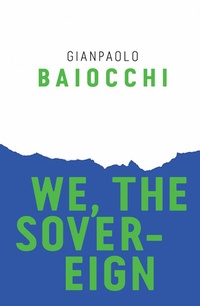
We, the Sovereign
Description

In this book, Gianpaolo Baiocchi argues that the only answer is a radical utopia of popular self-rule. This means that the 'people' who rule must be understood as a demos that is totally open, inclusive and egalitarian, constantly expanding its boundaries. But it also means that sovereignty must be absolute, possessing total power over all relevant decisions that impact the conditions of life. Only, he argues, by a process of explosive and creative tension between this radical view of the 'we' and an absolute idea of the 'sovereign' can we transform our approach to political parties and state institutions and make them instruments of total emancipation.
Illustrated by the real-life experiences of movements throughout the world, from Latin America to Southern Europe, Baiocchi's provocative vision will be essential reading for all activists who want to understand the true meaning of radical democracy in the 21st century.
More details
Other editions
Additional editions
Content
1 Movements and Questions of Our Time 1
2 We, The Sovereign 19
3 Social-Movement Parties 35
4 Another State is Possible 72
Conclusion: The 21st Century Popular Sovereignty 95
For Further Reading 111
1
Movements and Questions of Our Time
Radical politics are no longer the same. There is today a new generation of activists taking to streets and plazas demanding radical social change and actively imagining alternatives to the status quo. Some are demanding a complete transformation of institutions, wanting democracies that are meaningful and livelihoods that are less precarious.
For a brief moment in the early 2010s, the issue of democracy very dramatically and suddenly took center stage all around the world in the form of urban protests and occupations of prominent public plazas. In December of 2010, in Tunisia, protesters took to the streets and clashed with police following the self-immolation of Mohamed Bouazizi, a street vendor in the city of Sidi Bouzid. This very quickly reverberated all over that country (eventually causing the overthrow of the dictatorial regime), but also in neighboring countries. Over the next weeks, young people took to the streets and plazas demanding change in Egypt, Syria, Yemen, Libya, Morocco, and Oman, the so-called Arab Spring.
Partially inspired by this turn of events, Spain's Indignados next took center stage in that country the following March, while hundreds of thousands of people occupied the streets of Lisbon with the Desperate Generation movement. In Greece, the anti-austerity protests, which had been underway since 2010, intensified in May of 2011, with the Indignant Citizen Movement taking over public places all over the country. In Chile that same year, in August, students began massive national protests against inequality and cuts in education, in what some call the Chilean Winter. And in the United States, Occupy began in Zuccotti Park in September, before spreading to some 600 cities and towns across the country before the year's end and forever shaping a generation of young people who took part in it.
Just few months later, Brazil's June Protests of 2013 started as a protest against a 20-cent bus fare increase but became an inchoate set of protests on myriad issues in several different cities, bringing the country to a standstill for days. In July of 2013, Patrisse Cullors, Opal Tometi, and Alicia Garza founded Black Lives Matter in the aftermath of the protests of the vigilante killing of seventeen-year-old Trayvon Martin. Black Lives Matter has become a loosely organized network with chapters and virtual chapters in many cities, and has decidedly changed the public conversation about police violence and racism in the United States. Shortly after that, Hong Kong's dramatic Umbrella Revolution of 2014 has made the issue of democracy on that island unavoidable. And as I write, national resistance to Donald Trump's regime in the United States, with networks such as #ItTakesRoots, seems to be changing the landscape of left politics.
This is only a very partial list of the most visible global protest movements and new radical politics arising in the last few years. A slightly longer list might also include Idle No More, the worldwide indigenous peoples' movement founded in 2012, the UK student protests of 2010, the Taiwanese Sunflower Student Movement of 2014, and many other anti-austerity protests throughout the globe. It might also include the Icelandic Pots and Pans Revolution of 2009, which led to the re-writing of the constitution, or the organizing behind Jeremy Corbyn's candidacy in the Labour Party in the UK, or Bernie Sanders in the US. And it might even include some of the energy around new political parties in Europe, such as Slovenia's ERP or Germany's Die Linke. And this doesn't even begin to mention local initiatives, including radical cooperatives such as Cooperation Jackson, in Mississippi.
Our Democracy / Their Democracy
Although the motivating issues are very diverse, there are some important commonalities that underwrite much of this recent organizing and many of these protests. Of course, the rejection of contemporary neoliberalism and the experience of precarity is a common denominator in many cases. There is also a strong undercurrent of claims for rights across these protests: the right to shelter, livelihood and existence, mobility, assembly, education, and healthcare is present across many contexts.
But most of all, there is also a strong uniting theme that representative democracy has failed to make good on its promises: it has failed to deliver meaningful representation, meaningful connection to a common condition, and a meaningful experience of control over the conditions of people's lives. Whether we are talking of World Cup mega-projects in Brazil, runaway police violence in the United States, or market fundamentalism in Portugal, in each and every case activists insist that the institutions of representative democracy do not allow regular people to make decisions concerning things that affect them. In each and every case there are elites (sometimes named, like "the 1 percent") making those decisions and benefiting from them. The institutions of democracy-political parties, elections, consultations-serve only as a buffer behind which powerful interests can hide, and limit people's imaginations by dictating what is sensible. Most of these movements prefigure-that is, they live out and model alternatives: defining features can be a commitment to horizontalism and sometimes leaderlessness, participatory democracy, and resisting traditional institutions. The archetypical picture that will remain in many people's memory of this period of struggle will not be barricades, strikes, or even mass protests-it will be the encampment, the temporary occupation, the open assembly: people sitting around in a circle discussing common concerns and platforms. And the open issue of "what next?" is one of the questions that faced nearly all of those participants.
A deep-seated suspicion of political parties, including on the left, is often an important corollary to these experiences. We on the left need to accept this fact as revealing of our failures, rather than with the paternalistic admonishment that was a surprisingly common reaction in many contexts. And activists across these settings no doubt have a clearer vision of what they do not want-authoritarian governments, neoliberalism and market fundamentalism, elite cities defined by displacement, police violence, gentrification, economic precariousness and poverty, and environmental degradation and injustice. What is much less clear across the board is a propositional vision-what might more truly, deeply democratic and egalitarian societies look like, for today and tomorrow?
This chapter introduces the main set of questions around democratic practice that these groups are grappling with, questions that are this book's primary concern. Everywhere these movements have been in tension with traditional representative democracy, and everywhere they have been inventing new practices. Yet there are also a number of questions these movements have been facing, such as the relationship to political parties and institutions, how central it is to have a programmatic platform, the relationship with other movements, and internal tensions around horizontalist principles. Nowhere has this been more poignant than with Spain's Indignados, and for this reason we momentarily turn to an international day of protest against austerity with an epicenter in Madrid.
15 October 2011
On this day tens of thousands of Madrileños-joined by many more Spaniards who had come in from far-flung corners of the country-flooded the city's downtown to converge at one of the city's historic plazas, the iconic Puerta del Sol. At this event marking the five-month anniversary of the original occupation of the Puerta, a broad swath of the city's residents-young and old, retired, working age, families with strollers-took their places in the six-hour march buoyed by the chants that the 15M movement, or the Indignados, had become known for: "if we can't dream, you won't sleep"; "they don't represent us"; and "these are our weapons" (as they lift their hands in the air, a sign of agreement at assemblies). The march culminated in an assembly, where thousands of participants sat down for a large group discussion, which then broke into smaller working-group discussions, every one following the careful participatory methodology that had become one of the movement's signature features.
The Indignados were a complete novelty in an otherwise staid Spanish political system, and took many observers by surprise. The 15M evolved from a group that coalesced around an internetbased manifesto, the Democracia Real Ya (Real Democracy Now, shortened to DRY). The 15M (15 May) became the much larger and more diffuse movement that manifested itself that evening in Madrid. "They do not represent us," was one of its original slogans, as was "We are not goods in the hands of politicians and bankers." The original manifesto, which discussed unemployment, the mortgage crisis, and housing affordability, focused not so much on economics as on the breakdown of political accountability and representation. To some on the left, this focus on representation and political process was insufficiently radical, as was the movement's refusal to rally around specific platforms (which could only come after deliberative processes).
The original...
