

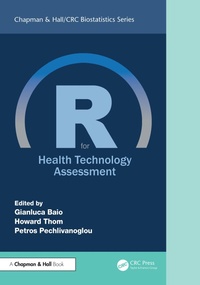
R for Health Technology Assessment
1st Edition
Published on 30. June 2025
450 pages
978-1-040-36202-0 (ISBN)
Description

R for Health Technology Assessment discusses the use of proper statistical software, specifically R, to perform the whole pipeline of analytic modelling in health technology assessment (HTA). It has been designed with the objective of establishing the use of R as the standard tool for HTA amongst academics, industry practitioners and regulators. It covers a lot of ground, starting with the necessary background in HTA, R and statistical inference, followed by various modelling tools, ranging from missing data, survival analysis and decision trees, through to multistate models and discrete event simulation. The methods are all illustrated with many detailed worked examples and case studies using real data, and there are detailed descriptions of the code and processes.
Key Features:
Introductory chapters on the various topics of the book, including HTA, R and statistical inference
A wide range of common analytical tools used in HTA, from modelling for individual-level data, missing data, survival analysis, decision-modelling and network meta-analysis
More advanced and increasingly popular tools, such as those for population adjustment, discrete event simulation and the use of web applications as front-end for the overall statistical modelling
Many detailed worked examples and case studies using real data to illustrate the methodology
Fully integrated R code gives detailed guidance on implementation of the techniques
Supplemented by a website with additional resources, including annotated code and data
This text is primarily aimed at modellers working in the field of HTA, regulators and reviewers of reimbursement dossiers and cost-effectiveness analyses. It also complements a wide range of undergraduate and graduate programmes in HTA, health and public health economics, as well as academic researchers in the field of statistical modelling for HTA.
Key Features:
Introductory chapters on the various topics of the book, including HTA, R and statistical inference
A wide range of common analytical tools used in HTA, from modelling for individual-level data, missing data, survival analysis, decision-modelling and network meta-analysis
More advanced and increasingly popular tools, such as those for population adjustment, discrete event simulation and the use of web applications as front-end for the overall statistical modelling
Many detailed worked examples and case studies using real data to illustrate the methodology
Fully integrated R code gives detailed guidance on implementation of the techniques
Supplemented by a website with additional resources, including annotated code and data
This text is primarily aimed at modellers working in the field of HTA, regulators and reviewers of reimbursement dossiers and cost-effectiveness analyses. It also complements a wide range of undergraduate and graduate programmes in HTA, health and public health economics, as well as academic researchers in the field of statistical modelling for HTA.
More details
Series
Edition
1. Auflage
Language
English
Place of publication
London
United Kingdom
Publishing group
Taylor & Francis Ltd
Target group
Professional and scholarly
College/higher education
Illustrations
16 Tables, black and white; 76 Line drawings, black and white; 76 Illustrations, black and white
File size
6,50 MB
ISBN-13
978-1-040-36202-0 (9781040362020)
Copyright in bibliographic data and cover images is held by Nielsen Book Services Limited or by the publishers or by their respective licensors: all rights reserved.
Schweitzer Classification
Other editions
Additional editions
Gianluca Baio | Howard Thom | Petros Pechlivanoglou
R for Health Technology Assessment
Book
06/2025
1st Edition
Chapman & Hall/CRC
€164.70
Shipment within 15-20 days

Book
06/2025
CRC Press
Unfortunately, price unknown
Available (delivery time upon request)
Persons
Gianluca Baio is Professor of Statistics and Health Economics in the Department of Statistical Science at University College London (UK). Gianluca's main interests are in Bayesian statistical modelling for cost effectiveness analysis and decision-making problems in the health systems, hierarchical/multilevel models and causal inference using the decision-theoretic approach. Gianluca leads the Statistics for Health Economic Evaluation research group within the department of Statistical Science and was the co-director of UCL MSc Programme in Health Economics and Decision Science. He is a founding member and former Scientific co-Director of the R-HTA consortium (https://r-hta.org/) and a founding member of the ConVOI (https://www.convoi-group.org/) network. He also served as Secretary (2014-2016) and then Programme Chair (2016-2018) in the Section on Biostatistics and Pharmaceutical Statistics of the International Society for Bayesian Analysis. He collaborates with the UK National Institute for Health and Care Excellence (NICE) as a Scientific Advisor on Health Technology Appraisal projects and has been the 18th Armitage Lecturer in November 2021. His research activity is now (almost) officially dead, since he has become the head of the department of Statistical Science at UCL, in 2021.
Howard Thom is Associate Professor in Health Economics at the University of Bristol, a health economics lead at the Bristol NICE Technology Assessment Group (TAG), and managing director of the consultancy Clifton Insight. At the University of Bristol he created the world's first annual short course on Economic Evaluation Modelling in R in 2019 and teaches on R for Health Technology Assessment for the International Society for Pharmacoeconomics and Outcomes Research. With Professor Gianluca Baio he founded the R for HTA organisation in 2018. He has published more than 70 peer reviewer papers, including new methods for network meta-analysis, structural uncertainty in cost-effectiveness models, and value of information analysis. He has built and contributed to dozens of academic and commercial cost-effectiveness models across a wide range of indications, including oncology (e.g. NSCLC, prostate cancer, breast cancer, hepatocellular carcinoma, and melanoma), neurology, rheumatology, and cardiology. Many of these models have been in R, including decision trees, Markov models, multistate microsimulations and discrete event simulations. He is a founding member and current Co-Director of the R-HTA consortium (https://r-hta.org/), as well as a member of the ConVOI (https://www.convoi-group.org/) network.
Petros Pechlivanoglou PhD, is a Senior Scientist at the Hospital for Sick Children, an Associate Professor at the Institute of Health Policy, Management and Evaluation (IHPME) at the University of Toronto and an adjunct ICES Scientist. He completed an MSc in econometrics and a PhD in health econometrics at the University of Groningen, the Netherlands. His current research focuses on the integration of large real-world data, decision analysis and statistical modelling in estimating the long-term health economic consequences of disease or treatment exposure, with a focus in early childhood. He has been an R user for over 20 years and has taught decision modeling using R for the last 15 years. Together with an international group of researchers has formed the Decision Analysis in R for Technologies in Health (DARTH) workgroup.
Howard Thom is Associate Professor in Health Economics at the University of Bristol, a health economics lead at the Bristol NICE Technology Assessment Group (TAG), and managing director of the consultancy Clifton Insight. At the University of Bristol he created the world's first annual short course on Economic Evaluation Modelling in R in 2019 and teaches on R for Health Technology Assessment for the International Society for Pharmacoeconomics and Outcomes Research. With Professor Gianluca Baio he founded the R for HTA organisation in 2018. He has published more than 70 peer reviewer papers, including new methods for network meta-analysis, structural uncertainty in cost-effectiveness models, and value of information analysis. He has built and contributed to dozens of academic and commercial cost-effectiveness models across a wide range of indications, including oncology (e.g. NSCLC, prostate cancer, breast cancer, hepatocellular carcinoma, and melanoma), neurology, rheumatology, and cardiology. Many of these models have been in R, including decision trees, Markov models, multistate microsimulations and discrete event simulations. He is a founding member and current Co-Director of the R-HTA consortium (https://r-hta.org/), as well as a member of the ConVOI (https://www.convoi-group.org/) network.
Petros Pechlivanoglou PhD, is a Senior Scientist at the Hospital for Sick Children, an Associate Professor at the Institute of Health Policy, Management and Evaluation (IHPME) at the University of Toronto and an adjunct ICES Scientist. He completed an MSc in econometrics and a PhD in health econometrics at the University of Groningen, the Netherlands. His current research focuses on the integration of large real-world data, decision analysis and statistical modelling in estimating the long-term health economic consequences of disease or treatment exposure, with a focus in early childhood. He has been an R user for over 20 years and has taught decision modeling using R for the last 15 years. Together with an international group of researchers has formed the Decision Analysis in R for Technologies in Health (DARTH) workgroup.
Content
1. Introduction to Health Technology Assessment. 2. Introduction to R. 3. Why R? A Low- and Middle-Income Countries Perspective. 4. Introduction to statistical modelling. 5. Individual level data. 6. Missing data. 7. Introduction to survival analysis in HTA. 8. Decision tree models. 9. Cohort Markov Models in Discrete Time. 10. Network Meta-Analysis. 11. Continuous time multistate models. 12. Discrete Event Simulation in R. 13. Population-adjusted indirect comparisons. 14. R and shiny in HTA.
