

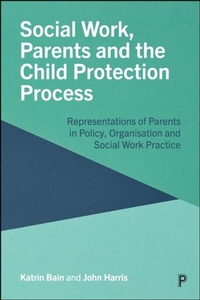
Social Work, Parents and the Child Protection Process
Representations of Parents in Policy, Organisation and Social Work Practice
1st Edition
Published on 18. October 2024
208 pages
978-1-4473-7065-9 (ISBN)
Description

Despite the pivotal role played by parents in the child protection process, little attention has been paid to how social workers perceive them. Exploring representations of parents within Children's Services - at the levels of policy, organisation and frontline practice - the concept of citizenship is used to construct a typology with ten variants of parent-citizenship. The typology reveals the complexities of parental representations and their relationship to the content of policy, organisational environments and dominant societal themes, as it uncovers how social workers represent parents in their day-to-day practice.
The book is a resource that can be used by students, practitioners, researchers and parent advocacy organisations to evaluate policy and practice and to contribute to the search for the best possible outcomes for families. Arguing that parental participation in the child protection process is essential, the book increases the visibility of parents and contributes to a much-needed dialogue about working with parents in Children's Services.
The book is a resource that can be used by students, practitioners, researchers and parent advocacy organisations to evaluate policy and practice and to contribute to the search for the best possible outcomes for families. Arguing that parental participation in the child protection process is essential, the book increases the visibility of parents and contributes to a much-needed dialogue about working with parents in Children's Services.
Reviews / Votes
"This text dares to engage readers constructively in practice dilemmas over child protection from a critical policy perspective that facilitates justice-orientated relationships against the impositions of political agendas." Walter Lorenz, Free University of Bozen-Bolzano and Charles University Prague "This timely and thought-provoking book about Children's Services brings parents from the shadows of child-centred practice into the spotlight. Positioning parents as citizens, the authors unpick the assumptions built into childcare legislation, management and practice. By sympathetically reporting the frustrations, contradictions and limitations of contemporary child protection social work, they lay the foundations for practice that treats parents with respect." Paul Bywaters, University of Huddersfield "In reconstructing the roles and representations of parents in the child protection process at the policy, organisational and practice levels, this nuanced book provides new and thought-provoking insights into the complexities and contradictions of the child protection process." Stefan Schnurr, University of Applied Sciences and Arts Northwestern Switzerland.More details
Edition
First Edition
Language
English
Place of publication
Bristol
United Kingdom
Publishing group
Bristol University Press
Target group
Professional and scholarly
Illustrations
Not illustrated
File size
1,00 MB
ISBN-13
978-1-4473-7065-9 (9781447370659)
Copyright in bibliographic data and cover images is held by Nielsen Book Services Limited or by the publishers or by their respective licensors: all rights reserved.
Schweitzer Classification
Other editions
Additional editions
Katrin Bain | John Harris
Social Work, Parents and the Child Protection Process
Representations of Parents in Policy, Organisation and Social Work Practice
Book
10/2024
1st Edition
Policy Press
€39.50
Shipment within 15-20 days
Katrin Bain | John Harris
Social Work, Parents and the Child Protection Process
Representations of Parents in Policy, Organisation and Social Work Practice
Book
10/2024
1st Edition
Policy Press
€129.50
Shipment within 15-20 days
Katrin Bain | John Harris
Social Work, Parents and the Child Protection Process
Representations of Parents in Policy, Organisation and Social Work Practice
E-Book
10/2024
1st Edition
Policy Press
€231.99
Available for download
Persons
Katrin Bain is Senior Lecturer in Social Work at London Metropolitan University.
John Harris is Emeritus Professor at the University of Warwick and Assistant Professor at Coventry University.
John Harris is Emeritus Professor at the University of Warwick and Assistant Professor at Coventry University.
Content
1 Introduction
Terminology
Structure of the book
2 Parent- citizenship
Parental participation in Children's Services
Level 1: Non- participation presented as engaging parents
Level 2: Tokenism
Level 3: Voice
Level 4: Citizen power
Power
Representations of parent- citizens
Conclusion
3 Risk, reform, regulation and relationships in child protection
Risk and reform
New risks
A regulated profession
Relationships
Conclusion
4 The demanding- responsible consumer- citizen parent and the poor- neglectful parent
The demanding- responsible consumer- citizen parent
The poor- neglectful parent
Conclusion
5 The franchisee parent
Family, parenthood and child- centred social work practice
Parental risk factors, concerning adult behaviour - effecting sustainable change
Engaging the franchisee parent
Variations of the franchisee parent
Conclusion
6 The partner parent and the respected parent
The partner parent
Family Group Conferences
The respected parent
Signs of Safety
Conclusion
7 The non- compliant parent
Non- compliance
Disguised compliance
Responses to the non- compliant parent
Troubled Families
Conclusion
8 The personalised- depersonalised parent
'Mum' and 'dad' in the original study
'Mum' and 'dad' in the replication study
Conclusion
9 The good enough parent
Good enough
Good enough in multi- agency working
More transparency?
Good enough parent
Conclusion
10 The 'parent- citizen' in policy, organisation and practice
Parent- citizenship within Children's Services
Cross- level connections
Citizenship
Repositioning parents in Children's Services
Conclusion
Appendix A: Documents used in analysis
Appendix B: The research design and process
Terminology
Structure of the book
2 Parent- citizenship
Parental participation in Children's Services
Level 1: Non- participation presented as engaging parents
Level 2: Tokenism
Level 3: Voice
Level 4: Citizen power
Power
Representations of parent- citizens
Conclusion
3 Risk, reform, regulation and relationships in child protection
Risk and reform
New risks
A regulated profession
Relationships
Conclusion
4 The demanding- responsible consumer- citizen parent and the poor- neglectful parent
The demanding- responsible consumer- citizen parent
The poor- neglectful parent
Conclusion
5 The franchisee parent
Family, parenthood and child- centred social work practice
Parental risk factors, concerning adult behaviour - effecting sustainable change
Engaging the franchisee parent
Variations of the franchisee parent
Conclusion
6 The partner parent and the respected parent
The partner parent
Family Group Conferences
The respected parent
Signs of Safety
Conclusion
7 The non- compliant parent
Non- compliance
Disguised compliance
Responses to the non- compliant parent
Troubled Families
Conclusion
8 The personalised- depersonalised parent
'Mum' and 'dad' in the original study
'Mum' and 'dad' in the replication study
Conclusion
9 The good enough parent
Good enough
Good enough in multi- agency working
More transparency?
Good enough parent
Conclusion
10 The 'parent- citizen' in policy, organisation and practice
Parent- citizenship within Children's Services
Cross- level connections
Citizenship
Repositioning parents in Children's Services
Conclusion
Appendix A: Documents used in analysis
Appendix B: The research design and process
