

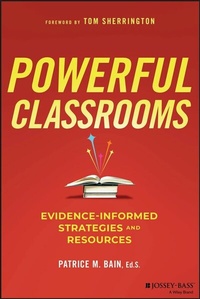
Powerful Classrooms
Description

Bring cognitive research to teaching practice with this practical toolkit
How do you introduce the science of learning to your faculty? How do you leverage professional development to ensure that teachers continually apply that science within their classrooms? How can you maximize learning in your classroom through the use of researched and evidence-informed strategies? These are the questions Patrice Bain sets out to answer in Powerful Classrooms: Evidence-informed Strategies and Resources. This book is a follow-up to Powerful Teaching, in which Bain and Pooja Agarwal unlocked the secrets to successfully applying the science of learning in classroom settings. Now, Bain seeks to share her strategies with a wider audience of educators and school administrators.
Patrice Bain is a longtime teacher and a leading voice in the science of learning. In this book, she uses easy-to-understand language to explain the latest findings from cognitive science about how humans learn best. Then, she offers practical techniques and activities for encouraging learning in any subject. Inside, you'll find:
- Clear explanations of the science of learning and how it can improve administration and classroom teaching
- Research-based practices that can be used everywhere from small-scale classrooms to large school districts
- A collection of the best articles, books, podcasts, and websites for further exploration
For administrators, instructional coaches, and teachers looking for simple yet powerful practices, adding Powerful Classrooms into your educational toolkit will enhance student success through the science of learning.
PATRICE M. BAIN, Ed.S., is an award-winning teacher and author. Her research-based teaching strategies have proven successful for thousands of students. In addition to Powerful Teaching and A Parent's Guide to Powerful Teaching, she also coauthored Organizing Instruction and Study to Improve Student Learning with the Institute of Education Sciences (IES).
More details
Other editions
Additional editions
Content
Chapter 1
How It Started
How often have we had the opportunity to be in the room, at the table, when a revolution begins? And, how often in our naivete do we simply navigate the waters, doing what needs to be done, and not realizing the enormity of what happened in that room until years later? Emerging before our eyes is a learning revolution based on cognitive science and robust research. The research began in my own classroom, and what scientists learned there is making its way around the globe.
HERE'S MY BACK STORY
My teaching career began in a small school district in southern Illinois, USA, in the early 1990s. My subject was World History, appearing in our curriculum for sixth graders for the first time. I had an incredible principal, Dr. Roger Chamberlain, who believed in encouraging his faculty to soar. I was also very fortunate to have a forward-thinking and fair superintendent, Mr. Jack Turner, and a like-minded school board. Because of their encouragement, I sought opportunities, and was rewarded by being named a Finalist for Illinois Teacher of the Year in 2000, and a European Fulbright Scholar in 2004. However, after having taught for over 12 years, enjoying opportunities stemming from teaching awards, and finishing an advanced educational degree, I was perplexed. The majority of my students received excellent grades, yet some did not. Why?
I didn't know the "how" nor the "where" of learning to answer the "why" for the differences in success between my students. Up until this time, most research on learning in the United States had been conducted at universities, in laboratories, with college students. The scholarly papers were published in academic journals and the findings were locked in ivory towers. And even though, at this time, I also served as adjunct faculty at two local universities teaching pedagogy to instructors pursuing advanced degrees, I wasn't aware this information existed. An epiphany arose: I had been taught how to teach, and I taught others how to teach, but I had no idea how we learn.
I had a serendipitous meeting with Dr. Mark McDaniel, a cognitive scientist at Washington University in St. Louis, Missouri. He was researching memory and, for the first time, I began to see a connection between learning and the science of memory formation. Could this be the link to success for the students who were not doing well? Dr. McDaniel introduced me to Dr. Henry Roediger, another cognitive scientist from Washington University. (McDaniel and Roediger are authors of a wonderful book about learning: Make It Stick.) I was not aware of their credentials nor expertise; in fact, even the term "cognitive scientist" was lost on me. To me, they were simply Mark and Roddy. (In hindsight, I shake my head at the audacity!) I remember having them over to my house in the country, enjoying a glass of wine on the porch amidst the trees, as conversations continued. I told them of my frustrations at the disconnect between teaching and learning. They discussed their research ideas. The lightbulb moment happened: they wanted to study how students learn in an authentic, public-school classroom. Would I consider a research study in my classroom? My immediate thought was that this might not only be the answers to my questions but could also benefit my underperforming students.
Many stakeholders were involved in deciding whether the study would go forward. Satisfying my district's administration, getting the community's support, and funding became steps along the path. Meetings with my school administration ensued. A question from my superintendent became my focus: Why do you want this? I answered with conviction, "I want to know how my students learn." Roediger and McDaniel obtained funding through the Institute of Education Sciences and my administration gave its approval. I obtained permission from the parents of my students, and in August 2006, we were ready to begin.
On that August day I met another researcher from Washington University, Pooja Agarwal. As we climbed the staircase to my classroom, we pondered. Where should we begin? We knew the focus of the study would be testing (which we now refer to as retrieval). There were no classroom studies for us to replicate. Many new conditions needed to be taken into account, which were nonexistent in university laboratory settings, such as fire drills, tornado drills, student absences, and the frequent interruptions of the overhead speaker: "Mrs. Bain, will you please send (student's name) to the office; he is leaving for an appointment." And, of course, because we were working with adolescents, we needed to consider how drama, divorcing parents, ill grandparents, etc., had an impact on learning. Designing research for a classroom required looking at a multitude of variables.
Since Pooja and I were in the best position to see the whole picture, we were granted the autonomy to create our ideas and take them to the Washington University cognitive scientists for their input and approval. For the first semester, 18 weeks, Agarwal was in my class daily, observing my teaching. We had weekly meetings to devise research methods. To me, this process was invaluable. I was not expected to change my teaching to fit the research design; rather, the design was of mutual respect for the research, the teaching, and the students. In January 2007, the research on retrieval (as measured and encouraged by testing) began.
Later that year, I was invited to be the sole US K-12 teacher to work with cognitive scientists, in conjunction with the Institute of Education Sciences in Washington D.C., writing Organizing Instruction and Study to Improve Student Learning.1 Once again, I had the good fortune to have a seat at the table. The recommendations emerging from this guide gave me clues for designing further experimental research with my students. For the next few years, Dr. Agarwal and I studied how spaced practice, interleaving, and feedback-driven metacognition played a role in retrieval and learning. I saw firsthand how my students flourished using the methods we studied. And I saw how they went from a simple recall of facts to deep and critical thinking; this allowed me to devise and develop strategies based upon the research.
About ten years after the research started in my classroom, I had a clear vision of exactly what our research had accomplished. Through robust research we had shown that grades, learning, and knowledge retention showed great gains using our results. I had another epiphany. It wasn't me, the teacher, making this difference. It was the research and evidence-informed methods and strategies I was using. I wanted to shout from a mountaintop: every teacher, no matter where in the world the classroom might be, could have the same success with students. People began to take notice of the research. Annie Murphy Paul spent a day in my class, observing my teaching and talking with my students for an article in Scientific American. A camera crew filmed a day in my class for a PBS (Public Broadcasting System) NOVA documentary: "The School of the Future." For several years I worked with REL (Regional Educational Lab) Mid-Atlantic giving presentations to teachers in Pennsylvania, Maryland, Delaware, and New Jersey. My co-presenters included Dr. Hal Pashler, Dr. Ken Koedinger, and Dr. Nate Kornell. I was interviewed along with Dr. Henry Roediger and one of my students, Zoe Hejna, for an NPR (National Public Radio) program. And finally, to document our story, and provide a map for others to follow, Dr. Agarwal and I published Powerful Teaching: Unleash the Science of Learning.2 The purpose of my next publication: A Parent's Guide to Powerful Teaching3 was to assist teachers in having a learning dialogue with parents and caregivers, in addition to helping families understand how learning happens and providing strategies for helping with schoolwork at home.
The learning revolution and research continue. What began in my classroom has expanded into many schools. A meta-analysis and research database can be found at Retrieval Practice.4 My bookshelves are filled with books rooted in cognitive science and the authors feel like kindred spirits. What was once tucked away in journals and ivory towers is now available to all. Each time a teacher reads a research and evidence-based book, attends professional development on the science of learning, listens to a related podcast, and incorporates the findings in the classroom, another seat is added to the table and the number of participants in this revolution increases.
And as we encounter new teaching methodologies, our new standard and duty is to ask, "On what evidence is this based?"
Little did I know that my simple question, "How do we learn?" would be answered by science-based methods that have spread globally, and have become mainstream for many. My curiosity about learning led to answers that enabled me to begin the first day of every school year with: "I'm your teacher and I'm going to teach you how to learn," because I know it works. I was in the room where it happened.
NOTES
- 1. Pashler, Harold, Patrice M. Bain, Brian A. Bottge, Arthur Graesser, Kenneth Koedinger, Mark McDaniel, and Janet Metcalf. Organizing Instruction and Study to Improve Student Learning. Washington, D.C.: National Center for Educational Research, Institute of Education Sciences...
