

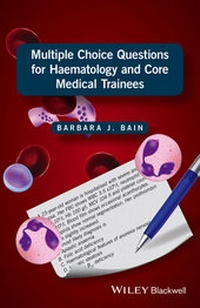
Multiple Choice Questions for Haematology and Core Medical Trainees
Description

Reviews / Votes
There may be other haematologists in the world who can write detailed single best answer and extended matching questions (SBAs, EMQs)...but I doubt that any one individual can do it as well as Barbara Bain. All questions are well-written, well-researched and include some of the very latest diagnostic and therapeutic advances... The feedback explaining the reasons for the correct answers is excellent and educational. And that is the point. This book will be a fantastic educational resource for trainees across the world but also for consultants like me who want to update their knowledge in an interactive manner. Just one health warning. Many of these questions are difficult, so no one should expect to get all the answers correct....Recommended for trainees and consultant haematologists without reservation. (British Journal of Haematology, 2016)More details
Other editions
Additional editions
Person
Content
Section 1
Single Best Answers Questions 1-50
This section comprises 50 Single Best Answer (SBA) questions. They are divided into questions 1-31, which are more relevant to the part 1 MRCP examination and questions 32-50, which are more relevant to the part 2 MRCP examination. Although having a general medical slant, these questions are also appropriate for haematology specialist trainees. Normal ranges are given in parentheses. Answers and feedback will be found on pages 101-123.
MRCP part 1 level
SBA 1
A 69-year-old Afro-Caribbean woman is referred to rheumatology outpatients because of painful joints and morning stiffness. She is found to have a minor degree of lymphadenopathy and her spleen is tipped on inspiration. An FBC shows WBC 98 × 109/l, Hb 83 g/l, platelet count 221 × 109/l, neutrophils 7.2 × 10⁹/l and lymphocytes 91 × 109/l. Her blood film shows mature small lymphocytes with scanty cytoplasm, round nuclei and coarsely clumped chromatin. Smear cells are present. Rheumatoid factor is detected and her erythrocyte sedimentation rate (ESR) is 54 mm in 1 h (<20).
The most likely diagnosis is:
- Adult T-cell leukaemia/lymphoma
- Chronic lymphocytic leukaemia
- Follicular lymphoma in leukaemic phase
- Mantle cell lymphoma
- Reactive lymphocytosis
SBA 2
A 69-year-old man who has received repeated courses of chemotherapy and chemo-immunotherapy for refractory mantle cell lymphoma presents with the gradual onset of cognitive impairment, dysphasia and dyspraxia. On lumbar puncture, pressure is normal, there is a slight increase in protein concentration, cell count is not increased and glucose is normal. Magnetic resonance imaging (MRI) of the brain shows multiple high intensity signals on T2-weighted and FLAIR sequences affecting mainly the white matter.
The most likely organism implicated is:
- BK virus
- Herpes simplex
- JC virus
- Treponema pallidum
- Varicella-zoster virus
SBA 3
A 49-year-old woman is admitted to the intensive care ward with septic shock. Her FBC shows WBC 18 × 109/l, Hb 83 g/l, platelet count 150 × 109/l, neutrophils 17.2 × 10⁹/l and lymphocytes 0.5 × 10⁹/l. Her blood film shows toxic granulation and left shift.
The appropriate haemoglobin threshold for blood transfusion in this patient would be:
- 60 g/l
- 70 g/l
- 80 g/l
- 90 g/l
- 100 g/l
SBA 4
A 23-year-old woman is hospitalised with severe anorexia nervosa. Her FBC shows WBC 3.5 × 10⁹/l, neutrophil count 1.1 × 10⁹/l, Hb 100 g/l, MCV 104 fl and platelet count 70 × 109/l. Blood film shows occasional acanthocytes. Neutrophils show normal segmentation. Her prothrombin time (PT) is slightly increased.
The most likely diagnosis is:
- Aplastic anaemia
- Folic acid deficiency
- Haematological features of anorexia nervosa
- Hepatic steatosis
- Vitamin B12 deficiency
SBA 5
A 60-year-old Cypriot woman is referred back to rheumatology outpatients as she has suffered a flare of her rheumatoid arthritis. Her FBC shows WBC 12.0 × 10⁹/l, RBC 3.62 × 10¹²/l, Hb 83 g/l, Hct 0.27 l/l, MCV 74 fl, MCHC 310 g/l, platelet count 441 × 109/l and neutrophils 9.2 × 10⁹/l. Her blood film shows increased rouleaux formation and the ESR is 65 mm in 1 h (<20). Serum ferritin is 47 µg/l (14-200), serum iron is 6 µmol/l (11-28) and total iron binding capacity 65 µmol/l (45-75).
The most likely explanation of the microcytic anaemia is:
- a thalassaemia trait
- Anaemia of chronic disease
- Anaemia of chronic disease plus iron deficiency
- ß thalassaemia trait
- Iron deficiency
SBA 6
A 60-year-old Caucasian man presents with a history of fatigue, nausea, abdominal discomfort, altered bowel function, insomnia, anxiety and altered taste. He is a self-employed painter and decorator with a past history of a coronary artery bypass and is taking atorvastatin. His FBC shows WBC 7.8 × 10⁹/l, Hb 105 g/l, Hct 0.30 l/l, MCV 79 fl, MCH 27.6 pg, MCHC 350 g/l, red cell distribution width (RDW) 15% (9.5-15.5), platelet count 403 × 109/l and reticulocyte count 120 × 109/l. His blood film shows anisocytosis, polychromasia, basophilic stippling and occasional nucleated red blood cells and myelocytes. A bone marrow aspirate shows dyserythropoiesis with abnormal sideroblasts including 3% ring sideroblasts.
The most likely diagnosis is:
- Lead poisoning
- Myelodysplastic syndrome (refractory anaemia)
- Myelodysplastic syndrome (refractory anaemia with ring sideroblasts)
- Pyrimidine 5´ nucleotidase deficiency
- Zinc deficiency
SBA 7
A 57-year-old man with a history of hypercholesterolaemia, heart failure and atrial fibrillation is on warfarin with a satisfactory international normalised ratio (INR). He presents with the sudden onset of marked swelling of the left leg and thigh with pain in his foot and calf. Within a short period of time, the distal foot become purplish blue and cold with no palpable pulses in the leg.
The most likely diagnosis is:
- Embolisation from the left atrium
- Femoral artery thrombosis
- Plegmasia alba dolens
- Plegmasia caerulea dolens
- Worsening heart failure
SBA 8
A 32-year-old woman with a history of irritable bowel syndrome is found to have iron deficiency anaemia and a serum folate of 1 µg/l (2-11). Her serum vitamin B12 is normal. Her diet is assessed as nutritionally adequate, although she says she has to 'watch what she eats'.
The test you would do next is:
- Antibodies to deamidated gliadin peptide
- Antiendomysial antibodies
- Antiendomysial antibodies, making sure that the patient is first on a gluten-free diet
- Duodenal biopsy
- Ig (immunoglobulin) A anti-tissue transglutaminase antibodies
SBA 9
A 23-year-old African man who presents with an epileptiform convulsion and fever is found to have a microangiopathic haemolytic anaemia, thrombocytopenia and acute kidney injury.
The micro-organism you would test for is:
- Escherichia coli O104:H4
- Escherichia coli O157:H7
- Hepatitis B
- Human herpesvirus 8
- Human immunodeficiency virus
SBA 10
An 18-year-old medical student is permitted to perform an unsupervised venepuncture on a febrile Indian patient and suffers a needle prick injury. He is anxious that he may have contracted human immunodeficiency virus (HIV) infection.
Assuming that the patient is infected, transmission is most likely for:
- Dengue fever
- Hepatitis B
- Hepatitis C
- Human immunodeficiency virus (HIV)
- Leishmaniasis
SBA 11
A 39-year-old woman presents with haemoptysis and is found to have a pulmonary arteriovenous malformation. She is also noted to be pale and to have telangiectasia of the lips and tongue. There are no other abnormal physical findings. A full blood count shows WBC 7.2 × 10⁹/l, RBC 3.10 × 10¹²/l, Hb 70 g/l, Hct 0.23 l/l, MCV 75.6 fl, MCH 23.8 pg, MCHC 315 g/l and platelet count 221 × 109/l.
The most likely underlying diagnosis is:
- Acquired von Willebrand disease
- Advanced liver disease
- CREST variant of scleroderma (calcinosis, Raynaud phenomenon, (o)esophageal dysmotility, sclerodactyly, telangiectasia)
- Hereditary haemorrhagic telangiectasia
- Heyde syndrome
SBA 12
A 29-year-old man suffered a road traffic accident in West Africa and required a splenectomy. A few weeks after his return to the UK he presents with chills, fever, myalgia and vomiting. He is found to be hypotensive with no localising signs. His FBC shows WBC 18 × 109/l, Hb 177 g/l, platelet count 98 × 109/l, neutrophils 17.2 × 10⁹/l and lymphocytes 0.6 × 10⁹/l. His blood film shows toxic granulation and left shift. No malaria parasites are seen on thick film examination. A coagulation screen shows a prolonged activated partial thromboplastin time (APTT) and increased D dimers.
The lost likely cause of the fever is infection by:
- Capnocytophaga canimorsus
- Haemophilus influenza type b
- Neisseria meningitidis
- Plasmodium falciparum
- Streptococcus pneumonia
SBA 13
A 52-year-old man with poor prognosis acute myeloid leukaemia achieves a complete remission with daunorubicin and cytarabine. He then receives an allogeneic haemopoietic stem cell transplant from a matched unrelated donor after conditioning with busulphan and cyclophosphamide. He receives methotrexate and tacrolimus for graft-versus-host disease prophylaxis. A week after transplantation he complains of abdominal pain and is found to have a tender liver, weight gain, oedema and ascites. His bilirubin has risen to 35 µmol/l (<17) and alanine aminotransferase is twice the upper limit of normal. Creatinine has risen to 132 µmol/l (60-125).
The most likely...
