

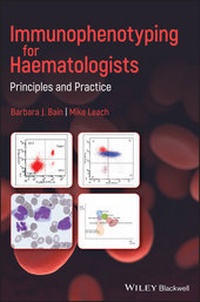
Immunophenotyping for Haematologists
Description

Written by two well-known haematology educators and experts on the topic, Immunophenotyping for Haematologists contains an introduction to running, reporting and interpreting immunophenotyping studies. The book offers a unique approach to the topic by putting the focus on clinical and laboratory haematologists who are not routinely involved in running and reporting on immunophenotyping studies.
Immunophenotyping using flow cytometry has become the method of choice in identifying and sorting cells within complex populations, for example, the analysis of immune or neoplastic cells in a blood sample. The text reviews the purpose and principles of immunophenotyping and includes an introduction and explanation of the principles and the role of immunophenotyping. The authors examine immunophenotypic characteristics of the disease groups commonly encountered and identify the features that differentiate malignant cells from normal cells. To enhance understanding, the book contains multiple choice and extended matching questions which integrates immunophenotyping with clinicopathological features and the results of other investigations to mimic everyday practice. This important book:
* Provides a concise introduction to running, reporting and interpreting immunophenotyping studies
* Contains a list of all the antibody specificities currently widely used in diagnosis and disease monitoring
* Presents an ideal reference for use in laboratories, including immunophenotyping laboratories
* Aids in the interpretation by covering immunophenotypic characteristics of commonly encountered disease groups
* Identifies the features that differentiate malignant cells from their normal counterparts
Written for haematologists working in both laboratory and clinical haematology, Immunophenotyping for Haematologists is a much-needed reference for understanding and interpreting immunophenotyping studies.
More details
Other editions
Additional editions
Persons
Barbara J. Bain, MB BS, FRACP, FRCPath, AM, is Professor of Diagnostic Haematology, St Mary's Hospital Campus, Imperial College Faculty of Medicine and Consultant Haematologist, St Mary's Hospital, London, UK.
Mike Leach, MB ChB, FRCP, FRCPath is Consultant Haematologist and Honorary Senior Lecturer, Haematology Laboratories and West of Scotland Cancer Centre, Gartnavel General Hospital, Glasgow, UK.
Content
Preface and Acknowledgement vii
Abbreviations Used in the Book ix
Part 1 Purpose and Principles of Immunophenotyping 1
Part 2 Immunophenotyping for Haematologists 11
Part 3 Immunophenotyping in the Diagnosis and Monitoring of Haematological Neoplasms and Related Conditions with Tables and Figures for Quick Reference 47
Part 4 Test Yourself 89
Index 127
