

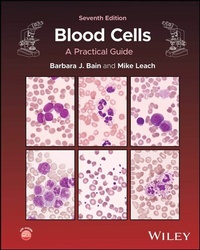
Blood Cells
Description

A comprehensive guide to blood cell morphology and interpretation, fully updated throughout
Understanding blood cell morphology and interpreting blood counts accurately is essential for both haematologists and biomedical scientists. This meticulously updated and comprehensive seventh edition of Blood Cells: A Practical Guide combines expert guidance with high-quality imaging. This edition introduces new clinical images to enhance the contextual understanding of haematological findings, alongside the latest WHO and International Consensus classifications of haematological neoplasms.
Blood Cells: A Practical Guide bridges the gap between laboratory science and clinical application, covering essential techniques such as specimen collection, blood film preparation and staining. The authors also discuss the principles of manual and automated blood counts, as well as abnormalities in blood counts and films within a clinical context. With up-to-date advice on additional tests to aid diagnosis, this new edition reinforces the importance of microscopy whilst addressing the evolving demands of laboratory and clinical haematology.
Designed as both a reference for practising haematologists and a bench manual for trainees, Blood Cells: A Practical Guide:
- Features new high-quality clinical and morphological images to enhance blood cell identification and interpretation
- Highlights potential pitfalls and spurious results in haematological analysis to improve diagnostic accuracy
- Offers a self-assessment component with multiple choice questions (MCQs) and extended matching questions (EMQs) available online
- Is written by leading experts with decades of experience in diagnostic haematology and blood cell morphology
Blood Cells: A Practical Guide remains an indispensable resource for those dedicated to the study and practice of haematology, such as haematologists, clinical scientists, and biomedical scientists at all levels. It also serves as a valuable reference for diagnostic haematology courses and laboratory training programmes in medical and biomedical science degrees.
More details
Other editions
Additional editions
Previous edition
Persons
Barbara J. Bain is a renowned haematologist with over 50 years of experience in clinical and laboratory haematology. She is Professor Emerita of Diagnostic Haematology at Imperial College London and Honorary Consultant Haematologist at St Mary's Hospital, London. She has contributed to the WHO Classification of Tumours of Haemopoietic and Lymphoid Tissues and has authored numerous influential publications in the field.
Mike Leach is a Consultant Haematologist at the Beatson West of Scotland Cancer Centre and Gartnavel General Hospital. With a strong focus on diagnostic haematopathology, he has extensive expertise in blood film morphology and haematological disease. As an Honorary Senior Lecturer, he is actively involved in the education and training of future haematologists and laboratory scientists.
Content
Preface, vi
Acknowledgements, vii
List of abbreviations, viii
About the companion website, x
1 Blood sampling and blood film preparation and examination, 1
2 Performing a blood count, 18
3 Morphology of blood cells, 65
4 Detecting erroneous blood counts, 204
5 Normal ranges, 229
6 Quantitative changes in blood cells, 252
7 Important supplementary tests, 315
8 Disorders of red cells and platelets, 330
9 Disorders of white cells, 487
Index, 570
