

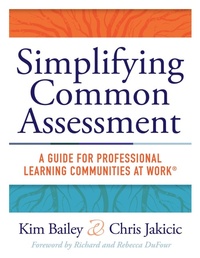
Simplifying Common Assessment
Description

Built on the process featured in Common Formative Assessment: A Toolkit for PLCs at Work(TM), this book demonstrates how educators can develop effective and efficient assessments. The authors simplify assessment development to give teacher teams the confidence to write and use team-designed common formative assessments that help ensure all students master essential skills and concepts. Design tasks and assessments that feature the greater rigor and complexity the new standards require. Use assessment data to make adjustments that increase student learning. Explore possible team structures and practices that foster successful use of common assessments.
Benefits
• Learn the different purposes that wide-angle questions and close-up questions serve in reaching assessment goals.
• Understand different types of assessments and what the data gained from each of them can reveal about student learning.
• Frame assessment and feedback methods to pursue the end goal of learning for all.
• Use templates and protocols to unwrap essential learning standards, create performance tasks, plan appropriate assessments, and analyze data.
• Discover a road map that can help guide your work with common assessments.
Contents
1 Framing the Power of Assessment in Professional Learning Communities
2 Starting With the End in Mind
3 Considering Rigor and Complexity
4 Intentionally Planning of Instruction and Assessment
5 Writing Questions That Work
6 Using Data to Support Student Learning
7 Focusing on Feedback and Grappling With Grading
8 Using Common Formative Assessments in Less Traditional Settings
Appendix Road Map for Implementing Common Assessments
More details
Other editions
Additional editions
Content
- Intro
- Acknowledgments
- Table of Contents
- About the Authors
- Foreword
- Introduction
- Chapter 1
- Chapter 2
- Chapter 3
- Chapter 4
- Chapter 5
- Chapter 6
- Chapter 7
- Chapter 8
- Epilogue
- Appendix
- References and Resources
- Index
