

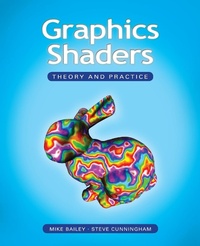
Graphics Shaders
Theory and Practice
Published on 22. April 2009
420 pages
978-1-4398-9411-8 (ISBN)
Description

Programmable graphics shaders, programs that can be downloaded to a graphics processor (GPU) to carry out operations outside the fixed-function pipeline of earlier standards, have become a key feature of computer graphics. This book is designed to open computer graphics shader programming to the student, whether in a traditional class or on their o
Reviews / Votes
Bailey and Cunningham provide a comprehensive, well-written overview of graphics shaders. ... Although the book uses the OpenGL Shading Language (GLSL) for its examples, it gives enough theoretical background for readers to learn the fundamentals for any graphics language. ... The book also addresses scientific visualization and the GLSL API to call GLSL functions from an OpenGL program. A final chapter offers ideas for using shaders in very entertaining ways. ... Highly recommended. [Appropriate for] graduate students through professionals/practitioners in computer graphics.-C. Tappert, CHOICE, December 2009
... a pick for any college-level, advanced computer library catering to programming professionals. ... discusses different types of shaders, how to use the glman program for free, and how to blend shaders into an interactive game environment. Libraries will find it a powerful, appealing lend for intermediate programmers seeking extra spice for their projects.
-Midwest Book Review, August 2009 Bailey and Cunningham provide a comprehensive, well-written overview of graphics shaders. ... Although the book uses the OpenGL Shading Language (GLSL) for its examples, it gives enough theoretical background for readers to learn the fundamentals for any graphics language. ... The book also addresses scientific visualization and the GLSL API to call GLSL functions from an OpenGL program. A final chapter offers ideas for using shaders in very entertaining ways. ... Highly recommended. [Appropriate for] graduate students through professionals/practitioners in computer graphics.
-C. Tappert, CHOICE, December 2009
... a pick for any college-level, advanced computer library catering to programming professionals. ... discusses different types of shaders, how to use the glman program for free, and how to blend shaders into an interactive game environment. Libraries will find it a powerful, appealing lend for intermediate programmers seeking extra spice for their projects.
-Midwest Book Review, August 2009
More details
Language
English
Place of publication
Florida
United States
Publishing group
Taylor & Francis Inc
Target group
College/higher education
File size
11,70 MB
ISBN-13
978-1-4398-9411-8 (9781439894118)
Copyright in bibliographic data and cover images is held by Nielsen Book Services Limited or by the publishers or by their respective licensors: all rights reserved.
Schweitzer Classification
Other editions
Additional editions
Book
04/2009
1st Edition
A K Peters
€97.98
Article exhausted; check different version
Persons
Mike Bailey, Oregon State University, Corvallis, USA
Steve Cunningham, Professor Emeritus, California State University Stanislaus, USA
Steve Cunningham, Professor Emeritus, California State University Stanislaus, USA
Content
The Fixed-Function Graphics Pipeline. Fundamental Shader Concepts. Using glman. The GLSL Shader Language. Lighting. Vertex Shaders. Fragment Shaders and Surface Appearance. Texture Mapping in Fragment Shaders. Noise. Image Manipulation with Shaders. Geometry Shader Concepts and Examples. The OpenGL API. Using Shaders for Scientific Visualization. Serious Fun. References. Index.
