

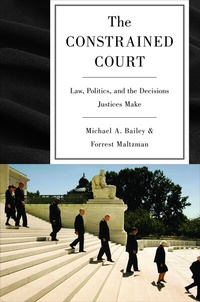
The Constrained Court
Law, Politics, and the Decisions Justices Make
1st Edition
Published on 16. June 2015
216 pages
978-1-4008-4026-7 (ISBN)
Description

How do Supreme Court justices decide their cases? Do they follow their policy preferences? Or are they constrained by the law and by other political actors? The Constrained Court combines new theoretical insights and extensive data analysis to show that law and politics together shape the behavior of justices on the Supreme Court.
Michael Bailey and Forrest Maltzman show how two types of constraints have influenced the decision making of the modern Court. First, Bailey and Maltzman document that important legal doctrines, such as respect for precedents, have influenced every justice since 1950. The authors find considerable variation in how these doctrines affect each justice, variation due in part to the differing experiences justices have brought to the bench. Second, Bailey and Maltzman show that justices are constrained by political factors. Justices are not isolated from what happens in the legislative and executive branches, and instead respond in predictable ways to changes in the preferences of Congress and the president.
The Constrained Court shatters the myth that justices are unconstrained actors who pursue their personal policy preferences at all costs. By showing how law and politics interact in the construction of American law, this book sheds new light on the unique role that the Supreme Court plays in the constitutional order.
Michael Bailey and Forrest Maltzman show how two types of constraints have influenced the decision making of the modern Court. First, Bailey and Maltzman document that important legal doctrines, such as respect for precedents, have influenced every justice since 1950. The authors find considerable variation in how these doctrines affect each justice, variation due in part to the differing experiences justices have brought to the bench. Second, Bailey and Maltzman show that justices are constrained by political factors. Justices are not isolated from what happens in the legislative and executive branches, and instead respond in predictable ways to changes in the preferences of Congress and the president.
The Constrained Court shatters the myth that justices are unconstrained actors who pursue their personal policy preferences at all costs. By showing how law and politics interact in the construction of American law, this book sheds new light on the unique role that the Supreme Court plays in the constitutional order.
All prices
More details
Edition
Course Book
Language
English
Place of publication
Princeton, NJ
United States
Publishing group
De Gruyter
Target group
Professional and scholarly
Edition type
Digital original
Product notice
Reflowable
Illustrations
28 halftones. 20 line illus. 12 tables.
File size
0,61 MB
ISBN-13
978-1-4008-4026-7 (9781400840267)
Schweitzer Classification
Other editions
Additional editions
Michael A. Bailey | Forrest Maltzman
The Constrained Court
Law, Politics, and the Decisions Justices Make
Book
09/2011
1st Edition
Princeton University Press
€76.75
Article exhausted; check different version
Michael A. Bailey | Forrest Maltzman
The Constrained Court
Law, Politics, and the Decisions Justices Make
Book
09/2011
1st Edition
Princeton University Press
€36.50
Shipment within 10-20 days
Persons
Michael A. Bailey is the Colonel William J. Walsh Professor in the Department of Government and Institute for Public Policy at Georgetown University. Forrest Maltzman is professor of political science at George Washington University. He is the author of Competing Principals and the coauthor of Crafting Law on the Supreme Court and Advice and Dissent.
Content
Preface ix
Chapter 1. Introduction 1
Chapter 2. The Measure of Law: Estimating Preferences across Institutions and Time 17
Part I. Legal Value Constraints
Chapter3. Disentangling Law and Policy Preferences 47
Chapter 4. Law Matters 64
Chapter 5. Causes and Consequences of Diverse Legal Values 80
Part II. Political Constraints
Chapter 6. Separation of Powers and the Strategic Constraint 95
Chapter 7. Signals from the Executive 121
Chapter 8. Conclusion 140
Appendix. Statistical Details 156
Notes 175
References 185
Index 203
Chapter 1. Introduction 1
Chapter 2. The Measure of Law: Estimating Preferences across Institutions and Time 17
Part I. Legal Value Constraints
Chapter3. Disentangling Law and Policy Preferences 47
Chapter 4. Law Matters 64
Chapter 5. Causes and Consequences of Diverse Legal Values 80
Part II. Political Constraints
Chapter 6. Separation of Powers and the Strategic Constraint 95
Chapter 7. Signals from the Executive 121
Chapter 8. Conclusion 140
Appendix. Statistical Details 156
Notes 175
References 185
Index 203

