
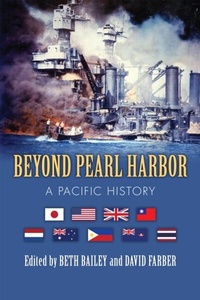
Beyond Pearl Harbor
Description
Alles über E-Books | Antworten auf Fragen rund um E-Books, Kopierschutz und Dateiformate finden Sie in unserem Info- & Hilfebereich.
In the United States, December 7, 1941, may live in infamy, in President Franklin D. Roosevelt's phrase, but for most Americans the date's significance begins and ends with the attack on Pearl Harbor. On December 8 (December 7 on the other side of the International Date Line) Japanese military forces hit eight major targets, all but one on western colonial possessions and military outposts in the Pacific: Kota Bharu on the northeast coast of Malaya (now Malaysia); Thailand, the one site not claimed by a western power; Pearl Harbor, O'ahu; Singapore, key to the defense of Britain's Asian empire; Guam, the only island in the Mariana chain not controlled by Japan; Wake Island; Hong Kong; and the Philippines. Told from multiple perspectives, the stories of these attacks reveal the arc of imperialism, colonialism, and burgeoning nationalism in the Pacific world.
In Beyond Pearl Harbor renowned scholars hailing from four continents and representing six nations reinterpret the meaning of the coordinated, and devastating, attacks of December 7/8, 1941. Working from a variety of angles, they revise and expand, to an unprecedented extent, what we understand about these events?in particular, how Japan's overwhelming, if short-lived, victories contributed to emerging solidarities and nationalist identities within and across Pacific societies. In their essays we see how various elite actors incorporated the attacks into new regimes of knowledge and expertise that challenged and displaced existing hierarchies. Extending far beyond Pearl Harbor, the events of December 1941, as we see in this volume, are part of a story of clashing empires and anti-colonial visions?a story whose outcome, even now, remains to be seen.
All prices
More details
Other editions
Additional editions
Content
Introduction: December 7/8, 1941, Beth Bailey and David Farber
Prologue, Beth Bailey
1. The Attack on Pearl Harbor . . . and Guam, Wake Island, Philippines, Thailand, Malaya, Singapore, and Hong Kong: December 7/8, the Pacific World, American Empire, and the American Political Imaginary, Beth Bailey and David Farber
2. ?American Lives?: Pearl Harbor and the War in the US Empire, David Immerwahr
3. Japan and the Spirit of December 8, Jeremy A. Yellen
4. Popular Japanese Responses to the Pearl Harbor Attack: December 8, 1941 to January 8, 1942, Samuel Hideo Yamashita
5. Identities and Alliances: China's Place in the World after Pearl Harbor, 1941-1945, Rana Mitter
6. Worldly Medicine in Wartime China: An Exploration of Pearl Harbor's Unintended Consequences, Nicole Elizabeth Barne
7. Pearl Harbor and the Asian Cultural Turn, Ethan Mark
8. The Philippines and the Politics of Anticipation, Christopher Capozzola
9. Pearl Harbor and Australia's War in the Pacific, Kate Darian-Smith
10. Tolerance, Reconciliation, and Alliance of Hope: Pearl Harbor Narratives in Japan, Yujin Yaguchi
Notes on Contributors
Index

System requirements
File format: ePUB
Copy protection: Adobe-DRM (Digital Rights Management)
System requirements:
- Computer (Windows; MacOS X; Linux): Install the free reader Adobe Digital Editions prior to download (see eBook Help).
- Tablet/smartphone (Android; iOS): Install the free app Adobe Digital Editions or the app PocketBook before downloading (see eBook Help).
- E-reader: Bookeen, Kobo, Pocketbook, Sony, Tolino and many more (not Kindle).
The file format ePub works well for novels and non-fiction books – i.e., „flowing” text without complex layout. On an e-reader or smartphone, line and page breaks automatically adjust to fit the small displays.
This eBook uses Adobe-DRM, a „hard” copy protection. If the necessary requirements are not met, unfortunately you will not be able to open the eBook. You will therefore need to prepare your reading hardware before downloading.
Please note: We strongly recommend that you authorise using your personal Adobe ID after installation of any reading software.
For more information, see our ebook Help page.
File format: PDF
Copy-Protection: Adobe-DRM (Digital Rights Management)
System requirements:
- Computer (Windows; MacOS X; Linux): Install the free reader Adobe Digital Editions prior to download (see eBook Help).
- Tablet/smartphone (Android; iOS): Install the free app Adobe Digital Editions or the app PocketBook before downloading (see eBook Help).
- E-reader: Bookeen, Kobo, Pocketbook, Sony, Tolino and many more (only limited: Kindle).
The file format PDF always displays a book page identically on any hardware. This makes PDF suitable for complex layouts such as those used in textbooks and reference books (images, tables, columns, footnotes). Unfortunately, on the small screens of e-readers or smartphones, PDFs are rather annoying, requiring too much scrolling.
This eBook uses Adobe-DRM, a „hard” copy protection. If the necessary requirements are not met, unfortunately you will not be able to open the eBook. You will therefore need to prepare your reading hardware before downloading.
Please note: We strongly recommend that you authorise using your personal Adobe ID after installation of any reading software.
For more information, see our eBook Help page.
File format: ePUB
Copy protection: Watermark-DRM (Digital Rights Management)
System requirements:
- Computer (Windows; MacOS X; Linux): Use a reading software that can process the file format ePUB: e.g., Adobe Digital Editions or FBReader – both free (see eBook Help).
- Tablet/Smartphone (Android; iOS): Before downloading, install the free app Adobe Digital Editions (see eBook Help).
- E-reader: Bookeen, Kobo, Pocketbook, Sony, Tolino and many more (not Kindle).
The file format ePUB works well for novels and non-fiction books – i.e., „flowing” text without complex layout. On an e-reader or smartphone, line and page breaks automatically adjust to fit the small displays.
This eBook uses Watermark-DRM, a „soft” copy protection. This means that there are no technical restrictions to prevent illegal distribution. However, there is a personalised watermark embedded in the eBook that can be used to identify the purchaser of the eBook in the event of misuse and to provide evidence for legal purposes.
For more information, see our eBook Help page.
