
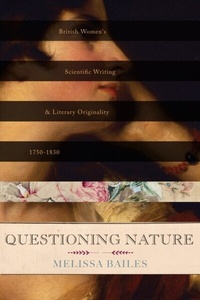
Questioning Nature
Description
Alles über E-Books | Antworten auf Fragen rund um E-Books, Kopierschutz und Dateiformate finden Sie in unserem Info- & Hilfebereich.
In the mid-eighteenth century, many British authors and literary critics anxiously claimed that poetry was in crisis. These writers complained that modern poets plagiarized classical authors as well as one another, asserted that no new subjects for verse remained, and feared poetry's complete exhaustion. Questioning Nature explores how major women writers of the era-including Mary Shelley, Anna Barbauld, and Charlotte Smith-turned in response to developing disciplines of natural history such as botany, zoology, and geology.
Recognizing the sociological implications of inquiries in the natural sciences, these authors renovated notions of originality through natural history while engaging with questions of the day. Classifications, hierarchies, and definitions inherent in natural history were appropriated into discussions of gender, race, and nation. Further, their concerns with authorship, authority, and novelty led them to experiment with textual hybridities and collaborative modes of originality that competed with conventional ideas of solitary genius.
Exploring these authors and their work, Questioning Nature explains how these women writers' imaginative scientific writing unveiled a new genealogy for Romantic originality, both shaping the literary canon and ultimately leading to their exclusion from it.
All prices
More details
Other editions
Additional editions
Person
Melissa Bailes is Assistant Professor of English at Tulane University.
Content
Introduction: Questioning Science, Questioning Originality
1. To Teach and to Please: Anna Barbauld's Original Poetry and Educational Prose of Natural History
2. Hybrid Britons: West Indian Colonial Identity and Georgic Originality in Maria Riddell's Natural History
3. The Evolution of the Plagiarist: Natural History in Anna Seward's Order of Poetics
4. Plagiarism and the Poet-Naturalist: Charlotte Smith's Collective Originality
5. Translating Cosmpolitanism: Revolution in Helen Maria Williams's Geopolitcal Nature
6. Reconstructing Origins: The Psychologization of Geological Catastrophe in Mary Shelley's The Last Man
Conclusion: Felicia Hemans, Geological Bodies, and the Fate of Originality
Notes
Bibliography
Index

System requirements
File format: ePUB
Copy protection: Adobe-DRM (Digital Rights Management)
System requirements:
- Computer (Windows; MacOS X; Linux): Install the free reader Adobe Digital Editions prior to download (see eBook Help).
- Tablet/smartphone (Android; iOS): Install the free app Adobe Digital Editions or the app PocketBook before downloading (see eBook Help).
- E-reader: Bookeen, Kobo, Pocketbook, Sony, Tolino and many more (not Kindle).
The file format ePub works well for novels and non-fiction books – i.e., „flowing” text without complex layout. On an e-reader or smartphone, line and page breaks automatically adjust to fit the small displays.
This eBook uses Adobe-DRM, a „hard” copy protection. If the necessary requirements are not met, unfortunately you will not be able to open the eBook. You will therefore need to prepare your reading hardware before downloading.
Please note: We strongly recommend that you authorise using your personal Adobe ID after installation of any reading software.
For more information, see our ebook Help page.
File format: PDF
Copy-Protection: Adobe-DRM (Digital Rights Management)
System requirements:
- Computer (Windows; MacOS X; Linux): Install the free reader Adobe Digital Editions prior to download (see eBook Help).
- Tablet/smartphone (Android; iOS): Install the free app Adobe Digital Editions or the app PocketBook before downloading (see eBook Help).
- E-reader: Bookeen, Kobo, Pocketbook, Sony, Tolino and many more (only limited: Kindle).
The file format PDF always displays a book page identically on any hardware. This makes PDF suitable for complex layouts such as those used in textbooks and reference books (images, tables, columns, footnotes). Unfortunately, on the small screens of e-readers or smartphones, PDFs are rather annoying, requiring too much scrolling.
This eBook uses Adobe-DRM, a „hard” copy protection. If the necessary requirements are not met, unfortunately you will not be able to open the eBook. You will therefore need to prepare your reading hardware before downloading.
Please note: We strongly recommend that you authorise using your personal Adobe ID after installation of any reading software.
For more information, see our eBook Help page.
File format: ePUB
Copy protection: without DRM (Digital Rights Management)
System requirements:
- Computer (Windows; MacOS X; Linux): Use a reader that can handle the file format ePUB, such as Adobe Digital Editions or FBReader – both free (see eBook Help).
- Tablet/Smartphone (Android; iOS): Install the free app Adobe Digital Editions or the app PocketBook (see eBook Help).
- E-reader: Bookeen, Kobo, Pocketbook, Sony, Tolino and many more (not Kindle).
The file format ePUB works well for novels and non-fiction books – i.e., 'flowing' text without complex layout. On an e-reader or smartphone, line and page breaks automatically adjust to fit the small displays.
This eBook does not use copy protection or Digital Rights Management
For more information, see our eBook Help page.
