

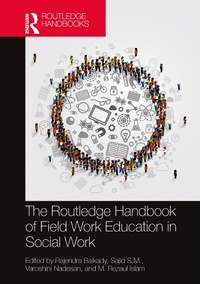
The Routledge Handbook of Field Work Education in Social Work
1st Edition
Published on 28. April 2022
616 pages
978-1-000-54094-9 (ISBN)
Description

This Handbook provides an authoritative account of international fieldwork education in social work. It presents an overview of advances in research in social work field education through in-depth analyses and global case studies.
Key features:
Discusses critical issues in teaching social work and curriculum development; health care social work; stimulated learning; field education policies; needs, challenges, and solutions in fieldwork education; reflexivity training; creativity and partnership; resilience enhancement; integrated and holistic education for social workers; student experience; practice education; and ethical responsibility of social work field instructors
Covers social work field education across geographical regions (Asia and the Pacific; North and South America; Australia and Oceania; Europe) and major themes and trends from several countries (U.S.A.; Canada; Australia; China; Hong Kong; Sweden; Aotearoa New Zealand; England; Ukraine; Spain; Estonia; Italy; Ireland; Slovenia; Poland; Romania; Greece; Norway; Turkey; and the Czech Republic)
Brings together international comparative perspectives on fieldwork education in social work from leading experts and social work educators
This Handbook will be an essential resource for scholars and researchers of social work, development studies, social anthropology, sociology, and education. It will also be useful to educators and practitioners of social work in global institutions of higher studies as well as civil society organisations.
Key features:
Discusses critical issues in teaching social work and curriculum development; health care social work; stimulated learning; field education policies; needs, challenges, and solutions in fieldwork education; reflexivity training; creativity and partnership; resilience enhancement; integrated and holistic education for social workers; student experience; practice education; and ethical responsibility of social work field instructors
Covers social work field education across geographical regions (Asia and the Pacific; North and South America; Australia and Oceania; Europe) and major themes and trends from several countries (U.S.A.; Canada; Australia; China; Hong Kong; Sweden; Aotearoa New Zealand; England; Ukraine; Spain; Estonia; Italy; Ireland; Slovenia; Poland; Romania; Greece; Norway; Turkey; and the Czech Republic)
Brings together international comparative perspectives on fieldwork education in social work from leading experts and social work educators
This Handbook will be an essential resource for scholars and researchers of social work, development studies, social anthropology, sociology, and education. It will also be useful to educators and practitioners of social work in global institutions of higher studies as well as civil society organisations.
Reviews / Votes
'Fieldwork is a key component of social work education and so a book that introduces students, practitioners, and academics to fieldwork with a global lens is timely and extremely welcomed. Introducing the readers to current practices and concerns from Europe, North and South America, Australia, and Oceania this handbook gathers key issues shared by the international community to provide effective and innovative fieldwork. As an international profession it is crucial that social work students receive up to date, relevant and innovative information that will inform their training and their future practice and to make connections with the global community of social workers and link its practice with current thinking and debates. As this book includes voices from many countries and perspectives it invites readers to think both locally and globally about undertaking the linkage of practice with theory as a crucial element of fieldwork. Informed by theory and evidence-based practice this timely and much need book identifies the challenges and its future directions. In pursuit of social justice practice this book makes an important contribution to 21st-century fieldwork for the education of social workers across the globe. I thoroughly recommend its inclusion into the global and national social work curricula.'Carolyn Noble, Professor of Social Work, Australian College of Applied Psychology, Sydney, Australia
'This Handbook is an impressive and important contribution to promote sustainable futures of field work education. It actualises the complexity of becoming social worker across entangled local, national, and global contexts. The reading awakened memories and questions from my own field placement as a student and teacher for international field work education. How had textbooks prepared me to work towards anti-oppression, capacity building, hope and creativity? What did I know about the geopolitical history of my place(ment)? How could I practice critical reflexivity to un-learn privilege and change oppressive structures? This book demonstrates the richness and multiple forms of social work, where structural privilege and marginalization, but also resistance and innovation, shapes spaces for field work education. As a contribution to global social work education, I warmly recommend it to be read through the lens of glocality, a fusion of local and global, that promotes seeing the many contributions as interlinked across communities and regions in the world.'
Mona B. Livholts, Professor of Social Work, University of Helsinki, Finland; Executive Board Member European Association of Schools of Social Work, EASSW
More details
Edition
1. Auflage
Language
English
Place of publication
London
United Kingdom
Publishing group
Taylor & Francis Ltd
Target group
College/higher education
Illustrations
40 Tables, black and white; 36 Line drawings, black and white; 36 Illustrations, black and white
ISBN-13
978-1-000-54094-9 (9781000540949)
Copyright in bibliographic data and cover images is held by Nielsen Book Services Limited or by the publishers or by their respective licensors: all rights reserved.
Schweitzer Classification
Other editions
Additional editions
Rajendra Baikady | Sajid S. M. | Varoshini Nadesan
The Routledge Handbook of Field Work Education in Social Work
Book
01/2024
1st Edition
Routledge India
€71.00
Shipment within 10-20 days
Rajendra Baikady | Sajid S. M. | Varoshini Nadesan
The Routledge Handbook of Field Work Education in Social Work
Book
04/2022
1st Edition
Routledge India
€315.40
Shipment within 10-20 days
Persons
Rajendra Baikady is U.R.C. Special Post-Doctoral Fellow and Senior Research Associate at the Department of Social Work and Community Development, University of Johannesburg, South Africa.
Sajid S.M. is a senior social work educator and Professor of Social Work at Jamia Millia Islamia, New Delhi, India.
Varoshini Nadesan is Lecturer and Postgraduate Supervisor at the Department of Social Work and Community Development, Faculty of Humanities, University of Johannesburg, South Africa.
M. Rezaul Islam is Professor in Social Work at the Institute of Social Welfare and Research, University of Dhaka, Bangladesh.
Sajid S.M. is a senior social work educator and Professor of Social Work at Jamia Millia Islamia, New Delhi, India.
Varoshini Nadesan is Lecturer and Postgraduate Supervisor at the Department of Social Work and Community Development, Faculty of Humanities, University of Johannesburg, South Africa.
M. Rezaul Islam is Professor in Social Work at the Institute of Social Welfare and Research, University of Dhaka, Bangladesh.
Content
Introduction: Signature Pedagogy - A Practice Laboratory of Social Work Education Part I: Transforming Practice Teaching: Perspectives from Asia and the Pacific 1. Reclaiming a Macro Lens, Recasting Multilevel Practice: Social Work Field Education in Hong Kong 2. Developing Healthcare Social Work Curriculum and Arranging Field Work Education in China 3. Fieldwork Education in Social Work as One Way of Building Bridges Between China and Europe 4. Fieldwork Education in Social Work: From the Perspectives of Vietnamese Social Work Students Part II: Strengthening Field Education in Social Work: The North and South American Experience 5. Adopting a Trauma-Informed Perspective in the Field Practicum: Current Realities and Future Challenges 6. Social Work Field Education in the United States 7. It's Time to Deconstruct the Problematic Attitude of 'Fieldwork' of 'Global North'! 8. Social Work Field Education in Canada 9. Integrated and Holistic Education for Social Work: The Special Place of Field Education 10. When the Going Gets Tough: Case Studies of Challenge and Innovation in Canadian Field Education Part III: Current Realities of Social Work Field Education in Australia and Oceania 11. Social Work Field Education in Australia: Concepts, Challenges and 21st-Century Concerns 12. 'Getting Used to the First Nation Person in the Room': A Discussion on Field Practice in Australia 13. Aotearoa New Zealand Field Education Practice 14. Understanding Simulated Learning and its Relationship to Field Education 15. Social Work Field Education in Australia: Issues and Trends Part IV: Social Work Field Education in Europe 16. 'She Subjected Me to Pressure from Everybody in the Team': Aligning Black African Students' Experiences of Field Education with Social Workers' Motivations for Becoming Practice Educators in England 17. Teaching Field Social Work: Views from Ukrainian Academia 18. Professional Placements in Social Work Training in Southern Spain: A Comparison with Other Social Sciences 19. Estonian Undergraduate Social Work Students' Reflections on the Field Placement: Challenges for the Novice Social Workers 20. Field Work Education in Social Work in Italy 21. A Critical Review of Practice Education in England 22. Hearing the Student Voice: An Evaluation of Students' Experiences and Learning in Fieldwork Education in University College Dublin, Ireland 23. Fieldwork in Social Work Education in Slovenia: Needs, Challenges and Possible Solutions 24. Prior to Embarking on First Fieldwork Education Exposure: Preparing Social Work Students Through Five Experiential Learning Activities 25. Reflexivity Development Demonstrated in Examples of Field Placements of Social Work Students 26. Experiences on Social Work Field Work Education in Romania 27. Reflexivity as a Pivotal Component of Fieldwork in Social Work Education 28. Unconventional Practice Placements: Creativity, Partnership and New Professional Opportunities in an Italian Experience of Social Work Field Education 29. Construction and Evaluation of Knowledge in Social Work from the Evidence of Professional Internships in Spain 30. Character Strengths and Virtues for Competent Fieldwork Education: Perspectives of Undergraduate Students from Two University Departments of Social Work in Greece 31. Supervision about Culture and Culture in Supervision: International Field Placement 32. Resilience Enhancement in Social Work Field Education 33. Social Work Field Instruction in Turkey: Challenges, Problems and Based Implications Part V: Social Work Field Education under Covid-19 34. The Self-directed Practicum: An Innovative Response to COVID-19 and a Crisis in Field Education 35. Covid-19 Pandemic: A Threat or an Opportunity to Fieldwork Education in England? 36. Performance of Volunteering and Work Duties during the Pandemic of Covid-19 in the Czech Republic: Lived Experience of Social Work Students . Conclusion: Technological Advancement and Changing Landscape of Social Work Practice - Challenges Ahead of Next-Generation Practitioners
