


Korean Conversations and Debating
A Language Guide for Self-Study or Classroom Use--Learn to Talk About Current Topics in Korean (With Companion Online Audio)
Published on 12. September 2023
192 pages
978-1-4629-2426-4 (ISBN)
Description

Is social media a waste of time? Is love with an artificial intelligence being possible? Gather your opinions and get ready to DEBATE IN KOREAN!
Korean Conversations and Debating offers intermediate and advanced level students the tools they need to bring their conversation skills to the next level. Each of the eight chapters is based around a fascinating topic relating to a controversial subject: Is social media a waste of time? Are print books better than e-books? Is virtual currency the future?
Designed for both self-study as well as classroom use, each chapter opens with a reading passage to introduce the topic, along with guided lessons, vocabulary lists and exercises both written and verbal. The topics and reading passages increase in difficulty as the book progresses from a lower-intermediate level to a more advanced level by the end. Free online audio recordings are available for all the Korean passages, along with a comprehensive Korean-English glossary.
Students will gain confidence and fluency in their speaking and writing, along with:
Read and debate about current controversial topics! Including:
Korean Conversations and Debating offers intermediate and advanced level students the tools they need to bring their conversation skills to the next level. Each of the eight chapters is based around a fascinating topic relating to a controversial subject: Is social media a waste of time? Are print books better than e-books? Is virtual currency the future?
Designed for both self-study as well as classroom use, each chapter opens with a reading passage to introduce the topic, along with guided lessons, vocabulary lists and exercises both written and verbal. The topics and reading passages increase in difficulty as the book progresses from a lower-intermediate level to a more advanced level by the end. Free online audio recordings are available for all the Korean passages, along with a comprehensive Korean-English glossary.
Students will gain confidence and fluency in their speaking and writing, along with:
- Develop advanced reading skills with interesting reading passages on controversial topics
- Expand their vocabulary for speaking in Korean about a variety of subjects
- Consolidate their use of correct grammar and more natural-sounding sentences
- Develop the ability to express opinions in both written and spoken Korean
- Use the art of persuasion and sophisticated verbal and written strategies of Korea
Read and debate about current controversial topics! Including:
- Is virtual currency the future of the economy?
- Can anyone be successful no matter what social status they are born with?
- Should pop stars and idols be exempt from military service?
- Are print books better than e-books?
- Is a low birth rate detrimental or beneficial to society?
More details
Other editions
Additional editions
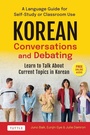
Juno Baik | Eunjin Gye | Julie Damron
Korean Conversations and Debating
A Language Guide for Self-Study or Classroom Use--Learn to Talk About Current Topics in Korean (With Companion Online Audio)
Book
09/2023
Tuttle Publishing
€17.50
Shipment within 10-20 days
Persons
Eunjin Gye is currently an adjunct lecturer of Korean in the Department of Asian and Near Eastern Languages at Brigham Young University. She has taught all levels of Korean at various Korean institutes and universities in the United States as well as within the Korean government. Her research interests include second language acquisition, psycholinguistic and pedagogy.
Juno Baik is Assistant Professor of Korean at Brigham Young University. He received a Ph.D. in Korean Linguistics and Pedagogy from Kyung Hee University, Korea. He has trained teachers of Korean as a second language and taught at universities, government institutions, and multinational corporations in Korea and the US since 2008. His interests are in second language acquisition and cognitive linguistics, focusing on how cognitive factors affect language acquisition. He is a co-author of Tuttle's Learning Korean along with Julie Damron.
Julie Damron is Associate Professor of Korean and linguistics at Brigham Young University. She received her PhD from Purdue university in linguistics and second language teaching. She currently heads the Korean Section at BYU and teaches Korean language courses, linguistics and research design. Julie has created online classes that serve more than 1,000 high school and college students around the world. She is the author of Tuttle's highly successful Korean Stories For Language Learners, and a co-author of Learning Korean along with Juno Baik.
Juno Baik is Assistant Professor of Korean at Brigham Young University. He received a Ph.D. in Korean Linguistics and Pedagogy from Kyung Hee University, Korea. He has trained teachers of Korean as a second language and taught at universities, government institutions, and multinational corporations in Korea and the US since 2008. His interests are in second language acquisition and cognitive linguistics, focusing on how cognitive factors affect language acquisition. He is a co-author of Tuttle's Learning Korean along with Julie Damron.
Julie Damron is Associate Professor of Korean and linguistics at Brigham Young University. She received her PhD from Purdue university in linguistics and second language teaching. She currently heads the Korean Section at BYU and teaches Korean language courses, linguistics and research design. Julie has created online classes that serve more than 1,000 high school and college students around the world. She is the author of Tuttle's highly successful Korean Stories For Language Learners, and a co-author of Learning Korean along with Juno Baik.
Content
- 9780804856157_Frontcover
- 9780804856157_text
- 9780804856157_Backcover
