

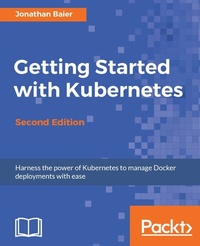
Getting Started with Kubernetes, Second Edition
Orchestrate and manage large-scale Docker deployments
2nd Edition
Published on 8. July 2025
286 pages
978-1-78728-413-5 (ISBN)
Description

Learn how to schedule and run application containers using Kubernetes.
Key Features
Get well-versed with the fundamentals of Kubernetes and get it production-ready for deployments
Confidently manage your container clusters and networks using Kubernetes
This practical guide will show you container application examples throughout to illustrate the concepts and features of Kubernetes
Book DescriptionKubernetes has continued to grow and achieve broad adoption across various industries, helping you to orchestrate and automate container deployments on a massive scale. This book will give you a complete understanding of Kubernetes and how to get a cluster up and running. You will develop an understanding of the installation and configuration process. The book will then focus on the core Kubernetes constructs such as pods, services, replica sets, replication controllers, and labels. You will also understand how cluster level networking is done in Kubernetes. The book will also show you how to manage deployments and perform updates with minimal downtime. Additionally, you will learn about operational aspects of Kubernetes such as monitoring and logging. Advanced concepts such as container security and cluster federation will also be covered. Finally, you will learn about the wider Kubernetes ecosystem with OCP, CoreOS, and Tectonic and explore the third-party extensions and tools that can be used with Kubernetes. By the end of the book, you will have a complete understanding of the Kubernetes platform and will start deploying applications on it. What you will learn
Download, install, and configure the Kubernetes codebase
Understand the core concepts of a Kubernetes cluster
Be able to set up and access monitoring and logging for Kubernetes clusters
Set up external access to applications running in the cluster
Understand how CoreOS and Kubernetes can help you achieve greater performance and container implementation agility
Run multiple clusters and manage from a single control plane
Explore container security as well as securing Kubernetes clusters
Work with third-party extensions and tools
Who this book is forThis book is for developers, sys admins, and DevOps engineers who want to automate the deployment process and scale their applications. You do not need any knowledge about Kubernetes.
Key Features
Get well-versed with the fundamentals of Kubernetes and get it production-ready for deployments
Confidently manage your container clusters and networks using Kubernetes
This practical guide will show you container application examples throughout to illustrate the concepts and features of Kubernetes
Book DescriptionKubernetes has continued to grow and achieve broad adoption across various industries, helping you to orchestrate and automate container deployments on a massive scale. This book will give you a complete understanding of Kubernetes and how to get a cluster up and running. You will develop an understanding of the installation and configuration process. The book will then focus on the core Kubernetes constructs such as pods, services, replica sets, replication controllers, and labels. You will also understand how cluster level networking is done in Kubernetes. The book will also show you how to manage deployments and perform updates with minimal downtime. Additionally, you will learn about operational aspects of Kubernetes such as monitoring and logging. Advanced concepts such as container security and cluster federation will also be covered. Finally, you will learn about the wider Kubernetes ecosystem with OCP, CoreOS, and Tectonic and explore the third-party extensions and tools that can be used with Kubernetes. By the end of the book, you will have a complete understanding of the Kubernetes platform and will start deploying applications on it. What you will learn
Download, install, and configure the Kubernetes codebase
Understand the core concepts of a Kubernetes cluster
Be able to set up and access monitoring and logging for Kubernetes clusters
Set up external access to applications running in the cluster
Understand how CoreOS and Kubernetes can help you achieve greater performance and container implementation agility
Run multiple clusters and manage from a single control plane
Explore container security as well as securing Kubernetes clusters
Work with third-party extensions and tools
Who this book is forThis book is for developers, sys admins, and DevOps engineers who want to automate the deployment process and scale their applications. You do not need any knowledge about Kubernetes.
All prices
More details
Edition
2nd Revised edition
Language
English
Place of publication
Birmingham
United Kingdom
Target group
Professional and scholarly
US School Grade: College Graduate Student
Edition type
Revised edition
File size
11,88 MB
ISBN-13
978-1-78728-413-5 (9781787284135)
Copyright in bibliographic data and cover images is held by Nielsen Book Services Limited or by the publishers or by their respective licensors: all rights reserved.
Schweitzer Classification
Other editions
Additional editions
Jonathan Baier
Getting Started with Kubernetes - Second Edition
Orchestrate and manage large-scale Docker deployments
Book
05/2017
Packt Publishing
€37.44
Shipment within 3-4 weeks
Person
Baier Jonathan :
Jonathan Baier is an emerging technology leader living in Brooklyn, New York. He has had a passion for technology since an early age. When he was 14 years old, he was so interested in the family computer (an IBM PCjr) that he pored over the several hundred pages of BASIC and DOS manuals. Then, he taught himself to code a very poorly-written version of Tic-Tac-Toe. During his teenage years, he started a computer support business. Throughout his life, he has dabbled in entrepreneurship. He currently works as Senior Vice President of Cloud Engineering and Operations for Moody's corporation in New York.
Jonathan Baier is an emerging technology leader living in Brooklyn, New York. He has had a passion for technology since an early age. When he was 14 years old, he was so interested in the family computer (an IBM PCjr) that he pored over the several hundred pages of BASIC and DOS manuals. Then, he taught himself to code a very poorly-written version of Tic-Tac-Toe. During his teenage years, he started a computer support business. Throughout his life, he has dabbled in entrepreneurship. He currently works as Senior Vice President of Cloud Engineering and Operations for Moody's corporation in New York.
Content
Table of Contents
Introduction to Kubernetes
Pods, Services, Replication Controllers, and Labels
Networking, Load Balancers, and Ingress
Updates, Gradual Rollouts, and Autoscaling
Deployments, Jobs, and DaemonSets
Storage & Running a stateful applications
Continuous Delivery
Monitoring and Logging
Cluster Federation
Container Security
Extending Kubernetes with OCP, CoreOS and Tectonic
Towards Production ready
Introduction to Kubernetes
Pods, Services, Replication Controllers, and Labels
Networking, Load Balancers, and Ingress
Updates, Gradual Rollouts, and Autoscaling
Deployments, Jobs, and DaemonSets
Storage & Running a stateful applications
Continuous Delivery
Monitoring and Logging
Cluster Federation
Container Security
Extending Kubernetes with OCP, CoreOS and Tectonic
Towards Production ready

