

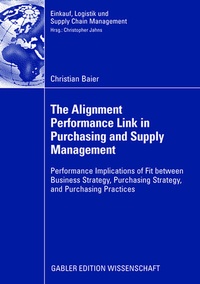
The Alignment Performance Link in Purchasing and Supply Management
Performance Implications of Fit between Business Strategy, Purchasing Strategy, and Purchasing Practices
1st Edition
Published on 11. August 2008
XV, 231 pages
978-3-8349-9751-7 (ISBN)
Description

Foreword In today's markets, companies face ever growing international competition, radical technological change, and increasingly demanding customers. These developments force managers to focus on core competencies and result in decreasing in-house val- add across industries. Adequate supplier selection and competent management of the supply base have thus become key firm success factors. As a consequence, purchasing and supply management (PSM) has developed into a powerful weapon for contributing to a firm's competitive advantage along dimensions such as cost, quality, and inno- tion. Such a contribution, however, critically depends upon the alignment of purch- ing strategies and practices with the company's overall business strategy. Only if the purchasing function supports the firm's competitive position can it effectively improve profitability. Unfortunately, existing research still lacks both the theoretical concepts and empirical foundation to provide detailed guidance to practitioners regarding how such alignment can be achieved and what impact it should have on firm performance. The doctoral thesis presented by Christian Baier develops and tests a comprehensive model of the alignment-performance link in PSM in order to close this knowledge gap. Drawing on insights from the market-based view, the resource-based view, princip- agent theory, and contingency theory, the author derives a solid theoretical understa- ing of the relationships between business strategy and strategies and practices at the functional level. By applying the theory of production competence to the PSM context, two critical levels of alignment are identified: strategic alignment, i. e.
More details
Other editions
Additional editions
Christian Baier
The Alignment Performance Link in Purchasing and Supply Management
Performance Implications of Fit between Business Strategy, Purchasing Strategy, and Purchasing Practices
Book
05/2008
1st Edition
Springer Gabler
€53.49
Shipment within 7-9 days
Person
Dr. Christian Baier promovierte bei Prof. Dr. Christopher Jahns am Supply Management Institute (SMI) der European Business School (EBS) in Oestrich-Winkel. Er ist als Unternehmensberater für McKinsey&Company, Inc. in Berlin tätig.
Content
Problem situation and research approach.- A theoretical perspective on the contribution of PSM to the generation of competitive advantage.- A conceptual model of the alignment-performance link in PSM.- An empirical analysis of the alignment-performance link in PSM.- Summary and conclusions.
3 A conceptual model of the alignment-performance link in PSM (S. 51-52)
The previous chapter outlined that PSM's ability to contribute to competitive advantage critically depends on the alignment of purchasing strategy and practices with the firm's business strategy. Given the lack of research on this topic, this chapter will now develop a model for empirically investigating the alignment-performance link in PSM. First, the conceptual model including detailed hypotheses regarding interrelationships between different strategy levels and their performance implications will be derived in section 3.1. Next, the key constructs used in this model will be defined in section 3.2. Last, an analytical approach for testing the model will be presented in section 3.3.
3.1 Development of hypotheses model
The development of a research model of the alignment-performance link in PSM must start with the identification of the key elements to be employed. Because the previous chapter highlighted the need for an alignment of different strategy levels, these levels will be discussed first in order to establish a sound basis for the model. Next, by applying insights from the theory of production competence, the strategy hierarchy will be adapted to the context of PSM. Based on the resulting conceptual model, detailed hypotheses on the links between the different strategy levels and their performance implications will then be developed in the last part of this section.
3.1.1 The strategy hierarchy as the foundation for a conceptual model of the alignment-performance link in PSM
The theory-based discussion in the last chapter showed that different strategy formulation and implementation levels have to be addressed and aligned if PSM wants to effectively contribute to the company's competitive advantage. In order to obtain an understanding of this strategy hierarchy in the firm and thus to establish a sound basis for the development of the conceptual model of the alignment-performance link in PSM, relevant contributions from strategic management literature will first be presented. Because the term 'strategy' is used in a variety of ways in literature, such discussion must start by outlining the connotations of this broad concept in greater detail.
The word 'strategy', which derives from the ancient Greek military term 'strategos', connoting the art of the general (Galbraith & Kazanjian, 1987, p. 3, Hayes & Wheelwright, 1984, p. 27), has been used extensively in the past decades. It has taken on a variety of broad, ill-defined, and ambiguous definitions covering such different aspects as establishing purpose, setting direction, developing plans, taking major actions, securing distinctive advantage, deploying resources, and ensuring internal consistency (Christensen et al., 1982, p. 93, Galbraith & Kazanjian, 1987, p. 3, Hofer & Schendel, 1978, p. 4, Mintzberg, 1987, pp. 11-17, Quinn, 1980, p. 7). Against this backdrop, Mintzberg et al. state: "We are the blind people and strategy formation is our elephant. Each of us, in trying to cope with the mysteries of the beast, grabs hold of some part of the other" (1998, p. 21).
The previous chapter outlined that PSM's ability to contribute to competitive advantage critically depends on the alignment of purchasing strategy and practices with the firm's business strategy. Given the lack of research on this topic, this chapter will now develop a model for empirically investigating the alignment-performance link in PSM. First, the conceptual model including detailed hypotheses regarding interrelationships between different strategy levels and their performance implications will be derived in section 3.1. Next, the key constructs used in this model will be defined in section 3.2. Last, an analytical approach for testing the model will be presented in section 3.3.
3.1 Development of hypotheses model
The development of a research model of the alignment-performance link in PSM must start with the identification of the key elements to be employed. Because the previous chapter highlighted the need for an alignment of different strategy levels, these levels will be discussed first in order to establish a sound basis for the model. Next, by applying insights from the theory of production competence, the strategy hierarchy will be adapted to the context of PSM. Based on the resulting conceptual model, detailed hypotheses on the links between the different strategy levels and their performance implications will then be developed in the last part of this section.
3.1.1 The strategy hierarchy as the foundation for a conceptual model of the alignment-performance link in PSM
The theory-based discussion in the last chapter showed that different strategy formulation and implementation levels have to be addressed and aligned if PSM wants to effectively contribute to the company's competitive advantage. In order to obtain an understanding of this strategy hierarchy in the firm and thus to establish a sound basis for the development of the conceptual model of the alignment-performance link in PSM, relevant contributions from strategic management literature will first be presented. Because the term 'strategy' is used in a variety of ways in literature, such discussion must start by outlining the connotations of this broad concept in greater detail.
The word 'strategy', which derives from the ancient Greek military term 'strategos', connoting the art of the general (Galbraith & Kazanjian, 1987, p. 3, Hayes & Wheelwright, 1984, p. 27), has been used extensively in the past decades. It has taken on a variety of broad, ill-defined, and ambiguous definitions covering such different aspects as establishing purpose, setting direction, developing plans, taking major actions, securing distinctive advantage, deploying resources, and ensuring internal consistency (Christensen et al., 1982, p. 93, Galbraith & Kazanjian, 1987, p. 3, Hofer & Schendel, 1978, p. 4, Mintzberg, 1987, pp. 11-17, Quinn, 1980, p. 7). Against this backdrop, Mintzberg et al. state: "We are the blind people and strategy formation is our elephant. Each of us, in trying to cope with the mysteries of the beast, grabs hold of some part of the other" (1998, p. 21).
