

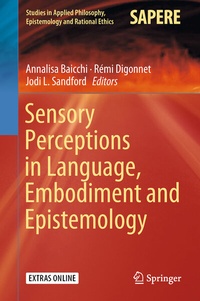
Sensory Perceptions in Language, Embodiment and Epistemology
Description

The book illustrates how the human ability to adapt to the environment and interact with it can explain our linguistic representation of the world as constrained by our bodies and sensory perception. The different chapters discuss philosophical, scientific, and linguistic perspectives on embodiment and body perception, highlighting the core mechanisms humans employ to acquire knowledge of reality. These processes are based on sensory experience and interaction through communication.
More details
Other editions
Additional editions
Content
The Language of Senses: a Window onto the World.- Our Biological Past in Our Modern Verbal World.- Embodied Semantics and the Mirror Neurons: Past Research and Some Proposals for the Future.- What is not Said: Metaphor and the Deflationary Account.- Do Metaphors Mean or Point? Davidson's Hypothesis Revisited.- A Neuroimaging Investigation into Figurative Language and Aesthetic Perception.- A Neuroimaging Investigation into Figurative Language and Aesthetic Perception.- Ception and the Discrepancy between Vision and Language.- Methodological Approaches and Semantic Construals of the SEEING Domain in English.- Metaphors for Musical Motion: Beyond TIME IS MOTION.- Defining Taste in English Informant Categorization.- The Linguistic Expression of Smells: from Lack to Abundance?.- Synaesthesia and Other Figures: What the Senses Tell us about Figurative Language.
