

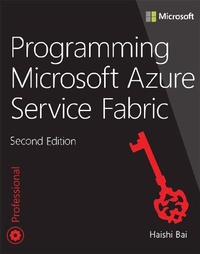
Programming Microsoft Azure Service Fabric
2nd Edition
Published on 7. June 2018
528 pages
978-1-5093-0710-4 (ISBN)
Description

Build, operate, and orchestrate scalable microservices applications in the cloud
This book combines a comprehensive guide to success with Microsoft Azure Service Fabric and a practical catalog of design patterns and best practices for microservices design, implementation, and operation. Haishi Bai brings together all the information you'll need to deliver scalable and reliable distributed microservices applications on Service Fabric. He thoroughly covers the crucial DevOps aspects of utilizing Service Fabric, reviews its interactions with key cloud-based services, and introduces essential service integration mechanisms such as messaging systems and reactive systems.
Leading Microsoft Azure expert Haishi Bai shows how to:
Set up your Service Fabric development environment
Program and deploy Service Fabric applications to a local or a cloud-based cluster
Compare and use stateful services, stateless services, and the actor model
Design Service Fabric applications to maximize availability, reliability, and scalability
Improve management efficiency via scripting
Configure network security and other advanced cluster settings
Collect diagnostic data, and use Azure Operational Management Suite to interpret it
Integrate microservices components developed in parallel
Use containers to mobilize applications for failover, replication, scaling, and load balancing
Streamline containerization with Docker in Linux and Windows environments
Orchestrate containers to schedule workloads and maintain services at desired states
Implement proven design patterns for common cloud application workloads
Balance throughput, latency, scalability, and cost
This book combines a comprehensive guide to success with Microsoft Azure Service Fabric and a practical catalog of design patterns and best practices for microservices design, implementation, and operation. Haishi Bai brings together all the information you'll need to deliver scalable and reliable distributed microservices applications on Service Fabric. He thoroughly covers the crucial DevOps aspects of utilizing Service Fabric, reviews its interactions with key cloud-based services, and introduces essential service integration mechanisms such as messaging systems and reactive systems.
Leading Microsoft Azure expert Haishi Bai shows how to:
Set up your Service Fabric development environment
Program and deploy Service Fabric applications to a local or a cloud-based cluster
Compare and use stateful services, stateless services, and the actor model
Design Service Fabric applications to maximize availability, reliability, and scalability
Improve management efficiency via scripting
Configure network security and other advanced cluster settings
Collect diagnostic data, and use Azure Operational Management Suite to interpret it
Integrate microservices components developed in parallel
Use containers to mobilize applications for failover, replication, scaling, and load balancing
Streamline containerization with Docker in Linux and Windows environments
Orchestrate containers to schedule workloads and maintain services at desired states
Implement proven design patterns for common cloud application workloads
Balance throughput, latency, scalability, and cost
More details
Series
Edition
2nd edition
Language
English
Place of publication
Boston
United States
Publishing group
Microsoft Press,U.S.
Target group
Professional and scholarly
File size
10,79 MB
ISBN-13
978-1-5093-0710-4 (9781509307104)
Copyright in bibliographic data and cover images is held by Nielsen Book Services Limited or by the publishers or by their respective licensors: all rights reserved.
Schweitzer Classification
Other editions
Additional editions
Haishi Bai
Programming Microsoft Azure Service Fabric
Book
09/2018
2nd Edition
Microsoft Press
€46.00
Shipment within 3-4 weeks
Person
Haishi Bai, principal software engineer at Microsoft, focuses on the Microsoft Azure compute platform, including IaaS, PaaS, networking, and scalable computing services. Ever since he wrote his first program on an Apple II when he was 12, Haishi has been a passionate programmer. He later became a professional software engineer and architect. During his 21 years of professional life, he's faced various technical challenges and a broad range of project types that have given him rich experiences in designing innovative solutions to solve difficult problems.
Haishi is the author of a few cloud computing books, and he's an active contributor to a few open-source projects. He also runs a technical blog (http://blog.haishibai.com) with millions of viewers. His twitter handle is @HaishiBai2010.
Haishi is the author of a few cloud computing books, and he's an active contributor to a few open-source projects. He also runs a technical blog (http://blog.haishibai.com) with millions of viewers. His twitter handle is @HaishiBai2010.
Content
PART I FUNDAMENTALS
CHAPTER 1 Hello, Service Fabric!
CHAPTER 2 Stateless Services
CHAPTER 3 Stateful Services
CHAPTER 4 Actor Pattern
CHAPTER 5 Service Deployments and Upgrades
CHAPTER 6 Availability and Reliability
CHAPTER 7 Scalability and Performance
PART II SERVICE LIFE CYCLE MANAGEMENT
CHAPTER 8 Service Fabric Scripting
CHAPTER 9 Cluster Management
CHAPTER 10 Diagnostics and Monitoring
CHAPTER 11 Continuous Delivery
PART III LINUX AND CONTAINERS
CHAPTER 12 Service Fabric on Linux
CHAPTER 13 Containers
CHAPTER 14 Container Orchestration
PART IV WORKLOADS AND DESIGN PATTERNS
CHAPTER 15 Scalable Web
CHAPTER 16 Scalable Interactive Systems
CHAPTER 17 System Integration
PART V ADVANCED TOPICS
CHAPTER 18 Serverless Computing
CHAPTER 19 Artificial Intelligence
CHAPTER 20 Orchestrating an Organic Compute Plane
PART VI APPENDICES
Appendix A: Using Microsoft Azure PowerShell Commands
Appendix B: Pattern Index
CHAPTER 1 Hello, Service Fabric!
CHAPTER 2 Stateless Services
CHAPTER 3 Stateful Services
CHAPTER 4 Actor Pattern
CHAPTER 5 Service Deployments and Upgrades
CHAPTER 6 Availability and Reliability
CHAPTER 7 Scalability and Performance
PART II SERVICE LIFE CYCLE MANAGEMENT
CHAPTER 8 Service Fabric Scripting
CHAPTER 9 Cluster Management
CHAPTER 10 Diagnostics and Monitoring
CHAPTER 11 Continuous Delivery
PART III LINUX AND CONTAINERS
CHAPTER 12 Service Fabric on Linux
CHAPTER 13 Containers
CHAPTER 14 Container Orchestration
PART IV WORKLOADS AND DESIGN PATTERNS
CHAPTER 15 Scalable Web
CHAPTER 16 Scalable Interactive Systems
CHAPTER 17 System Integration
PART V ADVANCED TOPICS
CHAPTER 18 Serverless Computing
CHAPTER 19 Artificial Intelligence
CHAPTER 20 Orchestrating an Organic Compute Plane
PART VI APPENDICES
Appendix A: Using Microsoft Azure PowerShell Commands
Appendix B: Pattern Index
