

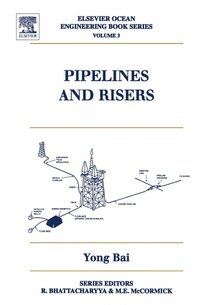
Pipelines and Risers
Published on 7. February 2001
520 pages
978-0-08-053901-0 (ISBN)
Description

Pipelines and Risers
More details
Other editions
Additional editions
Yong Bai
Pipelines and Risers: Volume 3
Book
02/2001
Elsevier
€142.37
Article exhausted; check different version
Content
- Front Cover
- Pipelines and Risers
- Copyright Page
- Table of Contents
- Series Preface
- Foreword
- Preface
- Chapter 1. Introduction
- 1.1 Introduction
- 1.2 Design Stages and Process
- 1.3 Design Through Analysis (DTA)
- 1.4 Pipeline Design Analysis
- 1.5 Pipeline Simulator
- 1.6 References
- Chapter 2. Wall-thickness and Material Grade Selection
- 2.1 General
- 2.2 Material Grade Selection
- 2.3 Pressure Containment (hoop stress) Design
- 2.4 Equivalent Stress Criterion
- 2.5 Hydrostatic Collapse
- 2.6 Wall Thickness and Length Design for Buckle Arrestors
- 2.7 Buckle Arrestor Spacing Design
- 2.8 References
- Chapter 3. Buckling/Collapse of Deepwater Metallic Pipes
- 3.1 General
- 3.2 Pipe Capacity under Single Load
- 3.3 Pipe Capacity under Couple Load
- 3.4 Pipes under Pressure Axial Force and Bending
- 3.5 Finite Element Model
- 3.6 References
- Chapter 4. Limit-state based Strength Design
- 4.1 Introduction
- 4.2 Out of Roundness Serviceability Limit
- 4.3 Bursting
- 4.4 Local Buckling/Collapse
- 4.5 Fracture
- 4.6 Fatigue
- 4.7 Ratcheting
- 4.8 Dynamic Strength Criteria
- 4.9 Accumulated Plastic Strain
- 4.10 Strain Concentration at Field Joints Due to Coatings
- 4.11 References
- Chapter 5. Soil and Pipe Interaction
- 5.1 General
- 5.2 Pipe Penetration in Soil
- 5.3 Modeling Friction and Breakout Forces
- 5.4 References
- Chapter 6. Hydrodynamics around Pipes
- 6.1 Wave Simulators
- 6.2 Choice of Wave Theory
- 6.3 Mathematical Formulations used in the Wave Simulators
- 6.4 Steady Currents
- 6.5 Hydrodynamic Forces
- 6.6 References
- Chapter 7. Finite Element Analysis of In-situ Behavior
- 7.1 Introduction
- 7.2 Description of the Finite Element Model
- 7.3 Steps in an Analysis and Choice of Analysis Procedure
- 7.4 Element Types used in the Model
- 7.5 Non-linearity and Seabed Model
- 7.6 Validation of the Finite-Element Model
- 7.7 References
- Chapter 8. On-bottom Stability
- 8.1 General
- 8.2 Force Balance: The Simplified Method
- 8.3 Acceptance Criteria
- 8.4 Special Purpose Program for Stability Analysis
- 8.5 Use of FE Analysis for Intervention Design
- 8.6 References
- Chapter 9. Vortex-induced Vibrations (VIV) and Fatigue
- 9.1 General
- 9.2 Free-span VIV Analysis Procedure
- 9.3 Fatigue Design Criteria
- 9.4 Response Amplitude
- 9.5 Modal Analysis
- 9.6 Example Cases
- 9.7 References
- Chapter 10. Force Model and Wave Fatigue
- 10.1 Introduction
- 10.2 Fatigue Analysis
- 10.3 Force Model
- 10.4 Comparisons of Frequency Domain and Time Domain Approaches
- 10.5 Conclusions and Recommendations
- 10.6 References
- Chapter 11. Trawl Impact, Pullover and Hooking Loads
- 11.1 Introduction
- 11.2 Trawl Gears
- 11.3 Acceptance Criteria
- 11.4 Impact Response Analysis
- 11.5 Pullover Loads
- 11.6 Finite Element Model for Pullover Response Analyses
- 11.7 Case Study
- 11.8 References
- Chapter 12. Installation Design
- 12.1 Introduction
- 12.2 Pipeline Installation Vessels
- 12.3 Software OFFPIPE and Code Requirements
- 12.4 Physical Background for Installation
- 12.5 Finite Element Analysis Procedure for Installation of In-line Valves
- 12.6 Two Medium Pipeline Design Concept
- 12.7 References
- Chapter 13. Reliability-Based Strength Design of Pipelines
- 13.1 General
- 13.2 Reliability-based Design
- 13.3 Uncertainty Measures
- 13.4 Calibration of Safety Factors
- 13.5 Buckling/Collapse of Corroded Pipes
- 13.6 Conclusions
- 13.7 References
- Chapter 14. Remaining Strength of Corroded Pipes
- 14.1 Introduction
- 14.2 Review of Existing Criteria
- 14.3 Development of New Criteria
- 14.4 Evaluation of New Criteria
- 14.5 Reliability-based Design
- 14.6 Example Applications
- 14.7 Conclusions
- 14.8 References
- Chapter 15. Residual Strength of Dented Pipes with Cracks
- 15.1 Introduction
- 15.2 Fracture of Pipes with Longitudinal Cracks
- 15.3 Fracture of Pipes with Circumferential Cracks
- 15.4 Reliability-based Assessment and Calibration of Safety Factors
- 15.5 Design Examples
- 15.6 Conclusions
- 15.7 References
- Chapter 16. Risk Analysis applied to Subsea Pipeline Engineering
- 16.1 Introduction
- 16.2 Acceptance Criteria
- 16.3 Identification of Initiating Events
- 16.4 Cause Analysis
- 16.5 Probability of Initiating Events
- 16.6 Causes of Risks
- 16.7 Consequence Analysis
- 16.8 Example 1: Risk analysis for a Subsea Gas Pipeline
- 16.9 Example 2: Dropped Object Risk Analysis
- 16.10 References
- Chapter 17. Route Optimization, Tie-in and Protection
- 17.1 Introduction
- 17.2 Pipeline Routing
- 17.3 Pipeline Tie-ins
- 17.4 Flowline Trenching/Burying
- 17.5 Flowline Rockdumping
- 17.6 Equipment Dayrates
- 17.7 References
- Chapter 18. Pipeline Inspection, Maintenance and Repair
- 18.1 Operations
- 18.2 Inspection by Intelligent Pigging
- 18.3 Maintenance
- 18.4 Pipeline Repair Methods
- 18.5 Deepwater Pipeline Repair
- 18.6 References
- Chapter 19. Use of High Strength Steel
- 19.1 Review of Usage of High Strength Steel Linepipes
- 19.2 Potential Benefits and Disadvantages of High Strength Steel
- 19.3 Welding of High Strength Linepipe
- 19.4 Cathodic Protection
- 19.5 Fatigue and Fracture of High Strength Steel
- 19.6 Material Property Requirements
- 19.7 References
- Chapter 20. Design of Deepwater Risers
- 20.1 General
- 20.2 Descriptions of Riser System
- 20.3 Metallic Catenary Riser for Deepwater Environments
- 20.4 Stresses and Service Life of Flexible Pipes
- 20.5 Drilling and Workover Risers
- 20.6 Riser Projects in Norway
- 20.7 References
- Chapter 21. Design Codes and Criteria for Risers
- 21.1 Design Guidelines for Marine Riser Design
- 21.2 Design Criteria for Deepwater Metallic Risers
- 21.3 Limit State Design Criteria
- 21.4 Design Conditions and Loads
- 21.5 Improving Design Codes and Guidelines
- 21.6 Comparison of lSO and API Codes with Hauch and Bai (1999)
- 21.7 References
- Chapter 22. Fatigue of Risers
- 22.1 General
- 22.2 Fatigue Causes
- 22.3 Riser VIV Analysis Program
- 22.4 Flexible Riser Analysis Program
- 22.5 Vortex-induced Vibration Prediction
- 22.6 Fatigue Life
- 22.7 Vortex-Induced Vibration Suppression Devices
- 22.8 Fatigue of Deepwater Metallic Risers
- 22.9 References
- Chapter 23. Piping Systems
- 23.1 Introduction
- 23.2 Design Criteria
- 23.3 Load Cases
- 23.4 Finite Element Models
- 23.5 References
- Chapter 24. Pipe-in-Pipe and Bundle Systems
- 24.1 General
- 24.2 Pipe-in-Pipe System
- 24.3 Bundle System
- 24.4 References
- Chapter 25. LCC Modeling as a Decision Making Tool in Pipeline Design
- 25.1 Introduction
- 25.2 Initial Cost
- 25.3 Financial Risk
- 25.4 Time value of Money
- 25.5 Fabrication Tolerance Example Using the Life-Cycle Cost Model
- 25.6 On-Bottom Stability Example
- 25.7 References
- Chapter 26. Design Examples
- 26.1 General
- 26.2 Åsgard Flowlines Project
- 26.3 Åsgard Transport Project
- 26.4 References
- Subject Index
