

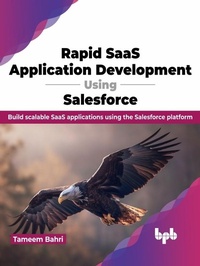
Rapid SaaS Application Development Using Salesforce
Build scalable SaaS applications using the Salesforce platform (English Edition)
1st Edition
Published on 31. December 2023
364 pages
978-93-5551-652-7 (ISBN)
Description

No detailed description available for "Rapid SaaS Application Development Using Salesforce".
More details
Other editions
Additional editions
Tameem Bahri
Rapid SaaS Application Development Using Salesforce
Build scalable SaaS applications using the Salesforce platform
Book
12/2023
BPB Publications
€41.00
Article not available for order
Content
- Intro
- Cover
- Title Page
- Copyright Page
- Dedication Page
- About the Author
- About the Reviewer
- Acknowledgement
- Preface
- Table of Contents
- 1. Introduction to the Salesforce Platform
- Introduction
- Structure
- Objectives
- What is a Salesforce application
- Why develop a Salesforce application
- Benefits for developers
- Benefits for entrepreneurs
- Benefits for CRM platform owners
- The Salesforce platform infrastructure
- Introducing Hyperforce
- Getting to know the Salesforce AppExchange
- Installing your first AppExchange solution
- Activities to publish a solution on AppExchange
- Key building blocks and tools
- Point-and-click building blocks
- Coding building blocks
- Supportive development tools
- No-code versus low-code versus full-code
- No-code tools
- Low-code tools
- Full-code tools
- Salesforce Objects: More than a database
- On-platform and off-Platform
- Summary
- 2. Deep Dive into Key Building Blocks and Tools
- Introduction
- Structure
- Objectives
- Learn about Salesforce users and licenses
- Practice working with objects, fields, and page layouts
- Learn about the Salesforce sharing and security model
- The org layer
- The object-and-field layer
- The record-level layer
- Practice using the Salesforce App Builder
- The App Builder's interface
- Practice creating a multiple pages application
- Practice using the Salesforce Report Builder
- Get introduced to the Salesforce Flow Builder
- The flow types
- Practice creating a flow
- Get introduced to the Salesforce Apex and triggers
- Introduction to the Salesforce Lightning Components and the Lightning Design System
- Summary
- 3. Develop a Sample Salesforce Application: PbP Phonebook
- Introduction
- Structure
- Objectives
- Introducing the high-level requirements
- Read between the lines and extract more requirements
- Define the high-level process flow
- Design the data model
- Design a low-fidelity prototype
- Build, validate, and rectify the application
- Solving the requirements and creating design decisions
- Deploy the application
- Identified gaps and lessons learned
- Summary
- 4. Learn the Salesforce Application Development Lifecycle
- Introduction
- Structure
- Objectives
- Introduction to the web application development process
- Rapid Application Development: The Salesforce philosophy
- Define the problem you are solving
- The first step: Define the problem
- The second step: Figure out the root cause
- The third step: Identify the impacted stakeholders
- The fourth step: Define the solution's scope
- The fifth step: Define the solution's constraints
- Design the application's blueprint
- Creating a backlog of user stories
- Defining a governance body
- Creating an end-to-end solution architecture
- Wireframe/prototype the application
- Build and validate the application
- Test and rectify the application
- Understanding the different types of tests
- Deploy and gather feedback
- Understanding source code management tools and their usage
- Understanding CI/CD
- Active feedback gathering
- Summary
- 5. Understand the Supporting Tools and Artifacts
- Introduction
- Structure
- Objectives
- Demystify the need for documenting software architecture
- What needs to be documented and when
- Introducing UML diagrams
- Introducing UML structure diagrams
- Introducing UML behavior diagrams
- Introducing the context diagram
- Define actors, personas, and licenses
- Design the process flows
- Detail activities using sequence diagrams
- Create a landscape architecture diagram
- Define the integration interfaces
- Create a data model diagram
- Create supporting diagrams
- Summary
- 6. Create a Sample Application: Define and Refine the Requirements
- Introduction
- Structure
- Objectives
- Introduction to the way this scenario is created
- High-level requirements
- Goals and vision
- Desired features
- Proposed solution
- High-level imaginary demo
- Market proposition
- Future plans
- Reading between the lines, derived requirements
- Creating and validating the high-level process flows
- Defining the actors and licenses
- Designing the preliminary solution blueprint
- Creating and validating the user stories
- Summary
- 7. Create a Sample Application: Solve and Build the Application - Part 1
- Introduction
- Structure
- Objectives
- Introduction to the way the solution is created
- Designing, prototyping, and building: The job listing feature
- Ability to have multiple statuses/stages per job post
- Ability to create multiple job posts for each department
- Post the same job across multiple countries/regions
- Define multiple interview processes
- Save time by suggesting a pay range
- Allow defining a set of activities that need to be completed
- Help remind agents and candidates of tasks
- Support defining internal and external recruiters
- Provide clarity on the recruitment agency each external recruiter works for
- Allow defining a set of skills for a position and the candidate
- Designing, prototyping, and building: The internal/external candidate sourcing feature
- Maintain a complete history of a candidate's application submissions
- Ability to capture details about the candidates
- Allow tracking of the history of each interviewer
- Allow recruiters to search for internal candidates
- Summary
- 8. Create a Sample Application: Solve and Build the Application - Part 2
- Introduction
- Structure
- Objectives
- Recap and continue
- Designing, prototyping, and building - Online job application submission
- Formatting the requirements as user stories
- Solving and building US-011
- Solving and building US-024
- Solving and building US-031
- Designing, prototyping, and building - Other requirements
- Allow defining a specific commission rate
- Calculate the commission of external recruiters
- Allow tracking of the history of each recruiter
- Show indicators such as longest-to-recruit positions
- Configurable data refreshing exercise
- Creating the PSD recruitment application
- Summary
- 9. Create a Sample Application: Test and Deploy
- Introduction
- Structure
- Objectives
- The importance of a comprehensive test suite
- Deeper dive into test types and tools
- Functional tests
- Non-functional tests
- Cross-functional tests
- Writing test cases
- Formatting test cases
- Practicing creating a test case
- Creating an Apex unit test
- Deploying your application
- Understanding CI/CD concepts in release management
- Packaging your application as an unmanaged package
- Deploying your unmanaged package to a new org
- Summary
- 10. Tips and Tricks and the Way Forward
- Introduction
- Structure
- Objectives
- Creating and publishing release notes
- The importance of release notes
- Who owns the creation of release notes
- Best practices for impactful release notes
- Sample template
- Introducing a feedback-gathering loop
- Developing highly customized applications
- Creating AI-powered applications
- Continue learning
- Summary
- Index
