

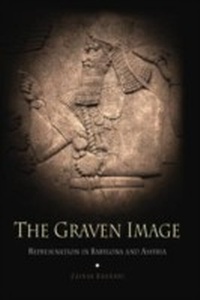
The Graven Image
Representation in Babylonia and Assyria
1st Edition
Published on 16. September 2011
256 pages
978-0-8122-0677-7 (ISBN)
Description

Mesopotamia, the world's earliest literate culture, developed a rich philosophical conception of representation in which the world was saturated with signs. Instead of imitating the natural world, representation-both in writing and in visual images-was thought to participate in the world and to have an effect upon it in natural, magical, and supernatural ways. The Graven Image is the first book to explore this tradition, which developed prior to, and apart from, the Greek understanding of representation.
The classical Greek system, based on the notion of mimesis, or copy, is the one with which we are most familiar today. The Assyro-Babylonian ontology presented here by Zainab Bahrani opens up fresh avenues for thinking about the concept of representation in general, and her reading of the ancient Mesopotamian textual and visual record in its own ontological context develops an entirely new approach to understanding Babylonian and Assyrian arts in particular.
The Graven Image describes, for the first time, rituals and wars involving images; the relationship of divination, the organic body, and representation; and the use of images as a substitute for the human form, integrating this ancient material into contemporary debates in critical theory. Bahrani challenges current methodologies in the study of Near Eastern archaeology and art history, introducing a new way to appreciate the unique contributions of Assyrian and Babylonian culture and their complex relationships to the past and present.
The classical Greek system, based on the notion of mimesis, or copy, is the one with which we are most familiar today. The Assyro-Babylonian ontology presented here by Zainab Bahrani opens up fresh avenues for thinking about the concept of representation in general, and her reading of the ancient Mesopotamian textual and visual record in its own ontological context develops an entirely new approach to understanding Babylonian and Assyrian arts in particular.
The Graven Image describes, for the first time, rituals and wars involving images; the relationship of divination, the organic body, and representation; and the use of images as a substitute for the human form, integrating this ancient material into contemporary debates in critical theory. Bahrani challenges current methodologies in the study of Near Eastern archaeology and art history, introducing a new way to appreciate the unique contributions of Assyrian and Babylonian culture and their complex relationships to the past and present.
Reviews / Votes
"Bahrani opens up the field of discourse for the study of ancient Near Eastern art and brings it into dialogue with current disciplinary trends. . . . The book will stimulate further discussion about the nature(s) of Babylonian and Assyrian representation across the disciplinary divides." (Journal of the American Oriental Society) "A welcome addition to the study of the ancient Near East. It breaks away from Eurocentric approaches and tries to do justice to Mesopotamian thought, thus shedding new light on the relationship between text and representation. . . . Bahrani's book will become the center of a lively debate." (Bryn Mawr Classical Review)More details
Series
Language
English
Place of publication
Pennsylvania
United States
Target group
College/higher education
US School Grade: College Graduate Student
Illustrations
28 illus.
28 illus.
ISBN-13
978-0-8122-0677-7 (9780812206777)
Copyright in bibliographic data and cover images is held by Nielsen Book Services Limited or by the publishers or by their respective licensors: all rights reserved.
Schweitzer Classification
Other editions
Additional editions
Book
07/2003
University of Pennsylvania Press
€65.00
Shipment within 10-20 days
Person
Zainab Bahrani is Edith Porada Professor of Art and Archaeology at Columbia University.
Content
List of Illustrations
Introduction
1. The Aesthetic and the Epistemic: Race, Culture, and Antiquity
2. The Extraterrestrial Orient: Despotic Time and the Time of the Despots
3. Ethnography and Mimesis: Representing Aesthetic Culture
4. Being in the Word: Of Grammatology and Mantic
5. Salmu: Representation in the Real
6. Decoys and Lures: Substitution and the Uncanny Double of the King
7. Presence and Repetition: The Altar of Tukulti-Ninurta
8. Conclusion: Image, Text, and DiffErance, or from Difference to DiffErance
Notes
Bibliography
Index
Acknowledgments
Introduction
1. The Aesthetic and the Epistemic: Race, Culture, and Antiquity
2. The Extraterrestrial Orient: Despotic Time and the Time of the Despots
3. Ethnography and Mimesis: Representing Aesthetic Culture
4. Being in the Word: Of Grammatology and Mantic
5. Salmu: Representation in the Real
6. Decoys and Lures: Substitution and the Uncanny Double of the King
7. Presence and Repetition: The Altar of Tukulti-Ninurta
8. Conclusion: Image, Text, and DiffErance, or from Difference to DiffErance
Notes
Bibliography
Index
Acknowledgments
