

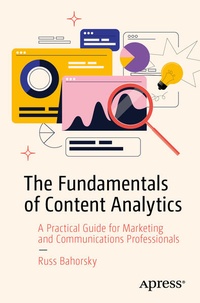
The Fundamentals of Content Analytics
Description

From feature stories and blog posts to explainer videos and social media campaigns, content teams are producing more than ever-often with limited visibility into what's working and why. This book bridges the gap for professionals who need practical, strategic analytics skills but lack technical backgrounds.
Featuring a clear, accessible, and actionable approach, author Russ Bahorsky brings a research-informed perspective to using content data to drive better decisions in today's digital-first organizations. The book introduces foundational concepts in content measurement, to help you formulate better research questions, and how to collaborate with data experts. With real-world case studies and accessible frameworks, it demystifies analytics without oversimplifying it.
Web Content Analytics is not a book about becoming a data scientist-it's a book about asking better questions, building smarter processes, and creating content that connects.
What You Will Learn
- Align content analytics with business and mission goals.
- Ask effective research questions that guide data strategy.
- Gain practical methods for collecting, organizing, and analyzing content data and using it to make better business decisions.
- Collaborate effectively with data experts and communicate insights clearly.
- Apply ethical data practices and prepare for emerging trends in content analytics.
Who This Book is For
Marketing and communications professionals, content strategists and editorial managers, brand and campaign leads, nonprofit and higher education communicators, graduate students in marketing or communication
More details
Other editions
Additional editions
Person
As a professional immersed in content strategy and audience engagement, Russ Bahorsky brings both practical experience and a research-informed perspective. With an MBA in marketing from Johns Hopkins University and credentials in UX from Nielsen Norman, Russ has led content teams at National Geographic, APA, and the University of Virginia. He help organizations connect storytelling to outcomes using measurable strategies, and this book is built from that real-world insight.
Content
Part I: Strategic Foundations of Content Analytics .- Chapter 1: Aligning Content Analytics with Business Goals.- Chapter 2: Formulating Research Questions.- Chapter 3: Mapping Content Journeys.- Chapter 4: Data Collection and Preparation.- Part II: Building the Analytics Toolkit .- Chapter 5: Analyzing Content Performance.- Chapter 6: Qualitative Analytics.- Chapter 7: Forecasting Content Performance.- Chapter 8: Testing Content Effectiveness.- Chapter 9: Advanced Methods and Partnering with Experts.- Part III: Leadership in Analytics.- Chapter 10: Reporting and Communicating Insights. Chapter 11: Building and Sustaining a Content Analytics Program.- Chapter 12: Ethics, Privacy, and Responsible Data Use.- Chapter 13: The Future of Content Analytics. App A: Event Tagging Using Google.- App B: Pattern Hunting with Excel.- App C: Calculating RMSE in Excel.- App D: Basic Statistical Tests.- App E: Bias Audit.- Glossary.
