

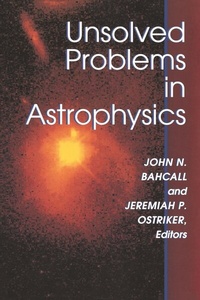
Unsolved Problems in Astrophysics
1st Edition
Published on 19. November 2018
382 pages
978-0-691-18856-0 (ISBN)
Description

The field of astrophysics is in the midst of a technologically driven renaissance, as fundamental discoveries are being made with astonishing frequency. In the last decade, new detectors in space, on earth, and deep underground have, when coupled with the computational power of modern computers, revolutionized our knowledge and understanding of the astronomical world. This is a great time for a student of any age to become acquainted with the remarkable universe in which we live. This volume is a collection of essays, originally presented orally to a diverse group of students and professionals, which reveal the most fertile areas for future study of astronomy and astrophysics. The emphasis of this work is on the clear description of the current state of our knowledge as a preparation for the future unraveling of the mysteries of the universe that appear today as most fundamental and most amenable to solution.
A stellar group of astronomers and astrophysicists describes the directions and styles of work that they think are most likely to lead to progress. Bibliographical notes at the end of each presentation provide guidance for the reader who wishes to go more deeply into a given subject. Unsolved Problems in Astrophysics is a uniquely stimulating introduction to some of the most important topics in modern astrophysics.
A stellar group of astronomers and astrophysicists describes the directions and styles of work that they think are most likely to lead to progress. Bibliographical notes at the end of each presentation provide guidance for the reader who wishes to go more deeply into a given subject. Unsolved Problems in Astrophysics is a uniquely stimulating introduction to some of the most important topics in modern astrophysics.
More details
Other editions
Additional editions
John Bahcall | Jeremiah P. Ostriker
Unsolved Problems in Astrophysics
Book
02/1997
Princeton University Press
€71.70
Article not available at the moment
John Bahcall | Jeremiah P. Ostriker
Unsolved Problems in Astrophysics
Book
02/1997
Princeton University Press
€76.88
Article exhausted; check different version
Persons
John N. Bahcall is Professor of Natural Sciences at the Institute for Advanced Study, Princeton, President Emeritus of the American Astronomical Society, and author of Neutrino Astrophysics. Jeremiah P. Ostriker is Charles A. Young Professor of Astronomy, Provost at Princeton University, and author of Development of Large Scale Structure in the Universe.
Content
- Cover
- Title Page
- Copyright Page
- Contents
- PREFACE
- 1 THE COSMOLOGICAL PARAMETERS
- 1.1 INTRODUCTION
- 1.2 WHY MEASURE THE PARAMETERS?
- 1.2.1 Testing the Physics
- 1.2.2 How Will It All End?
- 1.3 THE STATE OF THE MEASUREMENTS
- 1.4 COSMOLOGY FOR THE NEXT GENERATION
- 2 IN THE BEGINNING
- 2.1 THE FUTURE FATE OF COSMOLOGY
- 2.2 TESTING INFLATION
- 2.3 THE POWER OF THE COSMIC MICROWAVE BACKGROUND
- 2.4 COSMIC CONCORDANCE
- 2.5 A NEW AGE?
- 3 UNDERSTANDING DATA BETTER WITH BAYESIAN AND GLOBAL STATISTICAL METHODS
- 3.1 INTRODUCTION
- 3.2 COMBINING EXPERIMENTAL MEASUREMENTS
- 3.3 BAYESIAN COMBINATION OF INCOMPATIBLE MEASUREMENTS
- 3.4 ANOTHER VARIANT OF THE METHOD
- 3.5 RESULTS FOR THE HUBBLE CONSTANT
- 3.6 CONCLUSION
- 4 LARGE-SCALE STRUCTURE IN THE UNIVERSE
- 4.1 INTRODUCTION
- 4.2 CLUSTERING AND LARGE-SCALE STRUCTURE
- 4.2.1 Galaxies and Large-Scale Structure
- 4.2.2 Clusters and Large-Scale Structure
- 4.3 PECULIAR MOTIONS ON LARGE SCALES
- 4.4 DARK MATTER AND BARYONS IN CLUSTERS OF GALAXIES
- 4.5 lsiîm & 1?
- 4.6 THE SDSS AND LARGE-SCALE STRUCTURE
- 4.6.1 The Sloan Digital Sky Survey
- 4.6.2 Clusters of Galaxies
- 4.7 SUMMARY
- 5 UNSOLVED PROBLEMS IN GRAVITATIONAL LENSING
- 5.1 INTRODUCTION
- 5.2 GRAVITATIONAL LENS OPTICS
- 5.3 THE PROBLEMS
- 5.3.1 How Old Is the Universe?
- 5.3.2 What Is the Shape of the Universe?
- 5.3.3 What Is the Large Scale Distribution of Matter?
- 5.3.4 How Are Rich Clusters of Galaxies Formed?
- 5.3.5 When Did Galaxies Form and How Did They Evolve?
- 5.3.6 How Big Are Galaxies?
- 5.3.7 Of What Are Galaxies Made?
- 5.3.8 How Big Are AGN Ultraviolet Emission Regions ?
- 5.4 HOW MANY MORE SURPRISES WILL GRAVITATIONAL LENSES PROVIDE?
- 6 WHAT CAN BE LEARNED FROM NUMERICAL SIMULATIONS OF COSMOLOGY
- 6.1 INTRODUCTION
- 6.2 SIMULATION METHODS
- 6.2.1 Specification of Models
- 6.2.2 Physical Processes and Numerical Methods
- 6.3 RESULTS: COMPARISON WITH OBSERVATIONS
- 6.3.1 Hot Components
- 6.3.2 Warm Components
- 6.3.3 Cold Condensed Components
- 6.4 CONCLUSIONS, PROSPECTS, AND MORE QUESTIONS
- 7 THE CENTERS OF ELLIPTICAL GALAXIES
- 7.1 INTRODUCTION
- 7.1.1 Black Holes and Quasars
- 7.1.2 The Sphere of Influence
- 7.1.3 Cores and Cusps
- 7.2 PHOTOMETRY
- 7.2.1 The Peebles-Young Model
- 7.3 KINEMATIC EVIDENCE FOR CENTRAL BLACK HOLES
- 7.4 PHYSICAL PROCESSES
- 7.5 SUMMARY
- 8 THE MORPHOLOGICAL EVOLUTION OF GALAXIES
- 8.1 INTRODUCTION
- 8.2 EARLY FORMATION OF MASSIVE ELLIPTICALS
- 8.3 SLOW EVOLUTION OF MASSIVE DISK GALAXIES
- 8.4 REDSHIFT SURVEYS AND THE DWARF-DOMINATED UNIVERSE
- 8.5 FAINT GALAXY MORPHOLOGIES FROM HST
- 8.6 CONCLUSIONS
- 9 QUASARS
- 9.1 QUASARS AND THE END OF THE 'DARK AGE'
- 9.2 THE RELATION OF AGN S TO THE CENTRAL BULGES OF GALAXIES
- 9.3 QUASARS AND THEIR REMNANTS: PROBES OF GENERAL RELATIVITY?
- 9.3.1 Dead Quasars in Nearby Galaxies
- 9.3.2 Do These Holes Have a Kerr Metric?
- 10 SOLAR NEUTRINOS: SOLVED AND UNSOLVED PROBLEMS
- 10.1 WHY STUDY SOLAR NEUTRINOS?
- 10.2 WHAT DOES THE COMBINED STANDARD MODEL TELL US ABOUT SOLAR NEUTRINOS?
- 10.2.1 The Combined Standard Model
- 10.2.2 The Solar Neutrino Spectrum
- 10.3 WHY ARE THE PREDICTED NEUTRINO FLUXES ROBUST?
- 10.4 WHAT ARE THE THREE SOLAR NEUTRINO PROBLEMS?
- 10.4.1 Calculated versus Observed Chlorine Rate
- 10.4.2 Incompatibility of Chlorine and Water (Kamiokande) Ex periments
- 10.4.3 Gallium Experiments: No Room for7 Be Neutrinos
- 10.5 WHAT HAVE WE LEARNED?
- 10.5.1 About Astronomy
- 10.5.2 About Physics
- 10.6 WHAT NEXT?
- 10.6.1 Solvable Problems in Physics
- 10.6.2 Solvable Problems in Astronomy
- 10.7 SUMMARY
- 11 PARTICLE DARK MATTER
- 11.1 INTRODUCTION: THREE ARGUMENTS FOR NON-BARYONIC DARK MATTER
- 11.2 THE CASE FOR NON-BARYONIC MATTER
- 11.2.1 We've Looked for Baryonic Dark Matter and Failed
- 11.2.2 We Can't Seem To Make the Observed Large-Scale Structure with Baryons
- 11.2.3 Dynamical Mass Is Much Larger than Big Bang Nucleosynthesis Allows
- 11.3 NEUTRINOS AS DARK MATTER
- 11.3.1 Detecting Massive Neutrinos
- 11.4 WIMPs
- 11.4.1 Searching for WIMPs
- 11.4.2 Indirect WIMP Detection
- 11.4.3 What Is To Be Done?
- 11.5 AXIONS
- 11.6 CONCLUSIONS
- 12 STARS IN THE MILKY WAY AND OTHER GALAXIES
- 12.1 INTRODUCTION
- 12.2 RECENT STAR COUNT RESULTS
- 12.3 MICROLENSING AND STAR COUNTS
- 12.4 DISK DARK MATTER: STILL A QUESTION
- 12.5 MYSTERY OF THE LONG EVENTS
- 12.6 PROPER MOTIONS FROM EROS II
- 12.7 PIXEL LENSING: STELLAR MASS FUNCTIONS IN OTHER GALAXIES
- 12.8 STAR FORMATION HISTORY OF THE UNIVERSE
- 12.9 CONCLUSIONS
- 13 SEARCHING FOR MACHOS WITH MICROLENSING
- 13.1 INTRODUCTION
- 13.2 THE GRAVITATIONAL MICROLENS
- 13.3 THE "MACHO FRACTION" IN THE GALACTIC HALO
- 13.4 THE EXPERIMENTAL SITUATION
- 13.5 NEXT GENERATION EXPERIMENTS
- 13.5.1 What Can Be Achieved from the Ground?
- 13.5.2 Observing Macho Parallax
- 13.6 WORKING ON GRAVITATIONAL MICROLENSING
- 13.7 SUMMARY
- 13.7.1 What We Know Now
- 13.7.2 What We Will Learn from Current Experiments
- 13.7.3 Next Generation Experiments
- 13.8 LATE BREAKING NEWS
- 14 GLOBALLY ASYMMETRIC SUPERNOVA
- 14.1 INTRODUCTION
- 14.1.1 Preamble
- 14.1.2 Evidence for Asymmetry
- 14.1.3 State of the Art
- 14.2 INSTABILITY DURING CORE COLLAPSE
- 14.2.1 Accomplishments
- 14.2.2 Future Directions
- 14.3 OVERSTABLE CORE G-MODES
- 14.3.1 Accomplishments
- 14.3.2 Future Directions
- 14.3.3 Turbulent Excitation of g-Modes
- 15 IN AND AROUND NEUTRON STARS
- 15.1 INTRODUCTION
- 15.2 SUPERFLUID-SUPERCONDUCTOR INTERACTIONS IN A NEUTRON STAR CORE
- 15.3 THE STELLAR CRUST
- 15.4 SPUN-UP NEUTRON STARS
- 15.5 SPINNING-DOWN RADIOPULSARS
- 15.6 GLITCHES OF RADIOPULSAR SPIN PERIODS
- 16 ACCRETION FLOWS AROUND BLACK HOLES
- 16.1 INTRODUCTION
- 16.2 X-RAYS AND 7-RAYS FROM ACCRETING BLACK HOLES
- 16.3 HOT ACCRETION FLOW MODELS
- 16.3.1 Corona Models
- 16.3.2 SLE Two-Temperature Model
- 16.3.3 Optically-Thin Advection-Dominated Model
- 16.4 DIRECTIONS FOR FUTURE RESEARCH
- 16.4.1 Unresolved Theoretical Issues
- 16.4.2 Clues from Observations of Black Hole XRBs
- 16.4.3 Black Holes versus Neutron Stars
- 16.5 CONCLUSION
- 17 THE HIGHEST ENERGY COSMIC RAYS
- 17.1 INTRODUCTION
- 17.2 REVIEW OF EXISTING DATA ON THE HIGHEST ENERGY COSMIC RAYS
- 17.3 ACCELERATION AND TRANSPORT OF THE COSMIC RAYS & 1019 EV
- 17.4 THE BIG EVENTS
- 17.5 THE AUGER PROJECT
- 17.6 WHAT CAN WE LEARN FROM TWO LARGE SURFACE ARRAYS?
- 17.7 SHOULD A STUDENT WORK ON THIS PROBLEM?
- 17.8 FINAL REMARK
- 18 TOWARD UNDERSTANDING GAMMA-RAY BURSTS
- 18.1 INTRODUCTION
- 18.2 OBSERVATIONS
- 18.2.1 Observational Open Questions
- 18.3 A BRIEF SUMMARY
- 18.4 WHERE?
- 18.5 How?
- 18.5.1 The Compactness Problem
- 18.5.2 Relativistic Motion
- 18.5.3 Slowing Down of Relativistic Particles
- 18.5.4 The Acceleration Mechanism?
- 18.6 WHAT?
- 18.6.1 What Do We Need from the Internal Engine?
- 18.6.2 Coincidences and Other Astronomical Hints
- 18.7 WHY?
- 18.8 CONCLUSIONS
- 18.9 SOME OPEN QUESTIONS
