

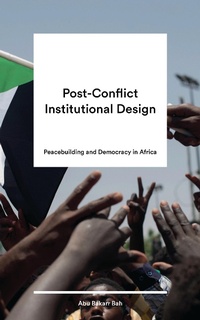
Post-Conflict Institutional Design
Peacebuilding and Democracy in Africa
1st Edition
Published on 15. January 2020
1 pages
978-1-78699-787-6 (ISBN)
Description

Since gaining independence from colonial rule, most African countries have been struggling to build democratic and peaceful states. While African multiparty politics may be viewed as a democratic system of governance, in reality it is plagued by ethnic and regional political grievances that undermine meaningful democracy.
By examining post-conflict institutional reforms in several African countries, this book sheds light on the common causes of violent conflicts and how institutional design can affect the conditions for peace and democracy in Africa. Focussing on conceptual and practical questions of designing ethnically and regionally inclusive state institutions and the way institutions are perceived by the citizenry Post-Conflict Institutional Design addresses political autonomy and control over resources, issues which are often key sources of ethnic and regional grievances. Crucially, it examines the meanings of institutional reforms as well ethnic and regional representation.
By examining post-conflict institutional reforms in several African countries, this book sheds light on the common causes of violent conflicts and how institutional design can affect the conditions for peace and democracy in Africa. Focussing on conceptual and practical questions of designing ethnically and regionally inclusive state institutions and the way institutions are perceived by the citizenry Post-Conflict Institutional Design addresses political autonomy and control over resources, issues which are often key sources of ethnic and regional grievances. Crucially, it examines the meanings of institutional reforms as well ethnic and regional representation.
Reviews / Votes
A creative multi-disciplinary approach to understanding the drivers of violent conflict in Africa, and an important set of contributions to the design of post-conflict political-institutional arrangements. * Alex de Waal, World Peace Foundation * This book valuably illustrates how post-conflict institutional design provides no ready-made template for peaceful governance in Africa, but must be deeply integrated into an understanding of the sources of violence and available social mechanisms for its resolution in each specific case. * Christopher Clapham, University of Cambridge * This is a thought provoking and interesting book that provides new perspectives on peacebuilding and democracy in Africa by bringing together a set of valuable case studies that combine empirical detail with new theoretical perspectives. I enjoyed it immensely. * Nic Cheeseman, University of Birmingham and author of Democracy in Africa * In this innovative and holistic collection, a diverse cast of authors revisit questions of identity, economy and institutions in Africa with sensitivity and nuance. An excellent overview of the challenges and the strengths confronting the continent today. * Zachariah Mampilly, Baruch College *More details
Edition
1. Auflage
Language
English
Place of publication
United Kingdom
Publishing group
Bloomsbury Publishing PLC
Target group
College/higher education
ISBN-13
978-1-78699-787-6 (9781786997876)
Copyright in bibliographic data and cover images is held by Nielsen Book Services Limited or by the publishers or by their respective licensors: all rights reserved.
Schweitzer Classification
Other editions
Additional editions
Book
01/2020
Zed Books Ltd
€112.85
Shipment within 3-4 weeks
Person
Abu Bakarr Bah is Professor of Sociology at Northern Illinois University, USA and Faculty Associate at the Center for Nonprofit and NGO Studies. He is also Editor-in-Chief of African Conflict & Peacebuilding Review and African Editor of Critical Sociology.
Content
1: Introduction: Institutional Design, Peacebuilding, and Democracy -Abu Bakarr Bah
2: The African Human Rights System and the Right to Autonomy - Niklas Hultin
3: Democracy, Postwar Transition and Peacebuilding in Music Videos From Uganda -Okaka Opio Dokotum
4: Harnessing Memory Institutions for Peace and Justice: The Case of South Africa - David Mwambari & Iris Nxumalo
5: Natural Resource Reforms in Postwar Liberia and Sierra Leone: Contradictions and Tensions - Michael D. Beevers
6: Devolution and Electoral Violence in Kenya - Aditi Malik
7: Institutional Design, Democracy, and Peacebuilding in Africa - Abu Bakarr Bah & Fredrick Ogenga
2: The African Human Rights System and the Right to Autonomy - Niklas Hultin
3: Democracy, Postwar Transition and Peacebuilding in Music Videos From Uganda -Okaka Opio Dokotum
4: Harnessing Memory Institutions for Peace and Justice: The Case of South Africa - David Mwambari & Iris Nxumalo
5: Natural Resource Reforms in Postwar Liberia and Sierra Leone: Contradictions and Tensions - Michael D. Beevers
6: Devolution and Electoral Violence in Kenya - Aditi Malik
7: Institutional Design, Democracy, and Peacebuilding in Africa - Abu Bakarr Bah & Fredrick Ogenga
