

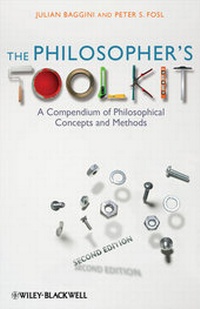
The Philosopher's Toolkit
A Compendium of Philosophical Concepts and Methods
2nd Edition
Published on 19. January 2010
304 pages
978-1-4443-1990-3 (ISBN)
Description

The second edition of this popular compendium provides thenecessary intellectual equipment to engage with and participate ineffective philosophical argument, reading, and reflection
* Features significantly revised, updated and expanded entries,and an entirely new section drawn from methods in the history ofphilosophy
* This edition has a broad, pluralistic approach--appealing toreaders in both continental philosophy and the history ofphilosophy, as well as analytic philosophy
* Explains difficult concepts in an easily accessible manner, andaddresses the use and application of these concepts
* Proven useful to philosophy students at both beginning andadvanced levels
* Features significantly revised, updated and expanded entries,and an entirely new section drawn from methods in the history ofphilosophy
* This edition has a broad, pluralistic approach--appealing toreaders in both continental philosophy and the history ofphilosophy, as well as analytic philosophy
* Explains difficult concepts in an easily accessible manner, andaddresses the use and application of these concepts
* Proven useful to philosophy students at both beginning andadvanced levels
More details
Other editions
Additional editions
Julian Baggini | Peter S. Fosl
The Philosopher's Toolkit
A Compendium of Philosophical Concepts and Methods
Book
04/2010
2nd Edition
Wiley
€19.90
Article exhausted; check for reprint
Persons
Julian Baggini (www.julianbaggini.com) is a freelance writerand co-founding editor of The Philosophers' Magazine.
Peter S. Fosl is Professor of Philosophy at TransylvaniaUniversity in Lexington, Kentucky.
Peter S. Fosl is Professor of Philosophy at TransylvaniaUniversity in Lexington, Kentucky.
Content
Preface.
Acknowledgements.
1. Basic Tools for Argument.
1.1 Arguments, premises and conclusions.
1.2 Deduction.
1.3 Induction.
1.4 Validity and soundness.
1.5 Invalidity.
1.6 Consistency.
1.7 Fallacies.
1.8 Refutation.
1.9 Axioms.
1.10 Definitions.
1.11 Certainty and probability.
1.12 Tautologies, self-contradictions and the law ofnon-contradiction.
2. More Advanced Tools.
2.1 Abduction.
2.2 Hypothetico-deductive method.
2.3 Dialectic.
2.4 Analogies.
2.5 Anomalies and exceptions that prove the rule.
2.6 Intuition pumps.
2.7 Logical constructions.
2.8 Reduction.
2.9 Thought experiments.
2.10 Useful fictions.
3. Tools for Assessment.
3.1 Alternative explanations.
3.2 Ambiguity.
3.3 Bivalence and the excluded middle.
3.4 Category mistakes.
3.5 Ceteris paribus.
3.6 Circularity.
3.7 Conceptual incoherence.
3.8 Counterexamples.
3.9 Criteria.
3.10 Error theory.
3.11 False dichotomy.
3.12 False cause.
3.13 Genetic fallacy.
3.14 Horned dilemmas.
3.15 Is/ought gap.
3.16 Masked man fallacy.
3.17 Partners in guilt.
3.18 Principle of charity.
3.19 Question-begging.
3.20 Reductios.
3.21 Redundancy.
3.22 Regresses.
3.23 Saving the phenomena.
3.24 Self-defeating arguments.
3.25 Sufficient reason.
3.26 Testability.
4. Tools for Conceptual Distinctions.
4.1 A priori/a posteriori.
4.2 Absolute/relative.
4.3 Analytic/synthetic
4.4 Categorical/modal.
4.5 Conditional/biconditional.
4.6 De re/de dicto.
4.7 Defeasible/indefeasible.
4.8 Entailment/implication.
4.9 Essence/accident.
4.10 Internalism/externalism.
4.11 Knowledge by acquaintance/description.
4.12 Necessary/contingent.
4.13 Necessary/sufficient.
4.14 Objective/subjective.
4.15 Realist/non-realist.
4.16 Sense/reference.
4.17 Syntax/semantics.
4.18 Thick/thin concepts.
4.19 Types/tokens.
5. Tools of Historical Schools and Philosophers.
5.1 Aphorism, fragment, remark.
5.2 Categories and specific differences.
5.3 Elenchus and aporia.
5.4 Hume's fork.
5.5 Indirect discourse.
5.6 Leibniz's law of identity.
5.7 Ockham's razor.
5.8 Phenomenological method(s).
5.9 Signs and signifiers.
5.10 Transcendental argument.
6. Tools for Radical Critique.
6.1 Class critique.
6.2 Deconstruction and the critique of presence.
6.3 Empiricist critique of metaphysics.
6.4 Feminist critique.
6.5 Foucaultian critique of power.
6.6 Heideggerian critique of metaphysics.
6.7 Lacanian critique.
6.8 Critiques of naturalism.
6.9 Nietzschean critique of Christian-Platonic culture.
6.10 Pragmatist critique.
6.11 Sartrean critique of 'bad faith'.
7. Tools at the Limit.
7.1 Basic beliefs.
7.2 Gödel and incompleteness.
7.3 Philosophy and/as art.
7.4 Mystical experience and revelation.
7.5 Paradoxes.
7.6 Possibility and impossibility.
7.7 Primitives.
7.8 Self-evident truths.
7.9 Scepticism.
7.10 Underdetermination.
Internet Resources for Philosophers.
Index.
Acknowledgements.
1. Basic Tools for Argument.
1.1 Arguments, premises and conclusions.
1.2 Deduction.
1.3 Induction.
1.4 Validity and soundness.
1.5 Invalidity.
1.6 Consistency.
1.7 Fallacies.
1.8 Refutation.
1.9 Axioms.
1.10 Definitions.
1.11 Certainty and probability.
1.12 Tautologies, self-contradictions and the law ofnon-contradiction.
2. More Advanced Tools.
2.1 Abduction.
2.2 Hypothetico-deductive method.
2.3 Dialectic.
2.4 Analogies.
2.5 Anomalies and exceptions that prove the rule.
2.6 Intuition pumps.
2.7 Logical constructions.
2.8 Reduction.
2.9 Thought experiments.
2.10 Useful fictions.
3. Tools for Assessment.
3.1 Alternative explanations.
3.2 Ambiguity.
3.3 Bivalence and the excluded middle.
3.4 Category mistakes.
3.5 Ceteris paribus.
3.6 Circularity.
3.7 Conceptual incoherence.
3.8 Counterexamples.
3.9 Criteria.
3.10 Error theory.
3.11 False dichotomy.
3.12 False cause.
3.13 Genetic fallacy.
3.14 Horned dilemmas.
3.15 Is/ought gap.
3.16 Masked man fallacy.
3.17 Partners in guilt.
3.18 Principle of charity.
3.19 Question-begging.
3.20 Reductios.
3.21 Redundancy.
3.22 Regresses.
3.23 Saving the phenomena.
3.24 Self-defeating arguments.
3.25 Sufficient reason.
3.26 Testability.
4. Tools for Conceptual Distinctions.
4.1 A priori/a posteriori.
4.2 Absolute/relative.
4.3 Analytic/synthetic
4.4 Categorical/modal.
4.5 Conditional/biconditional.
4.6 De re/de dicto.
4.7 Defeasible/indefeasible.
4.8 Entailment/implication.
4.9 Essence/accident.
4.10 Internalism/externalism.
4.11 Knowledge by acquaintance/description.
4.12 Necessary/contingent.
4.13 Necessary/sufficient.
4.14 Objective/subjective.
4.15 Realist/non-realist.
4.16 Sense/reference.
4.17 Syntax/semantics.
4.18 Thick/thin concepts.
4.19 Types/tokens.
5. Tools of Historical Schools and Philosophers.
5.1 Aphorism, fragment, remark.
5.2 Categories and specific differences.
5.3 Elenchus and aporia.
5.4 Hume's fork.
5.5 Indirect discourse.
5.6 Leibniz's law of identity.
5.7 Ockham's razor.
5.8 Phenomenological method(s).
5.9 Signs and signifiers.
5.10 Transcendental argument.
6. Tools for Radical Critique.
6.1 Class critique.
6.2 Deconstruction and the critique of presence.
6.3 Empiricist critique of metaphysics.
6.4 Feminist critique.
6.5 Foucaultian critique of power.
6.6 Heideggerian critique of metaphysics.
6.7 Lacanian critique.
6.8 Critiques of naturalism.
6.9 Nietzschean critique of Christian-Platonic culture.
6.10 Pragmatist critique.
6.11 Sartrean critique of 'bad faith'.
7. Tools at the Limit.
7.1 Basic beliefs.
7.2 Gödel and incompleteness.
7.3 Philosophy and/as art.
7.4 Mystical experience and revelation.
7.5 Paradoxes.
7.6 Possibility and impossibility.
7.7 Primitives.
7.8 Self-evident truths.
7.9 Scepticism.
7.10 Underdetermination.
Internet Resources for Philosophers.
Index.
