

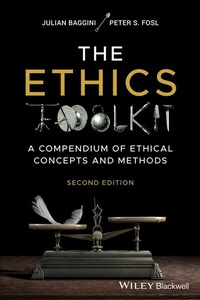
The Ethics Toolkit
Description

The Ethics Toolkit offers an engaging and approachable introduction to the core concepts, principles, and methods of contemporary ethics. Explaining to students and general readers how to think critically about ethics and actually use philosophical concepts, this innovative volume provides the tools and knowledge required to engage intelligently in ethical study, deliberation, and debate.
Invaluable as both a complete guide and a handy reference, this versatile resource provides clear and authoritative information on a diverse range of topics, from fundamental concepts and major ethical frameworks to contemporary critiques and ongoing debates. Throughout the text, Fosl and Baggini highlight the crucial role ethics plays in our lives, exploring autonomy, free will, consciousness, fairness, responsibility, consent, intersectionality, sex and gender, and much more.
Substantially revised and expanded, the second edition of The Ethics Toolkit contains a wealth of new entries, new recommended readings, more detailed textual references, and numerous timely real-world and hypothetical examples.
* Uses clear and accessible language appropriate for use inside and beyond the classroom
* Contains cross-referenced entries to help readers connect and contrast ideas
* Engages both non-Western and Western philosophy
* Offer insights into key issues in ethics with a firm grounding in the history of philosophy
* Includes an appendix of tools for the practice of ethics, including links to podcasts, web and print resources, and prominent ethics organizations
Written by the authors of the popular The Philosophers' Toolkit, this new edition of The Ethics Toolkit is a must-have resource for anyone interested in ethics, from general readers to undergraduate and graduate students.
More details
Other editions
Additional editions
Persons
JULIAN BAGGINI is the author of more than 20 books, including How the World Thinks, The Edge of Reason, and The Ego Trick. He was the founding editor of The Philosophers' Magazine, has served as Academic Director of the Royal Institute of Philosophy and is an Honorary Research Fellow at the University of Kent.
PETER S. FOSL is Professor of Philosophy and Director of the PPE program at Transylvania University, Kentucky, USA. The author of Hume's Scepticism and the recipient of numerous teaching awards, Fosl was appointed the 2013-14 David Hume Fellow at the University of Edinburgh.
Content
Introduction ix
Part I The Grounds of Ethics 1
1.1 Aesthetics 1
1.2 Agency 5
1.3 Authority 8
1.4 Autonomy 12
1.5 Awareness and Consciousness 16
1.6 Character and Self-Cultivation 20
1.7 Conscience 23
1.8 Constraints 26
1.9 Evolution 28
1.10 Flourishing 31
1.11 Harmony 33
1.12 Hierarchy 36
1.13 Interest 39
1.14 Intuition 42
1.15 Natural Law 45
1.16 Need and Desire 49
1.17 Obligation 52
1.18 Pain, Pleasure, and Happiness 54
1.19 Power 58
1.20 Revelation 61
1.21 Rights 64
1.22 Salvation 68
1.23 Sympathy 71
1.24 Tradition and History 73
Part II Central Concepts in Ethics 77
2.1 Act/Omission 77
2.2 Act/Rule 80
2.3 Bad/Evil/Good 82
2.4 Beneficence/Non-Maleficence 85
2.5 Can/Ought 88
2.6 Cause/Reason 90
2.7 Cognitivism/Non-Cognitivism 93
2.8 Consent 97
2.9 Dharma 100
2.10 Excuse/Explanation/Justification 102
2.11 Exploitation 106
2.12 Golden Mean 110
2.13 Harm 113
2.14 Honour/Shame 116
2.15 Identity 121
2.16 Individual/Collective 124
2.17 Intentions/Consequences 127
2.18 Internalism/Externalism 130
2.19 Intersectionality 133
2.20 Intrinsic/Instrumental Value 136
2.21 Karma 139
2.22 Legal/Moral 142
2.23 Liberty, Freedom 145
2.24 Metaethics/Normative Ethics 149
2.25 Moral Subjects and Agents 152
2.26 Public/Private 155
2.27 Responsibility 158
Part III Frameworks for Ethics 162
3.1 Buddhist Ethics 162
3.2 Care 165
3.3 Confucian Role Ethics 168
3.4 Consequentialism 171
3.5 Contractarianism 175
3.6 Cosmopolitanism 178
3.7 Critical Theory and Culture Critique 181
3.8 Discourse Ethics 183
3.9 Divine Command 185
3.10 Duty and Deontological Ethics 188
3.11 Egoism 192
3.12 Naturalism 195
3.13 Particularism 198
3.14 Perfectionism 200
3.15 Rationalism 203
3.16 Relativism 205
3.17 Relationality and Ubuntu 209
3.18 Subjectivism 213
3.19 Virtue Ethics 216
Part IV Assessment, Judgement, and Critique 221
4.1 Ability 221
4.2 Alienation 224
4.3 Authenticity 226
4.4 Class 229
4.5 Common Sense 232
4.6 Consistency 236
4.7 Counterexamples 238
4.8 Equality and Equity 241
4.9 Fairness 244
4.10 Fallacies 248
4.11 Impartiality and Objectivity 251
4.12 The Is/Ought Gap 255
4.13 Justice and Lawfulness 259
4.14 Moral Sentiment 262
4.15 Paternalism 265
4.16 Politics 268
4.17 Race 271
4.18 Reflective Equilibrium 275
4.19 Sex and Gender 277
4.20 Speciesism 280
4.21 Thought Experiments 284
4.22 Universality and Universalizability 286
Part V The Limits of Ethics 290
5.1 Akrasia 290
5.2 Casuistry and Rationalization 293
5.3 Extreme Circumstances, Grey Areas, and Liminal Cases 296
5.4 Fallenness 299
5.5 False Consciousness 302
5.6 Forgiveness and Mercy 306
5.7 Free Will and Determinism 309
5.8 Historical Distance and Time 313
5.9 Moral Luck 316
5.10 Nihilism and Amorality 319
5.11 Pluralism 322
5.12 Radical Disagreement 325
5.13 Radical Particularity 328
5.14 Scepticism 331
5.15 Self-deception 334
5.16 The Separateness of Persons 337
5.17 Standpoint 339
5.18 Supererogation 343
5.19 Tolerance 346
5.20 Tragedy 349
5.21 War 351
Appendix Resources for the Practice of Ethics 356
Index 360
Part I
The Grounds of Ethics
1.1 Aesthetics
"Beauty is truth, truth beauty," wrote John Keats in his 1819 poem "Ode on a Grecian Urn." Was he the victim of a romantic delusion, or is there really, as Plato (c. 429-347 BCE) suggested, an intrinsic relationship between the true, the beautiful, and even the good? Ludwig Wittgenstein (1889-1951) seemed to think there was a connection between at least the last two when he remarked that, "Ethics and aesthetics are one" (Tractatus 6.421). Taking at face value a statement from any thinker as cryptic as Wittgenstein is risky business. But nevertheless, many have argued for deep links between aesthetics and ethics. Beauty can be seen as capable of representing moral goodness, revealing the nature of goodness, and instructing us in goodness.
Representations of the good
Various ethical ideals have been personified in statues and images. At the second-century Library of Celsus in Ephesus, Turkey, for example, you'll encounter statues of women said to symbolize or incarnate wisdom (sophia) and virtue (aretê), while justice is often depicted as a blindfolded woman holding a pair of scales. Besides personifying ethical concepts, the aesthetic can bear ethical import in much more abstract ways. When one looks at, for example, the Parthenon in Athens, one sees a structure that exhibits exquisite balance, proportion, and harmony. The site of the structure on an elevated, central, and historic location communicates a connection with the divine and with the cultural past; it declares itself and functions as the centring pole of the Athenian polis.
What is it, though, that "moral" art such as the Parthenon communicates, and how does it do so? In his 1790 Critique of Judgement, Immanuel Kant (1724-1804) argued that art cannot directly depict moral principles, but it can offer symbols of morality. By this, Kant meant that the way we reflect upon objects of aesthetic experience is somehow analogous to the way we reflect on moral values. "The morally good," Kant writes, "is the intelligible that taste has in view" (AK 5:353). That's why beauty seems bound up with so many notions connected to morality. For example, says Kant, like properly moral thinking our experience of beauty is disinterested; we find beauty in things from which we have absolutely nothing to gain (e.g., someone else's art). Beauty is, argues Kant, universal in the sense that we think every reasonable person ought to be able to see it that way.
Moral judgement's connection to disinterested and normative aesthetic universality becomes evident via the trope of analogy: all rational beings ought to be able to apprehend the beautiful in a way analogous to the way all rational beings ought to be able to recognize what is morally right and good. In short, aesthetic thought makes universal claims independent of self-interest in a way analogous to the normative imperatives of ethical thought.
Revealing and defining the good
The connection between aesthetics and ethics isn't restricted to art representing goodness through sensuous experience. Nature's aesthetic qualities have also been thought to manifest moral significance. Ancient Pythagoreans believed that there are harmonic or at least harmonious relationships (harmonia) among the various structures of the natural world; and they maintained that achieving the good life entails replicating them in one's own soul (psychê), making, as it were, the microcosm correspond to the macrocosm. In his own ways, Plato followed the Pythagoreans in this, for example, in his Republic (e.g., 351d-352a, 443d-444b, 462d-462e). Kant saw in the "play" of our cognitive faculties that takes place in aesthetic experience something of the wondrous and natural fit of things in a morally good world.
Later, Romantic thinkers such as William Blake (1757-1827) and William Wordsworth (1770-1850) would also find in natural beauty a source of moral restoration for those suffering from the depravity of urban, industrial society - as well as an expression of a deeper spiritual or divine goodness and beauty. Reframing societal conceptions of beauty and ugliness has also been part of the struggle for political goodness and virtue, too. An important line of resistance and activism in the movement for black freedom and justice followed the proposition "Black is beautiful!" Labour to advance the social-political condition of women and those with disabilities has often focused on the oppressive effects of conventional standards of beauty.
Art as instruction
Perhaps the most widespread view of art's moral dimension is that it can help through didactic effect to develop our moral sensibilities and understanding. For example, Aristotle's (384-22 BCE) Poetics investigates the powerful and important effects of theatrical tragedy, which provides us with models of behaviour either to emulate or avoid and teaches us the proper objects of emotions such as pity and fear. When one walks around the ruins of ancient Greece, one is struck by the carefully chosen locations of its theatres. Directly above the great temple of Delphi, for example, stands a theatre whose seats survey the sacred mountain hollow below. The Athenian theatre of Dionysus, similarly, sits snuggly at the southern base of the acropolis just below the Parthenon. That's because, for the ancient Greeks and many others after them, art offers not simply the exhibition of morality but also moral instruction within a space promoting capable reflection and deliberation.
As Friedrich Schiller (1759-1805) argued in his "Letters on the Aesthetic Education of Man" (1795), part of moral instruction involves the cultivation of our feelings, sentiments, sympathies, and affections. Aesthetic experience can help people sympathize with the victims of war, crime, abuse, and vice. It can cultivate compassion, moral outrage, pity, pride, devotion, admiration, and respect. It can edify, elevate, and motivate.
Consider, for example, Picasso's painting Guernica (1937), Arnold Schoenberg's cantata A Survivor from Warsaw (1948), Charles Tindley et al.'s song "We Shall Overcome," Judy Chicago's installation Dinner Party (1979), Käthe Kollwiz's poster Vienna is Dying! (1920), Banksy's Israeli separation wall murals (2005-). Religious art, of course - from the stained glass in the Cathedral of Our Lady of Chartres to the transcendent geometries of Istanbul's Sultan Ahmed Blue Mosque - has often been crafted with moral didactics in mind. The relationship between aesthetics and ethics can, in fact, seem so deep as to lead one to wonder whether the former isn't a condition for the possibility of the latter.
But not everyone agrees that art makes us better people. Many great artists and art lovers have been terrible human beings. Degas was an anti-Semite, Caravaggio was violent and erratic, Picasso was a misogynist, and Bach was verbally abusive and carried a dagger because so many detested him. Art may have the potential to improve us, but its power to do so is far from irresistible.
In his dialogue Ion, Plato argues that art is more likely to corrupt than improve. Art (and artists) thought to be obscene, blasphemous, and corrupting has been condemned and attacked for millennia - for example, Salman Rushdie's The Satanic Verses (1988), Manish Harijan's paintings of Hindu gods with cartoon superheroes, Andreas Serano's Piss Christ (1988), the sixth-century Buddhas of Bamiyan, Afghanistan, and the early medieval Christian frescos of Göreme, Turkey. Recently, art that has been interpreted as racist, fortifying racism, or valorizing racists - such as the statue of slave trader and merchant Edward Colston in Bristol, England - has been withdrawn from public view. Whatever else these controversial artworks mean, the powerful passions generated by them give evidence of a widespread belief that art can influence our ethical outlook. Think of how authoritarian regimes always censor their artists, such as when the Nazis vilified what they regarded to be Jewish, Bolshevik, and otherwise degenerate art, such as Paul Klee's and George Grosz's paintings.
Even if aesthetic experience can make a positive contribution to moral understanding, we might still question whether it offers us moral insight, cognition, deliberation, or instruction in a special way that nothing else can match. Which raises the question: is there anything about moral life that aesthetic experience engages best or uniquely? When faced with an ethical problem, is it better to turn to philosophical theory, scripture, friends, paintings, novels, songs, or poems?
SEE ALSO
1.11 Harmony
2.7 Cognitivism/Non-Cognitivism
2.13 Harm
3.14 Perfectionism
3.15 Rationalism
READINGS
- José Louis Bermúdez and Sebastian Gardner eds., Art and Morality (New York: Routledge, 2003)
- Cora Diamond, "Anything but Argument?" Philosophical Investigations 5.1 (1982): 23-41
- Jerrold Levinson, ed., Aesthetics and Ethics: Essays at the Intersection, new edition (Cambridge: Cambridge University Press, 2001)
- Elizabeth Schellekens, Aesthetics and Morality (London:...
