

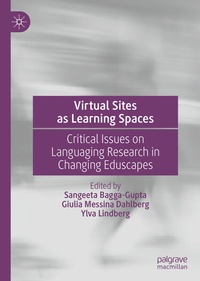
Virtual Sites as Learning Spaces
Description

This volume fills a gap in the literature between the domains of Communication Studies and Educational Sciences across physical-virtual spaces as they intersect in the 21st century. The chapters focus on "languaging" - communicative practices in the making - and its intersection with analogue and virtual learning spaces, bringing together studies that highlight the constant movement between analogue-virtual dimensions that continuously re-shape participants' identity positionings. Languaging is understood as the deployment of one or more than one language variety, modality, embodiment, etc in human meaning-making across spaces. Languaging activities are explored through a multitude of literary artefacts, genres, media, and modes produced in and across sites. The authors go beyond "best practice" approaches and instead present "how-to-explore" communicative practices for researchers, learners and teachers. This book will be of interest to readers situated in the areas of literacy, literature, bi/multilingualism, multimodality, linguistic anthropology, applied linguistics, and related fields.
Chapters 2, 5, 8 and 12 are open access under a CC BY 4.0 license at link.springer.com.
Reviews / Votes
"Virtual Sites as Learning Spaces is a fascinating and well-timed volume, unique in the combination of a social science and humanity perspective on learning in the virtual, and in how it allows a radical rupture with old frameworks on learning, language and identity, triggering the reader to imagine entirely new ones."(Mariëtte de Haan, Professor of Intercultural Education, Utrecht University, Netherlands, and co-editor of Media and Migration - Learning in a Globalized World (2016))
"As distinctions between online and offline contexts become increasingly blurred, our understandings of education and communication need refinement. This volume tackles a range of important questions about the multifaceted nature of language, literacies and learning across a range of digital-analogue contexts - from Facebook to Wikipedia. It is an empirically-rich and theoretically-varied addition to the critical literature on technology and education." (Neil Selwyn, Monash University, Australia, and author of Is Technology Good for Education? (2016))
"This book is an important contribution to the emergent research tradition on the potential and challenges that digital language practices have for understanding, enabling and investigating learning. It highlights crucial theoretical and methodological questions that scholars need to engage with and problematizes and provides nuanced empirical analyses of digital-analogue practices, illuminating the significance and value of digitality in contemporary education."(Sirpa Leppänen, Professor, Department of Language and Communication Studies, University of Jyväskylä, Finland)
"The 13 fascinating chapters in this volume address a variety of critical didactic topics that arise with the timely conception of virtual sites as eduscapes. The chapters shed new light on the language, genres, and ideologies at play in contemporary learning. The volume will enlighten educators and learners as well as a broader public interested in learning and new media." (Sune Auken, Leader of the Centre for Genre Research, University of Copenhagen, Denmark)
More details
Other editions
Additional editions
Persons
Sangeeta Bagga-Gupta is Full Professor of Education with a Multidisciplinary Focus at Jönköping University, Sweden. She is the Director of the research environment LPS, Learning Practices inside and outside Schools and leads the ongoing Swedish Research Council project PAL, Participation for all?
Giulia Messina Dahlberg is Senior Lecturer in Education at the Department of Education and Special Education, University of Gothenburg, Sweden. She is the co-leader of the network-based research environment CCD, Communication, Culture and Diversity.
Ylva Lindberg is Associate Professor in Comparative Literature at Jönköping University, Sweden. She is Dean of Research at the School of Education and Communication and the senior-leader of the network-based research environment CCD, Communication, Culture and Diversity.
Content
Section 1: Institutional Framing and Policies.- Chapter 1: On Epistemological Issues in Technologically Infused Spaces: Notes on Virtual Sites for Learning (Sangeeta Bagga-Gupta and Giulia Messina Dahlberg).- Chapter 2: Inscriptions and Digitalization Initiatives Across Time in the Nation-Sate of Sweden: the Relevance of Shifts and Continuities in Policy Accounts for Teachers' Work (Lars Almén and Sangeeta Bagga-Gupta).- Chapter 3: Authenticity of Language Practices in Virtual Learning Sites (Jonathan White).- Section 2: Genre Framings.- Chapter 4: Wikipedia's Falling Stars: Arguments for Demotion When Articles Lose Their Status as Featured Articles (Maria Mattus).- Chapter 5: The Story Event "The Beauty and the Beast" in Second Life: Literature Studies and the (Non-)Adoption of Virtual Worlds (Ylva Lindberg).- Chapter 6: Text Universe- a Pedagogical Strategy to Teach Literary Classics (Anette Svensson and Stefan Lundström).- Chapter 7: Wikipedia as a Virtual Learning Site anda Multilingual Languaging Site (Sverker Johansson and Ylva Lindberg).- Section 3: Identity and Learning Framings.- Chapter 8: "Oh it was a woman! Had I known I would have reacted otherwise!" Developing Digital Methods to Switch Identity-Related Properties in Order to Reveal Linguistic Stereotyping (Mattias Lindvall-Östling, Mats Deutschmann and Anders Steinvall).- Chapter 9: "Going on trial": Teachers' Team Performance in Social Media Groups When Facing Problematic Work-Related Issues (Louise Peterson, Annika Lantz-Andersson, Thomas Hillman, Mona Lundin and Annika Bergviken Rensfeldt).- Chapter 10: The Conceptualization of Time, Space and the Body in Virtual Sites and the Impact on Language Learner Identities (Regine Hampel).- Chapter 11: Self-Directed Language Learning: a Semiotic Analysis of a Language Learning App (Wing Yee and Jennifer Ho).- Section 4: Researching Virtual Learning Sites.- Chapter 12: Handling Languaging During Empirical Research: Ethnography as Action in and AcrossTime and Physical-Virtual Sites (Sangeeta Bagga-Gupta, Giulia Messina Dahlberg and Annaliina Gynne).- Chapter 13: On Methodology and the Educational Services: Reflections on the ViLS Contributions (Ylva Lindberg).
