

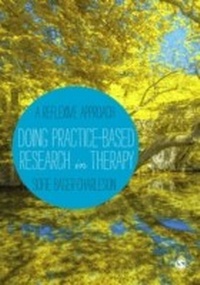
Doing Practice-based Research in Therapy
A Reflexive Approach
1st Edition
Published on 23. January 2014
216 pages
978-1-4462-9778-0 (ISBN)
Description

Learning how to use critical self-reflection creatively when practising therapy is an important component of training. This level of self-awareness is, however, often neglected in research, despite the centrality of the researcher to their work. Doing Practice-based Research in Therapy: A Reflexive Approach makes the vital link between practical research skills and self-awareness, critical reflection and personal development in practice-based research. Starting with a clear introduction to the theory, practice and debates surrounding this type of research, the book then guides the reader step-by-step through the practicalities of the research process, encouraging them to reflect upon and evaluate their practice at each stage.
The book:
- incorporates case studies throughout to illustrate different methodological approaches
- uses real life examples from students conducting practice-based psychotherapy research
- includes exercises, chapter objectives, end-of-chapter questions and suggestions for further reading to help consolidate learning
- encourages ongoing personal development by introducing personal development planning (PDP) and lifelong learning in the field of research.
By demystifying the reflexive approach, this highly practical guide ensures that trainees and qualified therapists get the most, both professionally and personally, from their practice-based research.
The book:
- incorporates case studies throughout to illustrate different methodological approaches
- uses real life examples from students conducting practice-based psychotherapy research
- includes exercises, chapter objectives, end-of-chapter questions and suggestions for further reading to help consolidate learning
- encourages ongoing personal development by introducing personal development planning (PDP) and lifelong learning in the field of research.
By demystifying the reflexive approach, this highly practical guide ensures that trainees and qualified therapists get the most, both professionally and personally, from their practice-based research.
Reviews / Votes
The book is very well structured and it could be used by a wide audience, at different levels of experience and expertise. -- Dr Biljana van Rijn Practice-based research is not well understood in the general social science research literature and this text will make a distinct contribution. -- Jeannie Wright The real strength of the book lies in its evident grounding in ongoing and current research practice, frequently quoting from, or giving live examples of, students' work, such as the personal impact of going through a professional complaint or evaluating a voluntary sector agency providing school-based therapy. Hence the chapter on formulating a research question, often the key struggle for beginning researchers, gives a range of real-life examples which will be valuable to most readers. -- Peter Jenkins - Senior Lecturer in Counselling at the University of Manchester Like Bager-Charleson, I come from a position that holds that all practitioners are knowledge creators, that every counselling session is potentially a source of new and important knowledge. However, as this book recognises, the professions of counselling and psychotherapy have struggled with finding methods of research that generate new ????knowledge to inform a developing profession while honouring its deeply subjective dimensions. This book sets out to demystify research, and to correct the profession?'s somewhat uncritical adoption of positivist methods of gathering evidence without due reference to the complex subjectivity of the researcher. It seeks to offer practitioners a perspective that allows them to appreciate the potential of a research approach that acknowledges and explores the messiness of everyday practice... ??I came to this book with high hopes and expectations stemming from my own struggles as a practitioner-researcher who also teaches research methods for guidance counsellors. I had hoped to find in this book a resource for helping me to think creatively about possibilities for methods congruent with the reflexive nature of psychotherapy. Though not without flaws, this book has easily met those expectations.????? -- Dr David McCormackMore details
Edition
1. Auflage
Language
English
Place of publication
London
United Kingdom
Target group
College/higher education
Product notice
Reflowable
ISBN-13
978-1-4462-9778-0 (9781446297780)
Copyright in bibliographic data and cover images is held by Nielsen Book Services Limited or by the publishers or by their respective licensors: all rights reserved.
Schweitzer Classification
Other editions
Additional editions
Book
01/2014
1st Edition
SAGE Publications Ltd
€181.54
Shipment within 15-20 days
Book
01/2014
1st Edition
SAGE Publications Ltd
€79.80
Shipment within 15-20 days
Person
Sofie Bager-Charleson is a psychotherapist, supervisor and writer. She draws from psychoanalytic, existential and cognitive behavioural theory with a particular interest in postmodern influences on therapy. She holds a PhD from Lund University in Sweden, where she specialised in attachment issues within families and reflective practice amongst teachers. She writes both fiction and non-fiction. She works as the Director of Studies on the MPhil/PhD at Metanoia Institute and Module Leader on the DPsych. She runs workshops and courses in therapeutic practice, reflective and creative writing, in both Sweden and England.
Content
Real-life research
Personal Development
A cross-disciplinary and multi-method approach of multilingualism in psychotherapy, by Jean-Marc Dewaele & Beverley Costa
What is evidence-based research?
Formulating the research question
Doing Your Literature Review, by Simon du Plock
Considering Ethics
The researcher as a person
Epistemology and methodology,
What is reflexivity?
Reflexivity on introspection
Reflexivity as intersubjective reflection
Reflexivity as mutual collaboration
Making an Impact, by Simon du Plock
Concluding remarks
Personal Development
A cross-disciplinary and multi-method approach of multilingualism in psychotherapy, by Jean-Marc Dewaele & Beverley Costa
What is evidence-based research?
Formulating the research question
Doing Your Literature Review, by Simon du Plock
Considering Ethics
The researcher as a person
Epistemology and methodology,
What is reflexivity?
Reflexivity on introspection
Reflexivity as intersubjective reflection
Reflexivity as mutual collaboration
Making an Impact, by Simon du Plock
Concluding remarks
