

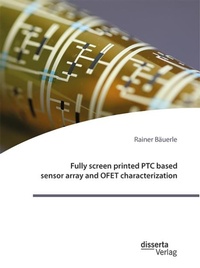
Fully screen printed PTC based sensor array and OFET characterization
Published in June 2025
127 pages
978-3-95935-633-6 (ISBN)
Description

Diese Arbeit stellt ein neuartiges Sensorkonzept vor. Für kostengünstige und einfach anpassbare Produktion ist der gesamte Sensor siebgedruckt. Der Kern des Sensors ist ein Kaltleiter mit spezieller Widerstand-Temperatur-Charakteristik. Durch Messen des Wärmeflusses wird der Füllstand einer Flüssigkeit in einem Container gemessen. Der Sensor ist hierbei außen am Container und nicht im Inneren. Weiterhin kann der Sensor den Luftstrom messen. Dadurch wird es möglich, den Luftstrom an der Oberfläche von Objekten zu erfassen, ohne abstehende Messsonden in den Luftstrom zu platzieren. Zusätzlich zu diesen Sensoren werden OFETs für die Anwendung in einer Sensormatrix untersucht.
Die hier entwickelten Sensoren ermöglicht eine einfache, anpassbare, und nachträgliche Installation einer Füllstandsmessung und erlauben eine Kartografierung des Luftstroms an der Objektoberfläche.
More details
Other editions
Additional editions

Book
10/2024
1st Edition
disserta Verlag
€49.50
Shipment within 7-9 days
Content
- Cover
- Copyright
- Table of contents
- 1. Introduction
- 2. Fundamentals
- 2.1. Organic Electronics
- 2.2. Positive Temperature Coefficient
- 2.3. Heat Flow
- 3. Device Fabrication and Characterization
- 3.1. Screen Printing
- 3.2. PTC Sensor Array Readout
- 3.3. Film Preparation
- 3.4. Analytical Methods
- 3.5. OFET Fabrication
- 4. Sensor Concept, Layout, and Verification
- 4.1. Conception
- 4.2. Verification
- 5. Level Sensor
- 5.1. Sensor Principle and Design
- 5.2. Single Level Sensing
- 5.3. Mixture Investigation
- 5.4. Outlook
- 6. Airflow Sensor
- 6.1. Sensor Principle and Design
- 6.2. Experimental Results
- 6.3. Sensor Matrix
- 7. OFET
- 7.1. Semiconductor Characterization
- 7.2. Device Characterization
- 8. Summary and Outlook
- A. Appendix
- A.1. Code
- Acronyms
- Bibliography
- Acronyms
- List of Figures
- List of Tables
- Publications, Presentations, Theses
1. Introduction
Sensors are part of every device nowadays. Cars incorporate sensors to obtain details
about their environment to a degree that allows autonomous driving [1, 2], people
wear smartwatches with over 10 different kinds of sensors [3], and smart clothes with
multiple sensors have emerged [4, 5]. Research and development of sensors never
stopped and is driven by the desire to gain further and more detailed information on
everything. Discovery of electrically conductive polymers and subsequent research in
conductive and semiconductive organic materials opened new and vast possibilities
for many sensors [6-9]. As the discovery revolutionized thinking about plastics in
electricity, the discoverers were awarded the Nobel Prize in 2000 [10]. Since then,
a vast selection of different organic materials has been found and tailored to suit
different applications, many of which are of the sensory type. Materials change
their properties, such as conductivity, depending on outer stimuli, meaning they
can sense aspects of their environment. The new group of materials not only allows
for new sensors by material properties, but also by their processibility. While most
classical inorganic (semi-)conductors require high vacuum, high temperatures and
further costly process conditions, many organic materials can be solution-processed,
thereby circumventing the cost intensive requirements. Devices made out of organic
electronics can thus be fabricated and offered at a much cheaper price. Methods for
solution-processing include, among others, spin-coating, blade-coating, and, most
important for structured devices, various printing techniques [11-15]. Inkjet, aerosol,
roll-to-roll, and screen printing can be utilized, depending on the materials' properties
and ability to form suitable inks. These printing options allow for cost-effective mass
production, production runs with low quantities to single prototypes, or individual
customization. Because most polymers are flexible and forgiving to bends, devices can
be fabricated on flexible substrates and mechanically new options become available.
Perhaps the most eye-catching commercial flexible devices today (2023) are curved
and bendable displays which are - albeit still at a premium price - readily available
[16, 17]. Less eye-catching, but nonetheless commercialized, are sensors based on
organic materials. The company InnovationLab GmbH developed and is already
selling organic sensor solutions1.
Another well commercialized product are resettable fuses based on polymers. They
heat up under power and limit currents. Current limitation is achieved by a strong
temperature-resistance correlation of the devices. Such correlations can be used
1https://www.innovationlab.de/en/printed-electronics/products/, accessed 19.06.23.
1
1. Introduction
as a sensing principle. If the behavior of the device is known, a resistance can
be translated to a temperature, rendering the device a temperature sensor. As
with most sensors, the measured variable (resistance) and the concluded parameter
(temperature) are not the same. Furthermore, the first concluded parameter can be
interpreted for further assumptions. In a heated device, the equilibrium temperature
depends on the environment's ability to absorb heat. An environment with good
heat absorption or conduction keeps the device cooler. The measured temperature
can therefore be interpreted to obtain thermal information about the environment.
Elevated temperatures, however, are a major challenge for organic electronics.
Further challenges are short lifetimes and quick degradation [18-20], both often
linked with weak performance under elevated temperatures. Commercial materials
are tested and optimized and can therefore be used right away in applications and
devices (within their specifications). Lifetime and longevity are thus good. New lab
materials, however, are often severely limited in their applications. Development of
air-stable and long-living materials and devices remains challenging and the materials
must be thoroughly tested. The world's largest chemical producer BASF, a partner
of the 2-HORISONS project, created a promising semiconductor candidate for use in
OFETs. The produced OFETs are intended for use in a sensor array. Sensors in an
array are used to obtain information about an area rather than one single value. For
technical reasons it is often useful to individually electronically switch through the
single sensors of the array with transistors, making it an active matrix. The new
semiconductor is tested for use in these transistors. As the semiconductor candidate
is a new material, however, the fabrication of devices using this material requires
tuning of process parameters. This can be done by simply guessing parameters
and testing the respective devices, and then adjusting the parameters based on the
results.
This work introduces a new sensor concept and application thereof and reports on
a new organic semiconductor intended for use in OFETs. A brief explanation of the
relevant topics as well as of the methods used is given in the beginning. Thereafter,
a new sensor is introduced. First, the general sensing concept is described. The
relation between resistance and temperature of the material is investigated and
exploited for sensing. Temperature itself is not the relevant property but rather heat
flow out of the device. To acquire data of an area, multiple single sensing pixels are
then combined, and circuitry and a readout are added to the sensor to visualize the
data. The finalized version of the sensor is then tested in two applications. In the
first application, the sensor detects the height of a liquid inside a container. The
information is obtained because of different cooling capabilities of materials and
accordingly different temperatures of sensor pixels. Based on the required power
to keep a specific temperature, liquid surfaces and interfaces are found. Due to
gravity, the liquid's surface is flat and only the height is of interest. Therefore, the
2
pixels are arranged in a vertical array. In the second application, the sensor is used
to map airflow. It functions similar to the level sensor, but with varying airflow
providing diverse cooling for pixels instead of the thermal mass of liquids. Airflow
over a surface is usually not uniform. Because of that, the pixels of the sensor are
arranged in a 2D array, resulting in the sensor mapping the airflow over a surface.
Following the description of the sensor, the organic field effect transistor (OFET)
is investigated. First, the material is examined with photoelectron spectroscopy
(PES). The experimentally obtained chemical composition is compared with the
desired structure to verify successful synthesis. Second, devices incorporating this
material are investigated. Basic on/off functionality is tested first. The resulting
on-off ratios as well as currents are reported to the fabrication team that then use
these results to improve performance. After good samples have been produced, they
are tested against operational stress. Devices are also continuously driven for days
under various conditions, e.g. permanently on or permanently off. Finally, the
temperature behavior of the devices is examined. As the OFETs are used in an
active matrix in conjunction with temperature sensors, they must be stable over
the whole temperature range to not falsify the results. Therefore, their behavior,
like on- and off-current, is recorded for a temperature range of 20? to 90?. To
estimate the influence of the OFETs on the result, they are also tested in series with
the temperature sensors. The major findings are then summarized. Textprobe:
Sensors are part of every device nowadays. Cars incorporate sensors to obtain details
about their environment to a degree that allows autonomous driving [1, 2], people
wear smartwatches with over 10 different kinds of sensors [3], and smart clothes with
multiple sensors have emerged [4, 5]. Research and development of sensors never
stopped and is driven by the desire to gain further and more detailed information on
everything. Discovery of electrically conductive polymers and subsequent research in
conductive and semiconductive organic materials opened new and vast possibilities
for many sensors [6-9]. As the discovery revolutionized thinking about plastics in
electricity, the discoverers were awarded the Nobel Prize in 2000 [10]. Since then,
a vast selection of different organic materials has been found and tailored to suit
different applications, many of which are of the sensory type. Materials change
their properties, such as conductivity, depending on outer stimuli, meaning they
can sense aspects of their environment. The new group of materials not only allows
for new sensors by material properties, but also by their processibility. While most
classical inorganic (semi-)conductors require high vacuum, high temperatures and
further costly process conditions, many organic materials can be solution-processed,
thereby circumventing the cost intensive requirements. Devices made out of organic
electronics can thus be fabricated and offered at a much cheaper price. Methods for
solution-processing include, among others, spin-coating, blade-coating, and, most
important for structured devices, various printing techniques [11-15]. Inkjet, aerosol,
roll-to-roll, and screen printing can be utilized, depending on the materials' properties
and ability to form suitable inks. These printing options allow for cost-effective mass
production, production runs with low quantities to single prototypes, or individual
customization. Because most polymers are flexible and forgiving to bends, devices can
be fabricated on flexible substrates and mechanically new options become available.
Perhaps the most eye-catching commercial flexible devices today (2023) are curved
and bendable displays which are - albeit still at a premium price - readily available
[16, 17]. Less eye-catching, but nonetheless commercialized, are sensors based on
organic materials. The company InnovationLab GmbH developed and is already
selling organic sensor solutions1.
Another well commercialized product are resettable fuses based on polymers. They
heat up under power and limit currents. Current limitation is achieved by a strong
temperature-resistance correlation of the devices. Such correlations can be used
1https://www.innovationlab.de/en/printed-electronics/products/, accessed 19.06.23.
1
1. Introduction
as a sensing principle. If the behavior of the device is known, a resistance can
be translated to a temperature, rendering the device a temperature sensor. As
with most sensors, the measured variable (resistance) and the concluded parameter
(temperature) are not the same. Furthermore, the first concluded parameter can be
interpreted for further assumptions. In a heated device, the equilibrium temperature
depends on the environment's ability to absorb heat. An environment with good
heat absorption or conduction keeps the device cooler. The measured temperature
can therefore be interpreted to obtain thermal information about the environment.
Elevated temperatures, however, are a major challenge for organic electronics.
Further challenges are short lifetimes and quick degradation [18-20], both often
linked with weak performance under elevated temperatures. Commercial materials
are tested and optimized and can therefore be used right away in applications and
devices (within their specifications). Lifetime and longevity are thus good. New lab
materials, however, are often severely limited in their applications. Development of
air-stable and long-living materials and devices remains challenging and the materials
must be thoroughly tested. The world's largest chemical producer BASF, a partner
of the 2-HORISONS project, created a promising semiconductor candidate for use in
OFETs. The produced OFETs are intended for use in a sensor array. Sensors in an
array are used to obtain information about an area rather than one single value. For
technical reasons it is often useful to individually electronically switch through the
single sensors of the array with transistors, making it an active matrix. The new
semiconductor is tested for use in these transistors. As the semiconductor candidate
is a new material, however, the fabrication of devices using this material requires
tuning of process parameters. This can be done by simply guessing parameters
and testing the respective devices, and then adjusting the parameters based on the
results.
This work introduces a new sensor concept and application thereof and reports on
a new organic semiconductor intended for use in OFETs. A brief explanation of the
relevant topics as well as of the methods used is given in the beginning. Thereafter,
a new sensor is introduced. First, the general sensing concept is described. The
relation between resistance and temperature of the material is investigated and
exploited for sensing. Temperature itself is not the relevant property but rather heat
flow out of the device. To acquire data of an area, multiple single sensing pixels are
then combined, and circuitry and a readout are added to the sensor to visualize the
data. The finalized version of the sensor is then tested in two applications. In the
first application, the sensor detects the height of a liquid inside a container. The
information is obtained because of different cooling capabilities of materials and
accordingly different temperatures of sensor pixels. Based on the required power
to keep a specific temperature, liquid surfaces and interfaces are found. Due to
gravity, the liquid's surface is flat and only the height is of interest. Therefore, the
2
pixels are arranged in a vertical array. In the second application, the sensor is used
to map airflow. It functions similar to the level sensor, but with varying airflow
providing diverse cooling for pixels instead of the thermal mass of liquids. Airflow
over a surface is usually not uniform. Because of that, the pixels of the sensor are
arranged in a 2D array, resulting in the sensor mapping the airflow over a surface.
Following the description of the sensor, the organic field effect transistor (OFET)
is investigated. First, the material is examined with photoelectron spectroscopy
(PES). The experimentally obtained chemical composition is compared with the
desired structure to verify successful synthesis. Second, devices incorporating this
material are investigated. Basic on/off functionality is tested first. The resulting
on-off ratios as well as currents are reported to the fabrication team that then use
these results to improve performance. After good samples have been produced, they
are tested against operational stress. Devices are also continuously driven for days
under various conditions, e.g. permanently on or permanently off. Finally, the
temperature behavior of the devices is examined. As the OFETs are used in an
active matrix in conjunction with temperature sensors, they must be stable over
the whole temperature range to not falsify the results. Therefore, their behavior,
like on- and off-current, is recorded for a temperature range of 20? to 90?. To
estimate the influence of the OFETs on the result, they are also tested in series with
the temperature sensors. The major findings are then summarized. Textprobe:
