

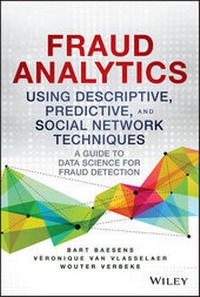
Fraud Analytics Using Descriptive, Predictive, and Social Network Techniques
A Guide to Data Science for Fraud Detection
Published on 27. July 2015
400 pages
978-1-119-14683-4 (ISBN)
Description

Detect fraud earlier to mitigate loss and prevent cascading damage
Fraud Analytics Using Descriptive, Predictive, and Social Network Techniques is an authoritative guidebook for setting up a comprehensive fraud detection analytics solution. Early detection is a key factor in mitigating fraud damage, but it involves more specialized techniques than detecting fraud at the more advanced stages. This invaluable guide details both the theory and technical aspects of these techniques, and provides expert insight into streamlining implementation. Coverage includes data gathering, preprocessing, model building, and post-implementation, with comprehensive guidance on various learning techniques and the data types utilized by each. These techniques are effective for fraud detection across industry boundaries, including applications in insurance fraud, credit card fraud, anti-money laundering, healthcare fraud, telecommunications fraud, click fraud, tax evasion, and more, giving you a highly practical framework for fraud prevention.
It is estimated that a typical organization loses about 5% of its revenue to fraud every year. More effective fraud detection is possible, and this book describes the various analytical techniques your organization must implement to put a stop to the revenue leak.
* Examine fraud patterns in historical data
* Utilize labeled, unlabeled, and networked data
* Detect fraud before the damage cascades
* Reduce losses, increase recovery, and tighten security
The longer fraud is allowed to go on, the more harm it causes. It expands exponentially, sending ripples of damage throughout the organization, and becomes more and more complex to track, stop, and reverse. Fraud prevention relies on early and effective fraud detection, enabled by the techniques discussed here. Fraud Analytics Using Descriptive, Predictive, and Social Network Techniques helps you stop fraud in its tracks, and eliminate the opportunities for future occurrence.
More details
Other editions
Additional editions
Bart Baesens | Veronique Van Vlasselaer | Wouter Verbeke
Fraud Analytics Using Descriptive, Predictive, and Social Network Techniques
A Guide to Data Science for Fraud Detection
Book
10/2015
Wiley
€48.50
Shipment within 15-20 days
Software
07/2015
Wiley
€46.80
No shipping information available
Persons
BART BAESENS is a full professor at KU Leuven, and a lecturer at the University ofSouthampton. He has done extensive research on analytics, customer relationshipmanagement, web analytics, fraud detection, and credit risk management. He regularlyadvises and provides consulting support to international firms with respect to theiranalytics and credit risk management strategy.
VÉRONIQUE VAN VLASSELAER is a PhD researcher in the Department of DecisionSciences and Information Management at KU Leuven. Her research focuses on the development of new techniques for fraud detection by combining predictive and network analytics.
WOUTER VERBEKE is an assistant professor at Vrije Universiteit Brussel (Brussels,Belgium). His research is situated in the field of predictive analytics and complex networkanalysis with applications in fraud, marketing, credit risk, human resources management,and mobility.
Content
Chapter 1: Fraud: Detection, Prevention & Analytics!
Introduction
Fraud!
Fraud Detection and Prevention
Big Data for Fraud Detection
Data Driven Fraud Detection
Fraud Detection Techniques
Fraud Cycle
The Fraud Analytics Process Model
Fraud Data Scientists
A Scientific Perspective on Fraud
References
Chapter 2: Data Collection, Sampling and Preprocessing
Introduction
Types of Data Sources
Merging Data Sources
Sampling
Types of Data Elements
Visual Data Exploration and Exploratory Statistical Analysis
Benford's Law
Descriptive Statistics
Missing Values
Outlier Detection and Treatment
Red Flags
Standardizing Data
Categorization
Weights Of Evidence Coding
Variable Selection
Principal Components Analysis
Ridits
PRIDIT Analysis
Segmentation
References
Chapter 3: Descriptive Analytics for Fraud Detection
Introduction
Graphical Outlier Detection Procedures
Statistical Outlier Detection Procedures
Clustering
One Class SVMs
References
Chapter 4: Predictive Analytics for Fraud Detection
Introduction
Target Definition
Linear Regression
Logistic Regression
Variable Selection for Linear and Logistic Regression
Decision Trees
Neural Networks
Support Vector Machines
Ensemble Methods
Multiclass Classification Techniques
Evaluating Predictive Models
Other Performance Measures for Predictive Analytical Models
Developing Predictive Models for Skewed Data Sets
Fraud Performance Benchmarks
References
Chapter 5: Social Network Analysis for Fraud Detection
Networks: Form, Components, Characteristics and their Applications
Is Fraud a Social Phenomenon? An Introduction to Homophily
Impact of the Neighborhood: Metrics
Community Mining: Finding Groups of Fraudsters
Extending the Graph: Towards a Bipartite Representation
Case Study: GOTCHA!
References
Chapter 6: Fraud Analytics: Post Processing
Introduction
The Analytical Fraud Model Lifecycle
Model Representation
Selecting the Sample to Investigate
Fraud Alert and Case Management
Visual Analytics
Backtesting Analytical Fraud Models
Model Design and Documentation
References
Chapter 7: Fraud Analytics: A Broader Perspective
Introduction
Data Quality
Privacy
Capital Calculation for Fraud Loss
An Economic Perspective on Fraud Analytics
In- Versus Outsourcing
Modeling Extensions
The Internet of Things
Corporate Fraud Governance
List of Figures
- Figure 1.1 Fraud Triangle
- Figure 1.2 Fire Incident Claim-Handling Process
- Figure 1.3 The Fraud Cycle
- Figure 1.4 Outlier Detection at the Data Item Level
- Figure 1.5 Outlier Detection at the Data Set Level
- Figure 1.6 The Fraud Analytics Process Model
- Figure 1.7 Profile of a Fraud Data Scientist
- Figure 1.8 Screenshot of Web of Science Statistics for Scientific Publications on Fraud between 1996 and 2014
- Figure 2.1 Aggregating Normalized Data Tables into a Non-Normalized Data Table
- Figure 2.2 Pie Charts for Exploratory Data Analysis
- Figure 2.3 Benford's Law Describing the Frequency Distribution of the First Digit
- Figure 2.4 Multivariate Outliers
- Figure 2.5 Histogram for Outlier Detection
- Figure 2.6 Box Plots for Outlier Detection
- Figure 2.7 Using the z-Scores for Truncation
- Figure 2.8 Default Risk Versus Age
- Figure 2.9 Illustration of Principal Component Analysis in a Two-Dimensional Data Set
- Figure 3.1 3D Scatter Plot for Detecting Outliers
- Figure 3.2 OLAP Cube for Fraud Detection
- Figure 3.3 Example Pivot Table for Credit Card Fraud Detection
- Figure 3.4 Break-Point Analysis
- Figure 3.5 Peer-Group Analysis
- Figure 3.6 Cluster Analysis for Fraud Detection
- Figure 3.7 Hierarchical Versus Nonhierarchical Clustering Techniques
- Figure 3.8 Euclidean Versus Manhattan Distance
- Figure 3.9 Divisive Versus Agglomerative Hierarchical Clustering
- Figure 3.10 Calculating Distances between Clusters
- Figure 3.11 Example for Clustering Birds. The Numbers Indicate the Clustering Steps
- Figure 3.12 Dendrogram for Birds Example. The Thick Black Line Indicates the Optimal Clustering
- Figure 3.13 Screen Plot for Clustering
- Figure 3.14 Scatter Plot of Hierarchical Clustering Data
- Figure 3.15 Output of Hierarchical Clustering Procedures
- Figure 3.16 k-Means Clustering: Start from Original Data
- Figure 3.17 k-Means Clustering Iteration 1: Randomly Select Initial Cluster Centroids
- Figure 3.18 k-Means Clustering Iteration 1: Assign Remaining Observations
- Figure 3.19 k-Means Iteration Step 2: Recalculate Cluster Centroids
- Figure 3.20 k-Means Clustering Iteration 2: Reassign Observations
- Figure 3.21 k-Means Clustering Iteration 3: Recalculate Cluster Centroids
- Figure 3.22 k-Means Clustering Iteration 3: Reassign Observations
- Figure 3.23 Rectangular Versus Hexagonal SOM Grid
- Figure 3.24 Clustering Countries Using SOMs
- Figure 3.25 Component Plane for Literacy
- Figure 3.26 Component Plane for Political Rights
- Figure 3.27 Must-Link and Cannot-Link Constraints in Semi-Supervised Clustering
- Figure 3.28 d-Constraints in Semi-Supervised Clustering
- Figure 3.29 e-Constraints in Semi-Supervised Clustering
- Figure 3.30 Cluster Profiling Using Histograms
- Figure 3.31 Using Decision Trees for Clustering Interpretation
- Figure 3.32 One-Class Support Vector Machines
- Figure 4.1 A Spider Construction in Tax Evasion Fraud
- Figure 4.2 Regular Versus Fraudulent Bankruptcy
- Figure 4.3 OLS Regression
- Figure 4.4 Bounding Function for Logistic Regression
- Figure 4.5 Linear Decision Boundary of Logistic Regression
- Figure 4.6 Other Transformations
- Figure 4.7 Fraud Detection Scorecard
- Figure 4.8 Calculating the p-Value with a Student's t-Distribution
- Figure 4.9 Variable Subsets for Four Variables V1, V2, V3, and V4
- Figure 4.10 Example Decision Tree
- Figure 4.11 Example Data Sets for Calculating Impurity
- Figure 4.12 Entropy Versus Gini
- Figure 4.13 Calculating the Entropy for Age Split
- Figure 4.14 Using a Validation Set to Stop Growing a Decision Tree
- Figure 4.15 Decision Boundary of a Decision Tree
- Figure 4.16 Example Regression Tree for Predicting the Fraud Percentage
- Figure 4.17 Neural Network Representation of Logistic Regression
- Figure 4.18 A Multilayer Perceptron (MLP) Neural Network
- Figure 4.19 Local Versus Global Minima
- Figure 4.20 Using a Validation Set for Stopping Neural Network Training
- Figure 4.21 Example Hinton Diagram
- Figure 4.22 Backward Variable Selection
- Figure 4.23 Decompositional Approach for Neural Network Rule Extraction
- Figure 4.24 Pedagogical Approach for Rule Extraction
- Figure 4.25 Two-Stage Models
- Figure 4.26 Multiple Separating Hyperplanes
- Figure 4.27 SVM Classifier for the Perfectly Linearly Separable Case
- Figure 4.28 SVM Classifier in Case of Overlapping Distributions
- Figure 4.29 The Feature Space Mapping
- Figure 4.30 SVMs for Regression
- Figure 4.31 Representing an SVM Classifier as a Neural Network
- Figure 4.32 One-Versus-One Coding for Multiclass Problems
- Figure 4.33 One-Versus-All Coding for Multiclass Problems
- Figure 4.34 Training Versus Test Sample Set Up for Performance Estimation
- Figure 4.35 Cross-Validation for Performance Measurement
- Figure 4.36 Bootstrapping
- Figure 4.37 Calculating Predictions Using a Cut-Off
- Figure 4.38 The Receiver Operating Characteristic Curve
- Figure 4.39 Lift Curve
- Figure 4.40 Cumulative Accuracy Profile
- Figure 4.41 Calculating the Accuracy Ratio
- Figure 4.42 The Kolmogorov-Smirnov Statistic
- Figure 4.43 A Cumulative Notch Difference Graph
- Figure 4.44 Scatter Plot: Predicted Fraud Versus Actual Fraud
- Figure 4.45 CAP Curve for Continuous Targets
- Figure 4.46 Regression Error Characteristic (REC) Curve
- Figure 4.47 Varying the Time Window to Deal with Skewed Data Sets
- Figure 4.48 Oversampling the Fraudsters
- Figure 4.49 Undersampling the Nonfraudsters
- Figure 4.50 Synthetic Minority Oversampling Technique (SMOTE)
- Figure 5.1a Köningsberg Bridges
- Figure 5.1b Schematic Representation of the Köningsberg Bridges
- Figure 5.2 Identity Theft. The Frequent Contact List of a Person is Suddenly Extended with Other Contacts (Light Gray Nodes). This Might Indicate that a Fraudster (Dark Gray Node) Took Over that Customer's Account and "shares" his/her Contacts
- Figure 5.3 Network Representation
- Figure 5.4 Example of a (Un)Directed Graph
- Figure 5.5 Follower-Followee Relationships in a Twitter Network
- Figure 5.6 Edge Representation
- Figure 5.7 Example of a Fraudulent Network
- Figure 5.8 An Egonet. The Ego is Surrounded by Six Alters, of Whom Two are Legitimate (White Nodes) and Four are Fraudulent (Gray Nodes)
- Figure 5.9 Toy Example of Credit Card Fraud
- Figure 5.10 Mathematical Representation of (a) a Sample Network: (b) the Adjacency or Connectivity Matrix; (c) the Weight Matrix; (d) the Adjacency List; and (e) the Weight List
- Figure 5.11 A Real-Life Example of a Homophilic Network
- Figure 5.12 A Homophilic Network
- Figure 5.13 Sample Network
- Figure 5.14a Degree Distribution
- Figure 5.14b Illustration of the Degree Distribution for a Real-Life Network of Social Security Fraud. The Degree Distribution Follows a Power Law (log-log axes)
- Figure 5.15 A 4-regular Graph
- Figure 5.16 Example Social Network for a Relational Neighbor Classifier
- Figure 5.17 Example Social Network for a Probabilistic Relational Neighbor Classifier
- Figure 5.18 Example of Social Network Features for a Relational Logistic Regression Classifier
- Figure 5.19 Example of Featurization with Features Describing Intrinsic Behavior and Behavior of the...
