

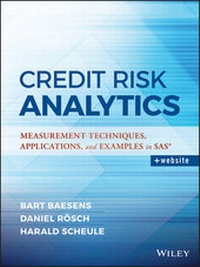
Credit Risk Analytics
Description

More details
Other editions
Additional editions
Persons
Content
Chapter 1
Introduction to Credit Risk Analytics
Welcome to the first edition of Credit Risk Analytics: Measurement Techniques, Applications, and Examples in SAS.
This comprehensive guide to practical credit risk analytics provides a targeted training guide for risk professionals looking to efficiently build or validate in-house models for credit risk management. Combining theory with practice, this book walks you through the fundamentals of credit risk management and shows you how to implement these concepts using the SAS software, with helpful code provided. Coverage includes data analysis and preprocessing, credit scoring, probability of default (PD) and loss given default (LGD) estimation and forecasting, low default portfolios, Bayesian methods, correlation modeling and estimation, validation, implementation of prudential regulation, stress testing of existing modeling concepts, and more, to provide a one-stop tutorial and reference for credit risk analytics.
This book shows you how to:
- Understand the general concepts of credit risk management
- Validate and stress test existing models
- Access working examples based on both real and simulated data
- Learn useful code for implementing and validating models in SAS
- Exploit the capabilities of this high-powered package to create clean and accurate credit risk management models
WHY THIS BOOK IS TIMELY
Despite the high demand for in-house models, there is little comprehensive training available. Practitioners are often left to comb through piecemeal resources, executive training courses, and consultancies to cobble together the information they need. This book ends the search by providing a thorough, focused resource backed by expert guidance.
Current Challenges in Credit Risk Analytics
Commercial banks are typically large in size, and their fundamental business model continues to rely on financial intermediation by (1) raising finance through deposit taking, wholesale funding (e.g., corporate bonds and covered bonds), and shareholder capital, and (2) lending, which is a major source of credit risk.
Commercial bank loan portfolios consist to a large degree of mortgage loans, commercial real estate loans, and small and medium-sized enterprise (SME) company loans. SME loans are often backed by property collateral provided by the SME owners. The reliance of commercial bank loan portfolios on real estate is fundamental. Note that various types of mortgage loans exist. Examples are prime mortgages, subprime mortgages, reverse mortgages, home equity loans, home equity lines of credit (HELOCs), and interest-only loans, as well as variable, fixed-rate, and hybrid loans, to name a few.
Further loan categories include consumer loans (car loans, credit card loans, and student loans) and corporate loans. Loans to large companies also exist but compete with other funding solutions provided by capital markets (i.e., issuance of shares and corporate bonds).
Other sources of credit risk are fixed income securities (e.g., bank, corporate, and sovereign bonds), securitization investments, contingent credit exposures (loan commitments and guarantees), credit derivatives, and over-the-counter (OTC) derivatives.
Credit risk was at the heart of the global financial crisis (GFC) of 2007 to 2009 and is the focus of this book. Post GFC, prudential regulators have increased risk model requirements, and rigorous standards are being implemented globally, such as:
- Implementation of Basel III: The Basel rules concern capital increases in terms of quantity and quality, leverage ratios, liquidity ratios, and impact analysis. We will discuss the Basel rules in more detail later.
- Stress testing: Regulators require annual stress tests for all risk models.
- Consistency across financial institutions and instruments: Regulators are currently identifying areas where regulation is applied in inconsistent ways.
- Reinvigoration of financial markets (securitization): A number of markets, in particular the private (i.e., non-government-supported) securitization market, have declined in volume.
- Transparency: Central transaction repositories and collection of loan-level data mean more information is collected and made available to credit risk analysts.
- Increase of bank efficiency, competition, deregulation, and simplification: The precise measurement of credit risk is a central constituent in this process.
Risk model methodologies have advanced in many ways over recent years. Much of the original work was based in science where experiments typically abstracted from business cycles and were often applied within laboratory environments to ensure that the experiment was repetitive. Today, credit risk models are empirical and rely on historical data that includes severe economic downturns such as the GFC.
State-of-the-art credit risk models take into account the economic fundamentals of the data generating processes. For example, it is now common to include the life cycle of financial products from origination to payoff, default, or maturity while controlling for the current state of the economy. Another aspect is the efficient analysis of available information, which includes Bayesian modeling, nonparametric modeling, and frailty modeling. Risk models are extended to exploit observable and unobservable information in the most efficient ways.
Despite all these advancements, a word of caution is in order. All empirical risk models remain subject to model risk as we continue to rely on assumptions and the historical data that we observe. For example, it is quite common to obtain R-squared values of 20 percent for linear LGD and exposure at default (EAD) models. As the R-squared measures the fraction of the observed variation that is explained by the model, these numbers suggest that there is a considerable amount of variation that these models do not explain. Providing more precise models will keep us busy for years to come!
A Book on Credit Risk Analytics in SAS
In our academic research, we work with a number of software packages such as C++, EViews, Matlab, Python, SAS, and Stata. Similar to real languages (e.g., Dutch and German), being proficient in one package allows for quick proficiency in other packages.
In our dealings with credit risk analysts, their financial institutions, and their regulators, we realized that in the banking industry SAS is a statistical software package that has come to be the preferred software for credit risk modeling due to its functionality and ability to process large amounts of data. A key consideration in the industry for using SAS is its quality assurance, standardization, and scalability. We will discuss this point in the next chapter in more detail.
Most documentation available for statistical software packages has been developed for scientific use, and examples usually relate to repeatable experiments in medicine, physics, and mathematics. Credit risk analytics is multidisciplinary and incorporates finance, econometrics, and law. Training material in this area is very limited, as much of the empirical work has been triggered by the digitalization and emergence of big data combined with recent econometric advances. Credit risk analytics requires the consideration of interactions with the economy and regulatory settings, which are both dynamic and often nonrepeatable experiments. We learned a great deal from existing literature but continuously reached limits that we had to overcome. We have collected much of this research in this text to show you how to implement this into your own risk architecture.
Structure of the Book
This book contains 15 chapters. We deliberately focused on the challenges in the commercial banking industry and on the analysis of credit risk of loans and loan portfolios.
Following the introduction in the first chapter, the book features three chapters on the preparation stages for credit risk analytics. The second chapter introduces Base SAS, which allows you to explicitly program or code the various data steps and models, and SAS Enterprise Miner, which provides a graphical user interface (GUI) for users that aim to extract information from data without having to rely on programming. The third chapter introduces how basic statistics can be computed in SAS, and provides a rigorous statistical explanation about the necessary assumptions and interpretations. The fourth chapter describes how data can be preprocessed using SAS.
Next, we have included five chapters that look into the most modeled parameter of credit risk analytics: the probability of default (PD). The fifth chapter develops linear scores that approximate the default probabilities without the constraints of probability measures to be bounded between zero and one. Credit scores are often provided by external appraisers to measure default behavior. Examples are real estate indexes, bureau scores, collateral scores, and economic indicators. The sixth chapter discusses methodologies to convert scores and other pieces of information into default probabilities by using discrete-time hazard models. Discrete-time methods are relatively simple, and their estimation is robust and has become a standard in credit risk analytics. The seventh chapter builds further on this and estimates default probabilities using continuous-time hazard models. These models explicitly model the life cycle of a borrower and do not assume that observations for a given borrower are independent over time, which discrete-time hazard models often do. The eighth chapter discusses the estimation of default...
