


Academic Translation
1st Edition
Will be published approx. on 10. July 2026
136 pages
978-1-040-70907-8 (ISBN)
Description

Scholarly writings in translation have contributed enormously to intellectual life throughout the world, but there has been little written on the practice of academic translation. Leading translation scholar, translator, and translator educator Brian James Baer discusses the specific challenges involved with academic translation and sets out ways of addressing them as a necessary first step in developing best practices for the field.
Ranging from terminological issues, citational practices, and conceptual networks to scholarly annotation, all chapters include activities and exercises in the form of sample texts and case studies. This is the ideal course book for a semester-long course on Academic Translation in an MA program and will also be of interest to translators and scholars undertaking academic translations, as well as anyone interested in translation's role in the circulation of knowledge.
Ranging from terminological issues, citational practices, and conceptual networks to scholarly annotation, all chapters include activities and exercises in the form of sample texts and case studies. This is the ideal course book for a semester-long course on Academic Translation in an MA program and will also be of interest to translators and scholars undertaking academic translations, as well as anyone interested in translation's role in the circulation of knowledge.
Reviews / Votes
"Academic translation has finally found a home! Brian Baer provides in this much needed book an excellent guide to an understudied field and practice. It should become an indispensable resource for all of those reading and writing in the humanities and the social sciences today who are no longer willing to take translation for granted."--Esperanca Bielsa, Universitat Autonoma de Barcelona, Spain
"In this lively study of how concepts travel across languages and scholarly traditions, Brian Baer as always combines personal experience and historical references to great effect. This book is as much an enjoyable read as a necessary manual for academic translators."
--Sherry Simon, Concordia University, Canada
"Thoroughly researched, well-argued and incisive, this book opens up the unjustly neglected field of academic translation while, in addition, offering actionable guidance for best practice. A most timely piece of work."
--Theo Hermans, University College London, UK
More details
Series
Edition
1. Auflage
Language
English
Place of publication
London
United Kingdom
Publishing group
Taylor & Francis Ltd
Target group
College/higher education
Professional and scholarly
Product notice
Reflowable
Illustrations
2 Halftones, black and white; 2 Illustrations, black and white
File size
3,84 MB
ISBN-13
978-1-040-70907-8 (9781040709078)
Copyright in bibliographic data and cover images is held by Nielsen Book Services Limited or by the publishers or by their respective licensors: all rights reserved.
Schweitzer Classification
Other editions
Additional editions
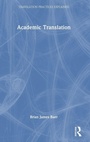
Brian James Baer
Academic Translation
Book
approx. 07/2026
1st Edition
Routledge
€191.50
Not yet published

Brian James Baer
Academic Translation
Book
approx. 07/2026
1st Edition
Routledge
€52.50
Not yet published
Person
Brian James Baer is Professor of Russian and Translation Studies at Kent State University, USA. He is founding editor of the journal Translation and Interpreting Studies and co-editor of the book series Literatures, Cultures, Translation and Translation Studies in Translation (Routledge). His publications include the monographs Translation and the Making of Modern Russian Literature and Queer Theory and Translation Studies, as well as the collected volumes Beyond the Ivory Tower: Re-thinking Translation Pedagogy with Geoffrey Koby; Contexts, Subtexts and Pretexts: Literary Translation in Eastern Europe and Russia; Researching Translation and Interpreting with Claudia Angelelli; Translation in Russian Contexts with Susanna Witt; Queering Translation, Translating the Queer with Klaus Kaindl; and Teaching Literature in Translation: Pedagogical Contexts and Reading Practices with Michelle Woods. His academic translations include Culture, Memory and History: Essays in Cultural Semiotics by Juri Lotman and Introduction to Translation Theory by Andrei Fedorov. He is the current president of the American Translation and Interpreting Studies Association.
Content
Introduction: The Place of Academic Translation
Chapter 1: Conceptualizing Academic Translation
Chapter 2: Choosing an Original
Chapter 3: Conceptual Networks I: Translating Keywords
Chapter 4: Conceptual Networks II: Citations Practices
Chapter 5: The Translator's Peritext: Annotations and Introductions
Epilogue: The Struggle for Legitimacy
Chapter 1: Conceptualizing Academic Translation
Chapter 2: Choosing an Original
Chapter 3: Conceptual Networks I: Translating Keywords
Chapter 4: Conceptual Networks II: Citations Practices
Chapter 5: The Translator's Peritext: Annotations and Introductions
Epilogue: The Struggle for Legitimacy
