

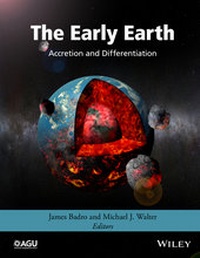
The Early Earth
Description

Reviews / Votes
"This book reviews our current understanding of the fundamental processes, which took a cloud of gas and dust in the solar nebula to the highly differentiated worl we know in a relatively short period of time (probably less than 100 million years, or about 2% of the age of the solar system)." "The papers follow a standard scientific research style - clear, but terse and to the point with frequent use of acronyms, and an expectation of considerable subject matter knowledge from the reader." William R. Green (05/09/2016)More details
Other editions
Additional editions
Persons
Content
1
Timing of Nebula Processes That Shaped the Precursors of the Terrestrial Planets
Marc Chaussidon1 and Ming-Chang Liu2,3
1Institut de Physique du Globe de Paris (IPGP), CNRS UMR 7154, Université Sorbonne-Paris-Cité, Paris, France
2Institute of Astronomy and Astrophysics, Academia Sinica (ASIAA), Taipei, Taiwan
3Now at Department of Earth, Planetary and Space Sciences, UCLA, Los Angeles, California, USA
ABSTRACT
Two key questions in Solar System formation concern the timescales of high-temperature processing (e.g., formations of solids, temperature fluctuations in the disk, etc.) in the early evolutionary stages, and the astrophysical environment in which the solar protoplanetary disk resided. Astrophysical theories of stellar evolution and astronomical observations of young stellar objects, analog to the forming Sun, provide some constraints on the lifetimes of their different evolutionary stages. Finer scale chronologies of the formation of the first solids and planetary objects in the solar accretion disk can be established from analyses of daughter isotopes from now-extinct, short-lived radionuclides in meteorites and in their components. In this review, we describe the high-temperature components of primitive meteorites, namely Ca-Al-rich Inclusions (CAI) and chondrules, we summarize the current knowledge on the origin of short-lived radionuclides, and we compare the two types of chronologies, the "astrophysical one" (derived from observations of young stellar objects and their disks) and the "meteoritical one" (derived from isotopic analyses of meteorites). Within the first few millions years, most of the mass of the solids, which will be at the origin of the terrestrial planets, were formed.
1.1. INTRODUCTION
Recent developments in astrophysics and cosmochemistry are changing our view of the formation and early evolution of the Solar System. A major recent result, coming independently from astrophysical modeling of accretion processes and from dating of meteorites and their components, is that the first planetesimals and the first planets formed very early, in the first few million years (Myr). Gravitational instabilities due to turbulent concentration of solids and further drag of gas can make objects of a few hundred kilometer-size in a few orbital periods in the inner disk [Johansen et al., 2007]. Refinements of our understanding of the 182Hf/182W chronometer and of the most appropriate way to correct for W isotopic modifications due to the capture of cosmic ray-induced neutrons in the parent bodies of meteorites, show that a class of differentiated meteorites (the magmatic iron meteorites) were formed by metal-silicate differentiation ~1 Myr after the start of the Solar System [Kruijer et al., 2014]. Thermal modeling of a planetesimal heated by the decay of short-lived 26Al shows that in order to reach internal temperatures that were high enough for complete metal-silicate differentiation at 1 Myr, this object must have been accreted at ~0.1-0.3 Myr [Kruijer et al., 2014]. Similarly, Hf/W chronometry shows that Mars is most likely a planetary embryo that had reached half of its present size at ~1.8 Myr, and that it escaped later giant impacts [Dauphas and Pourmand, 2011; Tang and Dauphas, 2014]. Thus, it can be expected that processes, which occurred early in the accretion disk when the nebular gas and dust were still present, left their traces in the composition of the building blocks of planets.
A key step, to which chemical and isotopic fractionations are linked, is the high-temperature processing of material in the nebula, such as evaporation of pre-existing (presolar) dust, (re)condensation of (evaporated) solids, and (re)melting and (re)crystallization of solid material. Part of (re)condensed/(re)crystallized solids further agglomerate to form the first "rocks" of the Solar System. Spectroscopic observations of accretion disks around forming stars reveal that dust is processed in the disk and redistributed between the inner and the outer zones [van Boeckel et al., 2004]. A refractory inclusion, presumably formed within a few tenths of an astronomical unit (AU) of the Sun, is present in the cometary matter returned to Earth by the Stardust NASA mission [Brownlee et al., 2006; Zolensky et al., 2006]. Modeling shows that viscous dissipation in the accretion disk, within the first 50-100 kyrs, is able to transport refractory solids formed close to the star to asteroidal or even cometary distances [Ciesla, 2010; Charnoz et al., 2011; Jacquet et al., 2011].
Thus, the first few million years are a key period for the evolution of the Solar System. High-temperature solids (refractory inclusions and chondrules, the major components of chondritic meteorites) are formed at that time. They can be considered to be "fossils" of this period. It is even conceivable that solid precursors of some chondrules are fragments of a first generation of planets that would have formed and been destroyed very early [Libourel and Krot, 2007], collisions between planetesimals being the rule in the first few million years of the disk [Bottke et al., 2006]. In this review, we concentrate on the timescales for the formation of the high-temperature components, which are presumably the first-generation solids formed in the Solar System, of chondrites. We first present the astrophysical timescales for the different steps in the formation of a solar mass star as derived from observations of young stars and their accretion disks, and then summarize our understanding of the nature of chondrites and their high-temperature components (chondrules and refractory inclusions) followed by a review of the latest developments with the study of short-lived radioactive nuclides in refractory inclusions and chondrules. We finish the paper by summarizing the cosmochemical timescales derived from the study of short-lived 26Al in meteorites.
1.2. YOUNG STELLAR OBJECTS AND THEIR DISKS: ANALOGS OF THE EARLY SOLAR SYSTEM
1.2.1. From the Interstellar Medium to a Protostellar Core
Stars form in the interstellar medium from gravitational collapse of dense fragments of giant molecular clouds. Such molecular clouds are the densest (typically more than 200 H2 molecules cm-3 and up to 104-106 H2 molecules cm-3 in their hot dense cores) and coldest (T ~10 K) of all interstellar clouds. They are dominantly made of gas (~95% of this gas is molecular H2, the remaining being mostly He) and of a small dust fraction (~1%). Their density is much higher than that of HII regions (T ~8000 K, density ~0.5 cm-3) where hydrogen is ionized by radiation emitted from young massive stars, or that of HI regions (T ~100 K, density ~50 cm-3), which contain neutral atomic hydrogen [Bless, 1996; Tielens, 2010 and references therein]. Spectroscopic studies of starlight absorbed and scattered by the interstellar dust grains show that the grain sizes range from ~5 nm to ~2.5 µm and that they have a large range of composition from carbonaceous dust to amorphous silicates [Tielens, 2010; Henning et al., 2010]. Dust is initially produced by high-temperature condensation in the envelopes of stars and their ejecta (where other phases such as diamonds, graphite, or refractory oxides are observed), and then is transported to and mixed with interstellar gas and dust. Thus, most of the refractory elements (C, Si, Mg, Fe, Ca, Al, Ti) in the interstellar space are in the dust and not in the gas. Asymptotic Giant Branch (AGB) stars are a major contributor of amorphous carbon dust (for C-rich AGBs) and of silicates (for O-rich AGBs) [Henning et al., 2010]. Once in the interstellar medium and in the intercloud region, dust is exposed to shock waves produced by supernova explosions and to cosmic rays, which could result in amorphization, evaporation, annealing, and/or shattering of the dust grains [e.g., Hirashita et al., 2014]. The broadening of the 10 µm line, i.e. stretching of the Si-O bond in silicates, due to amorphization, is a characteristic of the infrared spectra of interstellar dust. When in cold clouds, the dust can be coated by ices and low condensation temperature species. Typically the lifecycle of dust [Tielens et al., 2005] is such that dust is cycling many times between the intercloud regions and the clouds with a typical timescale of 3×10⁷ yr and that the total cycle from condensation in stellar ejecta to incorporation into a new forming star in the core of a dense molecular cloud is about 2×10⁹ yr long.
Gas (and associated dust) in molecular clouds is in equilibrium between contraction due to gravitational attraction and thermal (and magnetic) dilatation. For a given temperature there is a critical mass of gas, known as the Jeans mass, exceeding which the gravitational potential energy within the cloud overcomes the kinetic energy of the gas, according to the virial theorem. After some perturbation (e.g., supernova shock waves) compresses the gas, the Jeans mass can be locally reached and a region of the cloud collapses toward its center of mass. Typically a dense core has to be more massive than 10, the Jeans mass calculated with the average density ? = 105 H2 cm-3 and temperature T = 10 K, for collapse to take...
