

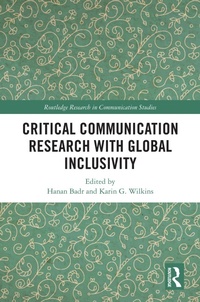
Critical Communication Research with Global Inclusivity
Published on 12. November 2025
254 pages
978-1-040-59007-2 (ISBN)
Description

Critical Communication Research with Global Inclusivity provides a critical lens through which to prepare, engage and read communication research methods.
Inviting new and innovative perspectives that question the status quo and push the boundaries of knowledge production, the book begins with the premise of global inclusivity, intentionally correcting the power imbalance of research conducted by those in areas of privilege against those in conditions of marginality. Building on emerging research on and from the Global South, this book echoes a growing need to interested students and scholars, not only to advance the subject of this work, but also to strengthen communication scholarship overall. Inspired by knowledge formed through feminist, critical and postcolonial perspectives, the book questions the imbalance of our knowledge production and suggests avenues for improvement.
Accompanying scholars in their negotiating processes to conduct research in non-Western contexts and supporting graduate and postgraduate students in research that does not conform to the standards developed in Western academic cultures, this volume will be of interest to those working in intercultural communication, interpersonal communication, research methods in communication, critical communication studies and journalism, as well as those from adjacent fields such as political studies, anthropology, sociology and area studies.
Inviting new and innovative perspectives that question the status quo and push the boundaries of knowledge production, the book begins with the premise of global inclusivity, intentionally correcting the power imbalance of research conducted by those in areas of privilege against those in conditions of marginality. Building on emerging research on and from the Global South, this book echoes a growing need to interested students and scholars, not only to advance the subject of this work, but also to strengthen communication scholarship overall. Inspired by knowledge formed through feminist, critical and postcolonial perspectives, the book questions the imbalance of our knowledge production and suggests avenues for improvement.
Accompanying scholars in their negotiating processes to conduct research in non-Western contexts and supporting graduate and postgraduate students in research that does not conform to the standards developed in Western academic cultures, this volume will be of interest to those working in intercultural communication, interpersonal communication, research methods in communication, critical communication studies and journalism, as well as those from adjacent fields such as political studies, anthropology, sociology and area studies.
More details
Series
Language
English
Place of publication
London
United Kingdom
Publishing group
Taylor & Francis Ltd
Target group
College/higher education
Professional and scholarly
Illustrations
3 Tables, black and white; 4 Line drawings, black and white; 6 Halftones, black and white; 10 Illustrations, black and white
File size
4,58 MB
ISBN-13
978-1-040-59007-2 (9781040590072)
Copyright in bibliographic data and cover images is held by Nielsen Book Services Limited or by the publishers or by their respective licensors: all rights reserved.
Schweitzer Classification
Other editions
Additional editions
Hanan Badr | Karin G. Wilkins
Critical Communication Research with Global Inclusivity
Book
11/2025
1st Edition
Routledge
€202.70
Shipment within 10-20 days
Persons
Hanan Badr is Professor and Chair for Public Spheres and Inequalities in the Department of Communication at the University of Salzburg, Austria.
Karin G. Wilkins is Dean of the School of Communication at the University of Miami, USA.
Karin G. Wilkins is Dean of the School of Communication at the University of Miami, USA.
Content
Part 1: Confronting Power and Privilege
1. Centering Global Inclusivity as an epistemic lens in communication studies
2. Understanding collective identities in communication studies: Inclusion and exclusion as part of the field's history
3. Intersectionality and standpoint epistemology in journalism studies: Interrogating journalism's power for a more equitable field
4. Academic International Research Teams: Chances and limitations of equal collaboration
Part 2: Crossing Geographic and Epistemic Borders
5. Communication history as a critical intervention: Crossing temporal and cultural boundaries of digital communication research
6. (Post-)colonial silences in transnational research: The case of the Herero and Nama genocide in German and Namibian newspapers
7. Rural Research in the Space of News Deserts: Redefining boundaries around Journalism Practice, the Climate Crisis, Natural Disasters, and Health Disparities
Part 3: Creating Innovative Inclusive Methods
8. To do no harm: from scientific ambition and extractivist design to taking research participants into account
9. Critical Algorithmic Literacy: Combining Critical Perspectives with Quantitative Data Sciences
10. Towards more truly international comparative research: Current opportunities and challenges of multilingual text analysis with computational methods
11. Finding innovative avenues in communication research for more inclusive data: Three approaches from intercultural communication
Part 4: Changing Scholarly Communities and Venues
12. Striving for excellence is striving for diversity: reflections from Digital Journalism editorial team
13. Broadening the conversation: inclusivity and internationalization in academic journals
14. (W)righting Wrongs: Creating Space for Scholars from an Overstudied Region
15. Prioritizing Global Inclusivity in a Growing Scholarly Community: Mobile Communication and Global Openness
16. Deepening de-westernization: Addressing global inequalities in communication studies
Index
1. Centering Global Inclusivity as an epistemic lens in communication studies
2. Understanding collective identities in communication studies: Inclusion and exclusion as part of the field's history
3. Intersectionality and standpoint epistemology in journalism studies: Interrogating journalism's power for a more equitable field
4. Academic International Research Teams: Chances and limitations of equal collaboration
Part 2: Crossing Geographic and Epistemic Borders
5. Communication history as a critical intervention: Crossing temporal and cultural boundaries of digital communication research
6. (Post-)colonial silences in transnational research: The case of the Herero and Nama genocide in German and Namibian newspapers
7. Rural Research in the Space of News Deserts: Redefining boundaries around Journalism Practice, the Climate Crisis, Natural Disasters, and Health Disparities
Part 3: Creating Innovative Inclusive Methods
8. To do no harm: from scientific ambition and extractivist design to taking research participants into account
9. Critical Algorithmic Literacy: Combining Critical Perspectives with Quantitative Data Sciences
10. Towards more truly international comparative research: Current opportunities and challenges of multilingual text analysis with computational methods
11. Finding innovative avenues in communication research for more inclusive data: Three approaches from intercultural communication
Part 4: Changing Scholarly Communities and Venues
12. Striving for excellence is striving for diversity: reflections from Digital Journalism editorial team
13. Broadening the conversation: inclusivity and internationalization in academic journals
14. (W)righting Wrongs: Creating Space for Scholars from an Overstudied Region
15. Prioritizing Global Inclusivity in a Growing Scholarly Community: Mobile Communication and Global Openness
16. Deepening de-westernization: Addressing global inequalities in communication studies
Index
