

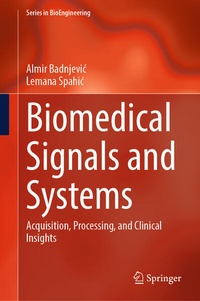
Biomedical Signals and Systems
Description

This textbook provides a structured introduction to biomedical signals and systems, with a focus on acquisition, processing, and clinical applications of physiological signals. It is designed for researchers and professionals in biomedical engineering, signal processing, and healthcare technology. The book is structured into eight chapters. The first chapter introduces the fundamental concepts of biomedical signals, their acquisition, processing, and the ethical-legal dimensions of their use. Then the focus lies on signal acquisition and processing techniques, while subsequent sections address cardiac, respiratory, and neurological signals, as well as ultrasound and blood pressure analysis. Each chapter balances theoretical foundations with practical examples and clinical applications, reflecting the inherently interdisciplinary nature of biomedical engineering. The book concludes with a review section that summarizes key concepts, provides multiple choice questions, and exercises.
More details
Other editions
Additional editions
Persons
Dr. Lemana Spahic is a double PhD in genetics and bioengineering and biomedical engineering with a research focus on applied intelligent systems for healthcare. She had worked in the field of biomedical engineering for the past 8 years, especially in the field of biomedical devices, medical device management, standardization, regulations and development of AI algorithms for disease diagnostics and published over 80 referenced journal papers, conference publications and book chapters. Dr. Spahic is a course lecturer for the courses biomedical instrumentation, biosensors, biomedical signals and systems and intelligent systems. Additionally, she is the secretary general of the IEEE SA working groups and a recognized innovator with her research solutions being translated into commercial products and nominated for the most innovative digital solution in Health & Well-Being from Bosnia And Herzegovina a WSA global awards competition.
Dr. Almir Badnjevic is a prominent figure in the field of biomedical and clinical engineering, with extensive academic, regulatory and industry experience. He holds a PhD in Electrical Engineering and he serves as professor at the Faculty of Pharmacy, University of Sarajevo, as well as guest lecturer at School of Engineering, University of Warwick, University of Donja Gorica, International Burch University and Università Campus Bio-Medico di Roma. Dr. Badnjevic is the president elect of the International Academy of sciences and Arts of Bosnia and Herzegovina, Fellow of World Academy of Art and Science (WAAS) and the ordinary member of European Academy of Sciences and Arts. Dr. Badnjevic is also the founder and director of the Verlab Company and Verlab Research Institute for Biomedical Engineering, Medical Devices and Artificial Intelligence. His work spans over 200 scientific publications, with a focus on medical device safety, AI in healthcare, and bioengineering applications. He is actively involved with international bodies such as ISO and IEC, contributing to the development of global standards for medical devices. He is UN Cyber Fellow, IUPESM Fellow and AAIA. Also he is member of Digital, Technology and AI at European Olypmic Committees. Recognized for bridging the gap between engineering and clinical practice, Dr. Badnjevic combines scientific rigor with practical expertise.
Content
Introduction to Biomedical Signals and Systems.- Biomedical Signal Acquisition and Processing.- Processing Cardiac Signals.- Processing Respiratory Signals.- Processing Electroencephalogram EEG Signals.- Processing Ultrasound Signals and Imaging.- Blood Pressure Signal Acquisition and Analysis.- Review & Practice Problems.
