

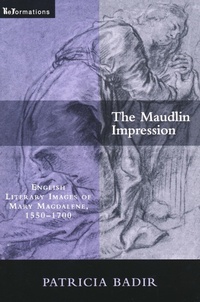
The Maudlin Impression
English Literary Images of Mary Magdalene, 1550-1700
1st Edition
Published on 15. October 2009
277 pages
978-0-268-07574-3 (ISBN)
Description

Patricia Badir's The Maudlin Impression investigates the figure of Mary Magdalene in post-medieval English religious writings and visual representations. Badir argues that the medieval Magdalene story was not discarded as part of Reformation iconoclasm, but was enthusiastically embraced by English writers and artists and retold in a wide array of genres. This rich study bridges the historical division between medieval and early modern culture by showing the ways in which Protestant writers, as well as Catholics, used the medieval stories, art, and symbolism related to the biblical Magdalene as resources for thinking about the role of the affective and erotic in Christian devotion. Their literary and artistic glosses protected a range of religious devotional practices and lent embodied, tangible form to the God of the Reformation. They employed the Magdalene figure to articulate religious experience by means of a poetics that could avoid controversial questions of religious art while exploring the potency and appeal of the beautiful.
The Maudlin Impression is a literary history of imitation and invention. It participates in the "religious turn" in early modern studies by demonstrating the resilience of a single topos across time and across changing Christian beliefs.
The Maudlin Impression is a literary history of imitation and invention. It participates in the "religious turn" in early modern studies by demonstrating the resilience of a single topos across time and across changing Christian beliefs.
Reviews / Votes
"The final chapter-on the Magdalene's afterlife in decadent Restoration art and drama-is dazzlingly provocative. It reads like the destination toward which the entire book has been leading, and it provides an entirely new perspective on the character of Angellica Bianca in Behn's The Rover. Perhaps even better is the marvelous postscript titled "A Something Else Thereby" after a line from John Donne's "The Relique," in which Badir reads that hauntingly cryptic poem in the light of the tradition the book explores." -Modern Philology"Badir's research . . . surely provides another example of the current trend to undermine any sharp dichotomy between medieval and early modern, Catholic and Protestant devotional sensibilities. Such scholarship, especially when it is presented with such original and insightful interplay between the verbal and the visual, deserves the attention of scholars of early modern England." -Sixteenth Century Journal
"Patricia Badir considers Herbert's 'Marie Magdalene' within the context of emblematic illustrations of her washing of Christ's feet. She finds in the poem's epigrammatic conciseness a parallel to visual depictions of an already well-known scene." -The Year's Work in English Studies
"Patricia Badir examines the figure of Mary Magdalene in England from the Reformation to the Restoration. Exploring drama, poetry, sermons, and artworks, she argues that Mary Magdalene served as a 'site of memory' that could transcend the rupture with the medieval past, and evoke the experience of Christ's physical presence for those generations deprived of the Eucharist after the rejection of transubstantiation." -Parergon
"The underlying thesis of this well-researched and intriguing book is that the Magdalene negotiates the losses of the Reformation for both Protestant and Counter-Reformation writers. . . . The central thesis of the work is compelling; the Magdalene proves a fruitful site for the investigation of the continuities, as well as the ruptures, of the Reformation." -The Journal of Ecclesiastical History
"Who was Mary Magdalene? Patricia skillfully surveys early-modern English reimaginings, as they appear in a wide array of poems, biographies, religious tracts, homilies, dramas, and illustrations. Badir finally answers the question 'Who was Mary Magdalene?' by defining her as a lieu de memoire, or a site of memory, which took on various lives in time. Wide-ranging, well-documented, and sharply observed, this book usefully complicates the oft-repeated assertion that Mary Magdalene became a Counter-Reformation symbol of penance." -The Catholic History Review
"In an original and illuminating study, Badir writes a new history of the Magdalene figure, one that turns on the irrevocable loss of Christ, first through his ascension and again through Protestant revisions of Eucharistic theology . . . In Badir's insightful book, the Magdalene's unique and imaginatively captivating role articulates an emerging meditative and representational poetics of absence and presence, of desire and grief." -Renaissance Quarterly
"[Badir] analyzes images of the Magdalene in literary texts by writers ranging from the somewhat obscure-the medieval period's Thomas Robinson and Lewis Wagner-to the canonical (John Donne, Nicholas Breton, Emilia Lanyer, George Herbert, Robert Herrick, and others). . . . This volume should interest anyone pursuing study of the early modern period, especially those focusing on religious texts." -Choice
"In this well-researched and clearly written book, Badir draws on poetry, homilies, plays, sermons, and paintings. A valuable contribution for scholars of Renaissance literature, this will also be accessible to serious nonspecialists curious about the figure of Mary Magdalene." -Library Journal
"Badir reveals a Magdalene far more complex than the iconic sinner-saint. This Magdalene represents Catholic sacramental devotion, Protestant attention to the Word, vain luxuriousness, meditative bereavement, and aristocratic allure." -Times Literary Supplement
More details
Series
Language
English
Place of publication
Notre Dame IN
United States
Target group
College/higher education
Illustrations
37 halftones - 37 Halftones, unspecified
ISBN-13
978-0-268-07574-3 (9780268075743)
Copyright in bibliographic data and cover images is held by Nielsen Book Services Limited or by the publishers or by their respective licensors: all rights reserved.
Schweitzer Classification
Other editions
Additional editions
Book
10/2009
University of Notre Dame Press
€47.40
Shipment within 10-20 days
Person
Patricia Badir is associate professor of English literature at the University of British Columbia.
Content
- Cover
- Half title
- Series page
- Title page
- Copyright
- Dedication
- Contents
- Introduction: Creeping After the Cart
- 1. The Look of Love
- 2. Touch Me Not
- 3. The Task of Beauty
- 4. Penance in a Sheet
- 5. She's a Nice Piece of Work
- Postscript: A Something Else Thereby
- Notes
- Bibliography
- Index
