

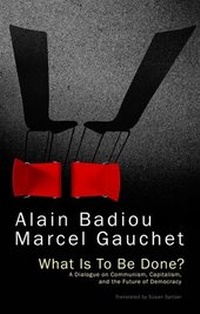
What Is To Be Done?
Description

More details
Other editions
Additional editions
Persons
Content
Chapter 1
The encounter with communism
To begin this dialogue, we'd like to propose that each of you say a few things about the importance of communism in your itinerary. This is the first time you are meeting. You come from different political and intellectual backgrounds. But communism has played a vital role for each of you. Before turning to the historical experience of communism and its philosophical definition, could you explain how you discovered it - the idea as well as the movement and the political regime?
Alain Badiou: I'm a latecomer to communism. I come from a social-democratic tradition originally. My father, Raymond Badiou, a member of the Resistance, was the Socialist mayor of Toulouse from 1944 to 1958. So it was quite natural that I should start out as a militant in the French Section of the Workers' International (SFIO), which was the equivalent of the French Socialist Party at the time. As a student at the École Normale Supérieure, which I entered in 1956, I started a socialist group along with my friend Emmanuel Terray, even though communists abounded there. But my real political birth certificate dates from the Algerian War. Back then, I was viscerally revolted by colonialism and the horrors that were taking place during the war - torture was going on everywhere, even in the Paris police stations. I got involved in the bitter struggle against the policy of Guy Mollet's Socialist government, which had taken a repressive line against the uprising. The heightened tension within the parliamentary left led to the breakup of the SFIO. My father, who was also committed to the fight against the Algerian War and had resigned as mayor of Toulouse as a result of his opposition to the official government line, eventually founded the Unified Socialist Party (PSU) along with some other people. I was actively engaged in these developments and was a militant in the PSU until the late 1960s, even serving as federal secretary for the Marne Department - with some success, moreover, since I quintupled the PSU's results in the legislative elections!
Marcel Gauchet: They should have held on to you . . .
A.B.: Yes, I had a great opportunity to rise into the upper ranks of the party hierarchy . . . Who knows what might have happened had it not been for May '68! It was a shock wave, a profound upheaval in my personal and political subjectivity. I was 31 at the time. That was when I broke away from parliamentary socialism and really converted to communism. However, this new militancy didn't lead to my joining the French Communist Party (PCF), which was very powerful at the time. I have never been a member of it or a fellow traveler. And for good reason: I'd already found the PCF to be too cautious in the anti-colonial struggles. When it came to the new revolutionary experiments, in the late 1960s and beyond, the PCF was, if anything, the enemy. A despised and very real enemy: the "official" militants wanted to hold on to their political monopoly in the factories. They prevented my friends and me from reaching out to the workers on the shop floors and from distributing flyers in the suburban markets. There were frequent, often violent, altercations between us. No, the communism that I gradually became affiliated with was certainly not represented by that bureaucratized party, so heavily dependent on the regime in power in the USSR. My communism was embodied in one of the French versions of Maoism, with the key event being the Cultural Revolution - which I'll come back to later. At any rate, my trajectory ran counter to the dominant pattern: while many militants, whether intellectuals or not, started out as communists before repudiating that heritage and moving on to something else, I, for my part, was "born" a socialist and became a communist!
M.G.: My itinerary was the exact opposite . . . I come from a rather modest social background: my father was a road worker and my mother a seamstress. I was brought up with Gaullism and the most traditional Catholicism, from which I would later have to forcefully break free. We lived in the Manche department [Lower Normandy], and out in the country: the traces of communism were non-existent, to say the least. We wondered what it could be like! My first encounter with communism was intellectual in nature: I was overwhelmed when I read Marx and Engels' The Communist Manifesto at age 15. It was a moment of sheer exhilaration. Marx is the most dazzling writer I've ever read. He is without a doubt the philosopher who has mattered most to me, in the most lasting way. Practically speaking, I discovered politics in the final years of the Algerian War. My initiation experience was the repression of the anti-war demonstration that resulted in a number of deaths at the Charonne metro station in Paris on February 8, 1962. The novice Marxist that I was became acquainted at that time with the PCF in the guise of its militants. I was dumbfounded by this encounter and immune ever after to the PCF. What arrogance, what a capacity for manipulation there were in the so-called "conscious vanguard of the Party!" It seemed as though they were moving their militants around like chess pieces, as though they were maneuvering them solely in the interests of the party apparatus. I might have encountered friendlier people, more open practices, more substantial intellectual content . . . But I didn't, and everything that happened thereafter only confirmed my original distrust. As you've no doubt gathered, I've never been either a member or even a sympathizer of the PCF. Instead, I was involved with another, unofficial version of communism: what was called at the time "councilism," a term that's quite difficult to define. The councilist movement is part of the anarcho-syndicalist tradition. It focuses on the participation of the masses in decision-making, on direct democracy, but always within the scope of the communist idea in the broad sense of the term. Back then, this councilist movement was very fragmented and split into little rival factions, sometimes with no more than a dozen people in them. It was an underground movement, a minority within a minority, something that's never easy and is often disheartening . . .
Then May '68 happened. At first I was in my element, because the event marked the triumphant entry of ultraleftism, of which councilism was one of the forms, onto the intellectual scene. My militant decision seemed to have met with a resounding confirmation at that time. And yet, a turning point had been reached. This is when our respective paths diverged: where, for you, May '68 paved the way for commitment to the communist idea, for me the failure of the movement - hardly surprising as such - and especially its consequences led me to a gradual, heartbreaking abandonment of my original Marxism. Little by little, I realized that communism was a model that could only lead to a dead end and that Marxism's very premises plunge us into insurmountable problems. I came to think that real political work could only be done within the framework of democracy - not the naïve democracy of my youth but democracy tout court. I felt it was necessary and urgent to rethink, to thoroughly reform, that certainly flawed but still improvable framework. The new focus was on making representative democracy advance and move forward. I'd been "born" a Marxist and I became a (critical!) fellow traveler of the Socialist Party. So that's how I entered the channel of "bourgeois politics," as I used to say condescendingly when I was young!
What role did philosophy play in your respective political and militant trajectories? Who and what were the major figures and intellectual currents that influenced the positions you took?
A.B.: My first essential influence was Sartre. When I was involved in the anti-colonial movement at the time of the Algerian War I was a convinced existentialist. I knew the great maxims by heart. My grounding in Sartre went far beyond anything the philosopher explicitly wrote about colonialism: I undertook a diligent, enthusiastic, and patient reading of Being and Nothingness. From the end of World War II on, Sartre himself embodied the idea that philosophy was intimately linked to politics. This was the famous figure of the politically engaged philosopher. This combination of creative intellectuality and political militancy is typically French, and Sartre rightly saw himself as an heir to Enlightenment thinkers such as Voltaire and Rousseau. His incomparable prestige stems from his inclusion in that tradition.
M.G.: Indeed, in France there's a belief that politics should be combined with intelligence. This is a feature very specific to our country. The US is in this respect a perfect counter-example. There, politics is pure pragmatism: the problem is winning elections . . . Apart from the case of Sartre, the extraordinary prestige of communism in the post-war period was undoubtedly linked to the connection you mentioned: the communist idea sought to bring together the theoretical and practical dimensions, to combine thinking and political activism. France was an ideal breeding ground, so to speak, for it. And it still seems to be so today . . .
A.B.: You're ratting me out! I'm French to the core . . .
M.G.: I'm sure you are!
A.B.: For me, the interrelationship between...
