

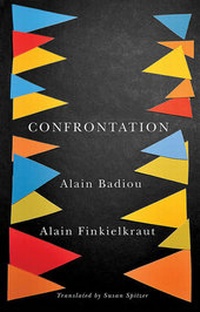
Confrontation
Description

Guided by Aude Lancelin, the two philosophers discuss subjects as diverse as national identity, Israel and Judaism, May 1968, and renewed popularity of the idea of communism. Their passionate debate is more than just the sum total of their disagreements, however, for neither of them is satisfied with the state of our society or the direction in which its political representatives persist in taking it. They agree that there needs to be change and their confrontation in this volume shows the importance of asking difficult questions, not only of each other, but also of our political systems.
More details
Other editions
Additional editions
Persons
Content
1. National Identity and Nations
2. Judaism, Israel, and Universalism
3. May '68
4. Communism (Past and Future)
Translator's Notes
Bibliography
Foreword
by Aude Lancelin
"We should never debate," Philippe Muray once said. "An original thinking of the world can and must be fired off like a definitive dissent, a temperamental incompatibility. We shouldn't argue; we should cut right to the heart of the matter."1 A brilliant essayist who wrote about the "end of History" and the all-pervasive simulacrum, Muray, the author of Désaccord parfait [Perfect Disagreement], had understood and articulated better than anyone else how transcending opinions is by no means the aim of most of the fake, media-driven debates today. Rather, their unwitting purpose is the evaporation of meaning. We see this sort of thing every day, moreover: the big media machine thrives on cartoonish, grossly exaggerated, if not outright made-up, conflicts, the better to divert attention from the real struggles going on. Let me just say how right my dear friend, who passed away suddenly in 2006, was once again. We should indeed never debate if it's only a pretext for creating a sham battlefield of that sort, a convenient cover for the inability either to act or to think. Still less should we debate if it's only a pretext for popularizing two weak viewpoints, each trying to give the other a boost to get heard - or, even worse, to attract a lot of attention.
There could be no question of any such thing happening with the two men here. Badiou and Finkielkraut represent two radically different visions that touch the very nerve of our time. Their names sound like two noms de guerre for two intellectual factions that are resolutely determined to fight it out with each other in France today. In fact, the first time I brought them together, for a discussion that was later published in the December 21, 2009, issue of Le Nouvel Observateur,2 each of them had been taken severely to task by their most ardent supporters just for having agreed to meet with his opponent. Those supporters were quickly reassured, though, when the magazine came out and the dreaded "happy ending" was nowhere to be found. A tense, electric, and occasionally even violent atmosphere came across on the page. This was clearly no ordinary debate but rather a confrontation, almost in the physical sense implied by the word.
A second discussion nevertheless took place on February 16, 2010. In the meantime, there had been extremely heated, copious, indeed countless reader reactions to the first one. Dozens of websites and blogs had spread it around the Web, thousands of passionate comments had gone back and forth, and Éditions Lignes had quickly informed us of their interest in publishing the text, augmented by the follow-up exchange.3 The second session was nothing like the first. A somewhat artificial sort of nervous tension had abated. And yet the topics discussed, especially Israel, May '68, and the partial resurgence of the communist Idea, were anything but lightweight. One might even have legitimately expected a cataclysmic replay of the famous family dinner drawn by the political cartoonist Caran d'Ache in Le Figaro at the height of the Dreyfus Affair, with everyone fighting around the table and the caption below reading: "They talked about it - the Dreyfus Affair!" But no such thing happened, actually. Instead, there was genuine mutual curiosity this time around, and humor, too, which often punctuated their most difficult exchanges.
The debate was supposed to have lasted an hour and a half in mid-afternoon, but it stretched out to over four full hours. The winter sun had already disappeared from the place de la Bourse, but not the two opponents, who were still having at each other, recovering, and going at it again as night fell, while their horses had been dead for quite some time already, to parody Victor Hugo in The Legend of the Centuries. Blows - extremely hard ones at times - were dealt, points conceded, and even helping hands extended, but there was obviously no agreement about when an end should be called. Was one really necessary? This time, they had really entered the thick of the fray, with all that implies of unexpected areas of agreement, and insurmountable obstacles as well.
Neither of these men - for good reason - is known for his love of consensus and the middle ground, let alone for his tendency to compromise. This is in fact one of the few things they have in common, which also makes them stand out today. It's the same kind of integrity regarding what each thinks is the truth that needs to be told without pulling any punches. And it's also a proven courage, which has been tested since the mid-2000s in certain highly publicized intellectual controversies in which they have both at times been savagely attacked. Stick firmly to your position, whatever the cost, Alain Badiou would say. Don't be intimidated by the rumblings of political correctness, Alain Finkielkraut would reply. And then they'd quarrel over the nature of this hostility that must be relentlessly confronted.
But doesn't this mean that we should ask all the more insistently: "Why bother debating, then?" We should never engage in dialogue, either, if it's only a pretext for setting out side by side two diametrically opposed monologues or two self-centered viewpoints feigning ignorance of their hopeless symmetry and their unmistakable complicity in the farce of media manipulation. But such was not the case here either. Indeed, the chief interest of this book lies in demonstrating just that fact. Alain Finkielkraut is no more a typical neo-conservative than Alain Badiou is a knee-jerk progressive. If they were, it would be so easy for the proponents of worst-case politics [la politique du pire]4 and so convenient for all of those - and there are plenty of them - who would never give up an antagonism that excuses them from having to abandon their intellectual laziness and relinquish even a single one of their prejudices.
Yet, since the 2007 presidential election and the stir caused by his book The Meaning of Sarkozy, Alain Badiou has been assigned the lead role of intransigent radical, battle-scarred yet fiendishly tenacious Maoist, and rabid pro-Palestinian activist, among other such shortcuts and falsifications that are always handy when it comes to imagining you can have access this way to a demanding body of work. But even a cursory reading of his recent politically interventionist books, not to mention his long-term philosophical work - recognized and studied worldwide since the publication of Being and Event in the late 1980s - would easily convince anyone of his exceedingly subtle, complex position. It is really only in France that the image of Alain Badiou as an extremist corrupter of innocent youth born after the fall of the Berlin Wall overshadows that of Badiou the philosopher of the One and the multiple, the subject of enormous con-ferences everywhere from Athens to Los Angeles.
Although he, too, is heavily caricatured, Alain Finkielkraut nevertheless stands out as a truly unique figure in the French landscape. I can attest all the more readily to this in that I happened to have clashed violently with him, on at least one occasion in the past, over the positions he took during the flare-up of violence in the French banlieues in 2005. A tireless opponent of a leveling, dominating mass democracy and a defender of a French public school system under threat from what he considers that mass democracy's inexorable expansion, the author of The Defeat of the Mind5 has never in actual fact - a persistent myth to the contrary notwithstanding - been part of the media-savvy syndicate called "the new philosophers." Although he fully shares their anti-Marxist sentiments and even co-founded the Institut d'études lévinassiennes with one of them, Bernard-Henri Lévy, Alain Finkielkraut has since that time taken his distance from the aggressively marketing aspect of their activity. Nor is there any trace in his career of support for America's wars in these early years of the twenty-first century. It would not even be going too far to say that his Péguyist defense of a vanishing eternal France, not to mention the unusual and, above all, very solitary support he has given a savagely pilloried writer such as Renaud Camus,6 has made him a controversial figure even in the French neo-conservative movement, where he nonetheless has ardent supporters.
Even once these distortions have been corrected, though, the disagreement between the two parties is still very deep, and the gulf that had to be bridged in order for them to meet was as wide as could possibly be. Commenting on the growing resonance of Alain Badiou's thought in France, Alain Finkielkraut once characterized it, with alarm, as "the most violent philosophy there is," "a symptom of the return of radicality and of the collapse of anti-totalitarianism."7 The Slovene philosopher Slavoj Zizek wrote a vigorous theoretical response to this accusation in the French daily Libération when his very close fellow traveler's Logics of Worlds, the sequel to Being and Event, was published in March 2007. "As Badiou himself might put it in his unique Platonic way," he wrote, "true ideas are eternal, they are indestructible, they always return every time they are proclaimed dead."8
There is also...
