

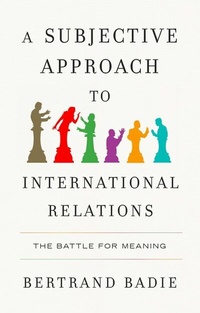
A Subjective Approach to International Relations
Description

China's growing power and Russia's invasion of Ukraine have thrust geopolitics back to the centre of the global stage, but the old frameworks of international relations, with their positivist methods and their emphasis on structural determinants, will not enable us to understand the increasingly dangerous world in which we are living today.
Bertrand Badie argues that states and the many other actors now operating in the international arena are products of their cultural contexts and political traditions. Their perspectives and motivations are profoundly subjective in character and are shaped by the narratives, memories and emotions that constitute people's everyday realities. In Badie's view, international disputes in the twenty-first century are best understood through the concept of the 'battle for meaning', confrontations between different modes of understanding the world. His judgement is that peace and stability depend on greater sensitivity to the worldviews of other actors in the international arena. A willingness to try to see the world from the perspective of one's friends, rivals and even one's enemies is vital.
This timely and engaging book by one of the world's leading scholars of international relations will be of great interest to students and scholars in politics and IR and to anyone concerned about the growing tensions in the world today.
More details
Other editions
Additional editions
Persons
Content
Introduction
Chapter 1. The return of geopolitics: a nostalgic illusion or a recurrent error?
The foundational times of geopolitics
Is geopolitics outdated?
Geographic renewal
Chapter 2. The two international scenes and their multiple meanings
A short subjective history of the international arena
The semantic ambiguity of the international system: the perpetual conflict of meaning
The two systems: the system in theory and the system in practice
Chapter 3. Four questions that have become fundamental
The identity of the actor is no longer a simple question
Thinking about the 'Other'
The construction of the context
What fusion of horizons?
Chapter 4. Rethinking the international agenda
The unavoidable battle for recognition
The confusion of contexts
Diplomacy has many meanings
The semantic clash of powers
A tentative conclusion: the looming battles for meaning
Notes
