

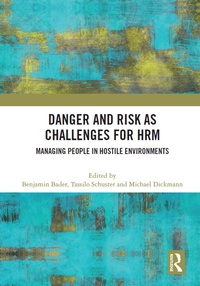
Danger and Risk as Challenges for HRM
Managing People in Hostile Environments
1st Edition
Published on 30. December 2020
226 pages
978-1-000-31661-2 (ISBN)
Description

Questions related to managing people in hostile environments have become more central on the agenda of business leaders and HR professionals in multinational corporations (MNCs). This is due to developments such as the increase of terrorism or the political instability in many regions. In consequence, research on the role of HR in hostile environments has increased, though it can still be considered in its early stages.
Danger and Risk as Challenges for HRM: Managing People in Hostile Environments adds to this emerging field of research by investigating the management of people in hostile environments from conceptual as well as empirical perspectives. It delivers an essential and comprehensive overview and gives deep insight into this highly relevant topic from leading authors in the field.
This book will be of great value to scholars and researchers interested in the role of human resource management (HRM) in hostile environments, people management in companies in conflict-affected areas and to those interested in new grounds in HR Research.
The chapters in this book were originally published as a special issue of the International Journal of Human Resource Management.
Danger and Risk as Challenges for HRM: Managing People in Hostile Environments adds to this emerging field of research by investigating the management of people in hostile environments from conceptual as well as empirical perspectives. It delivers an essential and comprehensive overview and gives deep insight into this highly relevant topic from leading authors in the field.
This book will be of great value to scholars and researchers interested in the role of human resource management (HRM) in hostile environments, people management in companies in conflict-affected areas and to those interested in new grounds in HR Research.
The chapters in this book were originally published as a special issue of the International Journal of Human Resource Management.
More details
Edition
1. Auflage
Language
English
Place of publication
London
United Kingdom
Publishing group
Taylor & Francis Ltd
Target group
College/higher education
ISBN-13
978-1-000-31661-2 (9781000316612)
Copyright in bibliographic data and cover images is held by Nielsen Book Services Limited or by the publishers or by their respective licensors: all rights reserved.
Schweitzer Classification
Other editions
Additional editions
Benjamin Bader | Tassilo Schuster | Michael Dickmann
Danger and Risk as Challenges for HRM
Managing People in Hostile Environments
Book
09/2023
1st Edition
Routledge
€51.98
Shipment within 15-20 days
Benjamin Bader | Tassilo Schuster | Michael Dickmann
Danger and Risk as Challenges for HRM
Managing People in Hostile Environments
Book
12/2020
1st Edition
Routledge
€179.51
Shipment within 15-20 days
Persons
Benjamin Bader is Deputy Head of Leadership, Work and Organisation Subject Group, and Senior Lecturer (Associate Professor) in International Human Resource Management at Newcastle University Business School, UK, and Associate Editor of The International Journal of Human Resource Management. Benjamin's research focuses on international human resource management, particularly expatriation in dynamic environments, global leadership, the impact of digitalisation on managing people and topics related to the future of work.
Tassilo Schuster is Senior Lecturer at the Friedrich-Alexander University Erlangen-Nuernberg. His main research interests are in the areas of international management, international human resource management and digitalisation of international companies. He is particularly interested in business strategies focusing on expatriate management, psychological contracts and the future of work.
Michael Dickmann is the Full Professor of International Human Resource Management at Cranfield University, School of Management, UK, and the Senior Editor-in-Chief of The International Journal of Human Resource Management. Michael's research focuses on human resource strategies, structures and processes of multinational organisations, cross-cultural management, international mobility and global careers. He is the lead author/editor of several books on international HRM and global careers.
Tassilo Schuster is Senior Lecturer at the Friedrich-Alexander University Erlangen-Nuernberg. His main research interests are in the areas of international management, international human resource management and digitalisation of international companies. He is particularly interested in business strategies focusing on expatriate management, psychological contracts and the future of work.
Michael Dickmann is the Full Professor of International Human Resource Management at Cranfield University, School of Management, UK, and the Senior Editor-in-Chief of The International Journal of Human Resource Management. Michael's research focuses on human resource strategies, structures and processes of multinational organisations, cross-cultural management, international mobility and global careers. He is the lead author/editor of several books on international HRM and global careers.
Content
Foreword
John D. Daniels
1. Managing people in hostile environments: lessons learned and new grounds in HR research
Benjamin Bader, Tassilo Schuster and Michael Dickmann
2. Engaging in duty of care: towards a terrorism preparedness plan
Michael Harvey, Marina Dabic, Tim Kiessling, Jane Maley and Miriam Moeller
3. Protecting expatriates in hostile environments: institutional forces influencing the safety and security practices of internationally active organisations
Anthony Fee, Susan McGrath-Champ and Marco Berti
4. In the line of fire: managing expatriates in hostile environments
Judie Gannon and Alexandros Paraskevas
5. Terrorism and expatriate withdrawal cognitions: the differential role of perceived work and non-work constraints
Anna Katharina Bader, Carol Reade and Fabian Jintae Froese
6. Mind the gap: the role of HRM in creating, capturing and leveraging rare knowledge in hostile environments
Gabriele Suder, Carol Reade, Monica Riviere, Andreas Birnik and Niklas Nielsen
7. A risk management model for research on expatriates in hostile work environments
Richard A. Posthuma, Jase R. Ramsey, Gabriela L. Flores, Carl Maertz and Rawia O. Ahmed
8. Localization of staff in a hostile context: an exploratory investigation in Afghanistan
Michael Dickmann, Emma Parry and Nadia Keshavjee
John D. Daniels
1. Managing people in hostile environments: lessons learned and new grounds in HR research
Benjamin Bader, Tassilo Schuster and Michael Dickmann
2. Engaging in duty of care: towards a terrorism preparedness plan
Michael Harvey, Marina Dabic, Tim Kiessling, Jane Maley and Miriam Moeller
3. Protecting expatriates in hostile environments: institutional forces influencing the safety and security practices of internationally active organisations
Anthony Fee, Susan McGrath-Champ and Marco Berti
4. In the line of fire: managing expatriates in hostile environments
Judie Gannon and Alexandros Paraskevas
5. Terrorism and expatriate withdrawal cognitions: the differential role of perceived work and non-work constraints
Anna Katharina Bader, Carol Reade and Fabian Jintae Froese
6. Mind the gap: the role of HRM in creating, capturing and leveraging rare knowledge in hostile environments
Gabriele Suder, Carol Reade, Monica Riviere, Andreas Birnik and Niklas Nielsen
7. A risk management model for research on expatriates in hostile work environments
Richard A. Posthuma, Jase R. Ramsey, Gabriela L. Flores, Carl Maertz and Rawia O. Ahmed
8. Localization of staff in a hostile context: an exploratory investigation in Afghanistan
Michael Dickmann, Emma Parry and Nadia Keshavjee
