

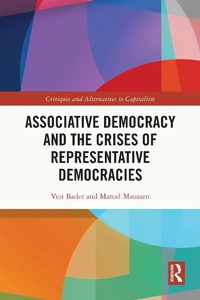
Associative Democracy and the Crises of Representative Democracies
1st Edition
Published on 18. August 2023
336 pages
978-1-000-93202-7 (ISBN)
Description

The familiar problems of democratic capitalism have given way to a deep crisis challenging the basic forms of governance introduced around the late 18th century and then gradually expanded and developed until the late 20th century. Associative Democracy and the Crises of Representative Democracies argues that we are in urgent need of normative guidelines and a strong understanding of a broad range of institutional options and innovative experiments in associative democracy in order to address the structural problems that existing institutional arrangements are confronted with whilst maintaining and strengthening democratic forms of government and governance.
The argument is developed against the background of a thorough survey of empirical social scientific studies on the crises of capitalisms and representative democracies. This book focuses primarily on democratic alternatives, though it also works out principles and institutions of democratic socialism as alternatives to capitalism. After introducing the theoretical approach, the book illustrates the ways this framework of analysis can be of use, with particular focus on three issues that are highly topical when it comes to the challenges our institutions are confronted with: democratic governance in relation to ecological crises and uncertainty; the threats to democracy raised by the crisis of political parties and representative party-democracy, and the challenges related to privatization and marketization of public services, particularly in healthcare. The book concludes by exploring opportunities to democratize the economy, locating viable alternatives to capitalism in the tradition of democratic socialism.
This urgent and thought-provoking book will be of great interest to academics and students in various disciplines in the humanities and social sciences, including political science, sociology, and economics.
The argument is developed against the background of a thorough survey of empirical social scientific studies on the crises of capitalisms and representative democracies. This book focuses primarily on democratic alternatives, though it also works out principles and institutions of democratic socialism as alternatives to capitalism. After introducing the theoretical approach, the book illustrates the ways this framework of analysis can be of use, with particular focus on three issues that are highly topical when it comes to the challenges our institutions are confronted with: democratic governance in relation to ecological crises and uncertainty; the threats to democracy raised by the crisis of political parties and representative party-democracy, and the challenges related to privatization and marketization of public services, particularly in healthcare. The book concludes by exploring opportunities to democratize the economy, locating viable alternatives to capitalism in the tradition of democratic socialism.
This urgent and thought-provoking book will be of great interest to academics and students in various disciplines in the humanities and social sciences, including political science, sociology, and economics.
Reviews / Votes
'This is a very timely intervention in an ongoing debate on the future of democracy and capitalism. Bringing together various strands of this debate which have hitherto been pursued in splendid isolation from each other, is one of the outstanding merits of the book. Its other merit, going beyond the limits of contemporary debates, are the very detailed and thorough discussions of major problems of extant democratic institutions as well as the difficulties of institutional reforms. Its third merit, no less than the previous ones, is to be found in a careful reassessment of the concept of associative democracy, providing a useful focus for rethinking the possibilities of a future economic democracy (or a democratic socialism). The book will largely contribute to refocussing and advancing the debate on the crises of democracies and their possible futures.'Michael R. Kraetke, Professor Emeritus of Political Economy, Lancaster University, UK and Visiting Professor of Political Economy, Tohoku University, Japan
'This complex and subtle book explores the possibilities for transforming contemporary capitalist societies in a more democratic direction. It draws effectively upon normative and empirical research to present a sophisticated account of why pluralistic, multi-level associative democracy is possible today. A major contribution.'
Joseph H. Carens, Professor Emeritus of Political Science, University of Toronto, Canada
More details
Series
Edition
1. Auflage
Language
English
Place of publication
London
United Kingdom
Publishing group
Taylor & Francis Ltd
Target group
College/higher education
Illustrations
1 Line drawings, black and white; 1 Illustrations, black and white
ISBN-13
978-1-000-93202-7 (9781000932027)
Copyright in bibliographic data and cover images is held by Nielsen Book Services Limited or by the publishers or by their respective licensors: all rights reserved.
Schweitzer Classification
Other editions
Additional editions
Veit Bader | Marcel Maussen
Associative Democracy and the Crises of Representative Democracies
Book
12/2024
1st Edition
Routledge
€63.60
Shipment within 10-20 days
Veit Bader | Marcel Maussen
Associative Democracy and the Crises of Representative Democracies
Book
08/2023
1st Edition
Routledge
€206.70
Shipment within 10-20 days
Persons
Veit Bader is Emeritus Professor of Sociology and of Social and Political Philosophy at the University of Amsterdam, Netherlands, where he was also a member of the Institute of Migration and Ethnic Studies (IMES). His research interests include critical political economy, critical social theory, social inequalities and collective action, democracy and the rule of law, legal theory, associative democracy, race, ethnicity and citizenship, multi-culturalism, ethics of migration and incorporation of minorities, global justice, and governance of religious diversity. He is author of several books, including Secularism or Democracy? Associational Governance of Religious Diversity (2007), and co-editor of Associative Democracy: The Real Third Way (Routledge, 2001), and Parties, Partisanship and Political Theory (Routledge, 2014). He has also led two European FP7 projects, RELIGARE (Religious Diversity and Models of Secularism in Europe 2009 - 2013) and ACCEPT (Tolerance, Pluralism and Cohesion 2009 - 2013).
Marcel Maussen is Associate Professor of Political Science at the University of Amsterdam, Netherlands, where he is also a member of the Challenges to Democratic Representation program group. His research interests include the accommodation of religious diversity, particularly that of Islam, in Western Europe, democratic theory, and the governance of diversity, including issues related to free speech, non-discrimination and anti-racism He is the author of several journal articles and chapters in edited volumes and is co-editor of Legal Practice and Cultural Diversity (Routledge, 2009), Regulation of Speech in Multicultural Societies (Routledge, 2015), and Religious Schools in Europe: Institutional Opportunities and Contemporary Challenges (Routledge, 2016).
Marcel Maussen is Associate Professor of Political Science at the University of Amsterdam, Netherlands, where he is also a member of the Challenges to Democratic Representation program group. His research interests include the accommodation of religious diversity, particularly that of Islam, in Western Europe, democratic theory, and the governance of diversity, including issues related to free speech, non-discrimination and anti-racism He is the author of several journal articles and chapters in edited volumes and is co-editor of Legal Practice and Cultural Diversity (Routledge, 2009), Regulation of Speech in Multicultural Societies (Routledge, 2015), and Religious Schools in Europe: Institutional Opportunities and Contemporary Challenges (Routledge, 2016).
Content
Introduction 1. Crises of democratic capitalism and prospects for democracy 2. A theory of complex democracy: Setting the stage 3. Democracy or expertocracy? Ecological crises and ecological democracy 4. Crisis of political parties and representative democracies: Rethinking parties in associational, experimentalist governance 5. Democratizing healthcare 6. Democratizing the economy: Institutionalizing alternatives to 'capitalism as we know it'
